Favorite Moments: Pancakes!

We all have our favorite moments in movies, books, and games, moments that stay with us long after the story is over. This column is my attempt to examine my favorite moments and see why they stick with me.

***

The Movie

‘Cabin Fever’ (2002)

The Scene

Why it’s great

It’s a scene of a kid who wants pancakes, does karate moves, and then bites a guy while making wolf sounds, while his dad yells his name in slow motion. It’s so random, so out of place in a movie about a flesh-eating virus, and so bizarre that it breaks the time-space continuum and transcends the comprehension of mere mortals.

What? I need to write more? Well, it’s an example of how having a random scene that has nothing to do with the rest of the story can become the most memorable moment of that story, AKA, The Big Lipped Alligator Moment.

Now, if you’ll excuse me, I need to go satisfy a sudden hankering for pancakes.

What we can learn from ‘Jakku: First Wave’

Today, we’re taking a look at Star Wars, but not at one of the official movies, books, or games; we’re into the world of Star Wars fan films, and one that focuses on everyone’s favorite movie mooks: the stormtroopers. Unlike most fan films, though, this one is quite unique: There’s no laser blasts, no lightsabers, no force powers, or any of the other famous features of the galaxy far, far, away. Instead, it’s a psychological story that takes a look at three stormtroopers before entering the biggest battle of their lives. Let’s take a deeper look at what this short can teach us.

Consider having your story follow doomed characters just before their end

‘Jakku’ sets its tone instantly by telling us that everyone we’re about to see are going to die. That knowledge hangs heavy throughout the runtime as we watch the final minutes of the stormtrooper’s lives, knowing that they’re not going to make it through the battle to come.

In our own stories, focusing on the end of a character’s life – whether they know it or not – is an excellent way to get the audience’s attention. We’re used to our heroes charging into combat and making it out alive, sometimes without a scratch… but what about those who don’t have a chance? How do the underdogs, the faceless, nameless people who don’t have plot armor or aren’t main characters, face their end? I find that more fascinating than following someone who will survive because of their importance to the plot.

As I’ve written before, staring death in the face reveals who someone really is: Just how would you react to knowing that your end is about to occur in the next few minutes? Do you run? Hide? Face it head on? Incorporating such questions gives you the chance to see a character’s deepest self.

Consider making your story take place in one location

It may sound counter-intuitive – and even boring – to set your story in a single location. Who can make compelling stories about love and war, loss and betrayal in just one room? (or a cockpit, or a boat, or a car, etc.) Yet, such a thing is possible; ‘Jakku’ takes place entirely inside the hold of an AT-AT, and is captivating thanks the power of its story and the situation, instead of big, flashy visuals.

The advantage of doing a story set in a single location is that it forces you, the writer, to be creative with how you tell your story, as well as almost mandating that it becomes a character piece, as you won’t have access to big-budget special effects. Can you tell a sci-fi story in a single room? A post-apocalyptic drama? A historical period piece? No matter what tale you tell, it will be more intimate than the most sprawling, epic tale that goes to numerous exotic places. (and as a bonus, if you’re doing a movie, you’ll save a lot of money from only having to build one set)

Consider having your big, tough guy join the armed forces for a silly reason

The lone moment of humor in ‘Jakku’ is an effective one: The stoic, fearless trooper seems to fit the mold we’ve seen many times elsewhere: the tough guy who loves to fight and believes whole-heartily in his country. The patriot, so to speak, who joined the armed forces for the noblest of causes. But that’s not the case: he joined the Empire just because he wanted to wear stormtrooper armor.

Silly? Yes, but it’s amusing because we, the audience, expect the big, buff, military types to love their countries and wanting to serve it above everything else. Learning that they joined the armed forces for the silliest of reasons makes them more memorable by defying our expectations.

Consider focusing on why your characters fight

In my opinion, the one thing ‘Jakku’ does best is showing that these stromtroopers aren’t fanatical troopers who mindlessly follow orders and charge into battle without a second thought. They’re human, with different levels of fear and courage. One wants to avenge his younger brother, who died on the Death Star. The other wants to fight for the Empire’s ideals, and the last is there to prove to himself that he really can fight. This humanization helps us see the Empire not as an endless wave of white-coated redshirts who can’t shoot the broad side of a barn, but as people with different reasons for joining the Empire: Some selfish, some noble, and others who are just looking to try something new.

In your own works, exploring why characters fight and risk their lives makes the more human. It’s one thing to read about soldiers charging into battle, but knowing why they’re doing it (beyond being ordered to by their superiors) makes for more compelling storytelling. Knowing that someone is fighting to avenge a fallen family member or friend, or fighting dirty just to end a war so they can go home, or that they’re trying to prove to themselves that they’re brave makes the more compelling than gung-ho marines.

The Takeaway:

Doing a small scale story helps you focus on characters instead of distracting your audience with flashy visuals, and exploring why a small group of doomed people do what they do (such as fighting in a war) makes for compelling drama, even if their reasons for doing so are on the silly side.

Favorite Moments: ‘Conan the Librarian’

We all have our favorite moments in movies, books, and games, moments that stay with us long after the story is over. This column is my attempt to examine my favorite moments and see why they stick with me.

***

The Scene

Why it’s great

I’ve written before about my love of Fish Out Of Water humor, which makes this scene from ‘UHF’ one of my favorites from the film. Not only do we have a giant, muscle-bound barbarian plucked out of the dark ages and in the modern era (the 1980’s), but he also has a job that’s one of the least suited for his particular skills.

While having people from different time periods dropped into the modern age is always great for comedy, extra humor can be gained when they get modern jobs that don’t always mesh with their talents and abilities. Even better is when they throw themselves into those jobs without hesitation, striving to do their best. When you combine that formula with the almost endless types of characters from history to choose from, you’ve got a formula for comedy gold.


What we can learn from ‘Ator: The Fighting Eagle’

If there’s one film genre the 80’s loved, it was hack-and-slash barbarian fantasy films. There seems to be no end to them, ranging in quality from ‘Conan’ to ‘Yor,’ and ‘Ator, the Fighting Eagle’, a 1982 Italian flick featuring a hunky, muscular, handsome hero out to save a kingdom from an evil ruler who has enslaved the land while wielding a giant sword, facing monsters, and wanting to marry his sister.

Wait, what?

Knowing that ‘Ator’ was chosen as the season finale for the Mystery Science Theater 3000 revival should give you a clue as to its quality: it’s not a very good movie, and aside from the creepy incest vibe, doesn’t do much to stand out among it’s many competitors. Still, it’s good for some chuckles, and has its fair share of lessons for the aspiring writer. So, with that said, let’s take a look at what it has to offer.

If you include a prologue, keep it brief

Read any writing how-to book, article, or opinion piece, and you’ll be told again and again to avoid prologues, AKA, dumping mountains of backstory and info on the audience. It’s solid advice, but, surprisingly, ‘Ator’ does a good job with its prologue. While cliched (a kingdom has been enslaved and a Chosen One will be born one day to set it free), it sets up the story quickly. But, more importantly, the prologue only gives us the most critical information:

*A land is enslaved by an evil force

*A child will be born to free it.

That’s it. Nothing about bloodlines, the kingdom’s history, how the land was formed, the various gods, religion, etc.

In our own stories, a prologue should be as bare-bones as possible. Keep it brief, tell your audience only what’s relevant to the story’s main problem, and save more background information for later in the story. Some great examples of well-done prologues include Disney’s ‘Beauty and the Beast’, New Line’s ‘Lord of the Rings’, and any of the Star Wars movies.

Be extra-careful including incest in your story

In a field as crowded as barbarian fantasy, ‘Ator’ stands out in a way it probably didn’t intend: by having the main character wanting to marry his sister. Thankfully, they’re not biologically related, but it leaves a creepy vibe that no amount of cute bear cub footage can get rid of, as Ator himself spends the movie fighting to save said sister so they can presumably become husband and wife.

In our own stories, there’s no topic that’s off-limits, but some should be handled very delicately, if at all, and incest is one of them. While the subject itself can be a topic for great drama and conflict (a married couple accidentally finds out that they’re brother and sister and has to deal with that, and the fact that they’ve had kids), how it’s handled is vitally important, and I think there’s two ways to do so:

1. You present the subject matter as a tool to tell a story.

2. You present the subject matter as something you want others to accept.

The first route, I believe, is safer. One memorable episode of the British TV series, ‘New Tricks’ featured a business owner who forced his sister to have an abortion after they had sex. The show didn’t endorse the act, instead using it as the catalyst for the episode’s mystery. Conversely, ‘Ator’ feels like it’s trying to say that incest is okay, even going so far as to reveal that Ator’s ancestors used to allow brothers and sisters to marry each other, making the film almost feel like a pro-incest propaganda piece. That can’t be what the movie intended, but it proves the value of being cautious in how controversial subjects are addressed.

Avoid having a random events plot

Much like ‘Wizards of the Lost Kingdom,’ most of ‘Ator’ feels like filler to kill time. Ator being seduced by a temptress, running away from random warriors in a foggy forest, and having his partner be trapped in a cave feel like time-killers that were put in without much consideration as to how they would tie into Ator’s quest to save his sister and the kingdom.

In our own stories, keeping all the events that happen in your story related to main quest/plot subtly tells your audience that you know where you’re going, and they’re more likely to hang around to see what’s going to happen. While it’s okay to occasionally have a random action sequence that doesn’t affect the plot in any way (such as the unique fight between Ator and a shadow), those should be the exception, rather than the rule. Action for the sake of action may be enjoyable for a short time, but it will quickly wear off its welcome when the audience realizes they’re not any closer to the story’s resolution.

Consider having the mentor betray the main character/s

Probably my favorite twist in Ator’s story comes near the end, when, having slain the leader of the spider cult, Ator is betrayed by his mentor Griba, who reveals that he only helped Ator so he could reclaim his position as the cult’s high priest.

We don’t see mentors betray their charges all that often in fiction – they can be mean, yes, and downright cruel, but they still want their students to succeed. But to betray them is rare, and gives writers a great opportunity to have the student fight the mentor, and use everything they’ve learned – and a few tricks they’ve picked up on their own – to win.

When people lose their loved ones, make sure they grieve

At the very end of the film, Ator’s companion, Roon, dies of her injuries after fighting off spider cult goons, but not before getting a chance to say farewell to Ator. It would have been a touching moment… had not the very next shot (and the last one of the film) been Ator and Sunya cheerfully running through a forest with big smiles on their faces, seemingly forgetting that Roon ever existed. While it’s natural for Ator to be ecstatic at having rescued his sister, an additional scene of him mourning Roon, or laying her to rest would have allowed him to give her some closure and a chance to honor and respect her memory before heading off.

Because of how final it is (at least, in real life), death shouldn’t be treated lightly when it comes to your story’s main characters. If one of them dies, have the others mourn. If there’s no time to do so (they’re being chased by giant spiders, for example), then have them mourn later, or, at the least, miss the presence of those they’ve lost. Otherwise, you run the risk of making the dead character feel like a throwaway piece of the scenery who aren’t worth remembering.

An Alternate Universe version of ‘Ator: The Fighting Eagle’ that learned from its mistakes

A brief prologue tells us about the prophecy of a child who will be born to save his kingdom from enslavement at the hands of a spider cult. Years later, that child, Ator, having fallen in love with a girl from his village, sets out on a quest to save her after she’s kidnapped by the cult’s leader. Along the way, he takes his bear-cub companion, meets up with an Amazon warrior named Roon, and works to build up his fighting skills with his mentor, Griba, and acquire weapons that will help him defeat the spider cult, while fighting off various challenges the cult’s leader sends his way (a seductive enchantress, a village paid-off to capture him, undead warriors the leader raises, etc.), defeating each one and growing stronger.

Finally reaching the cult’s temple, Ator uses all his skills to defeat the cult’s leader, only to be betrayed by Griba, who only helped Ator so he could reclaim his place as the cult’s leader. Using everything he’s learned, Ator barely manages to defeat him, kill the cult’s spider-god, and save his girlfriend. However, Roon is fatally wounded and dies. Mourning her, Ator buries her on a beautiful hillside and vows never to forget her for the help she gave him.

With his beloved as his side, Ator returns home, having freed his kingdom and found the love of his life.

Perfect Moments: My favorite Christmas Moment

Because of the Christmas holiday, I’ll be taking a break from posting until January 3rd. But before then, I’d like to share my favorite piece of Christmas related media. It’s not a movie or a TV special, but – of all things – a commercial for Directv.

While Christmas traditions revolve around giving gifts, celebrating the birth of Jesus, and many festivities, the one aspect of the holiday that often gets overlooked is the wish for peace on earth, and goodwill to all.

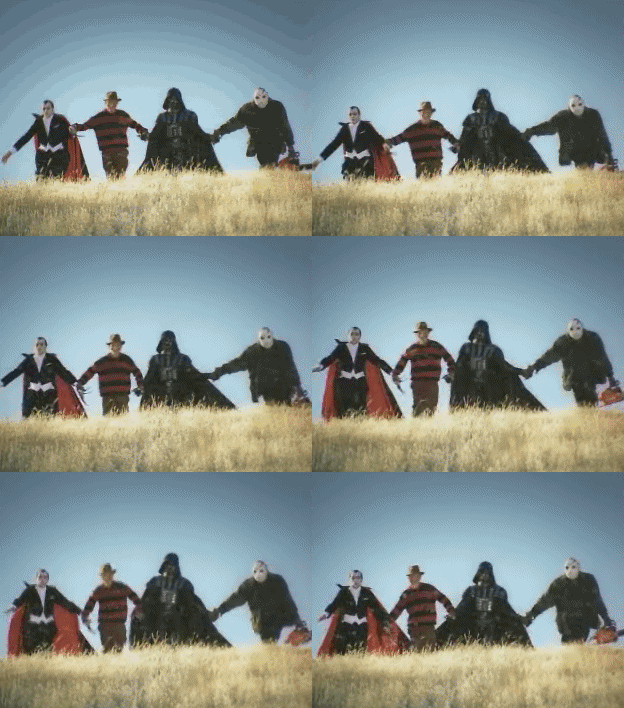
Imagine a world where there’s no evil or war. A world where everyone – including villans – are at peace with themselves and each other. It’s a dream that only gets more beautiful the older I get… but one that I know will almost certainly never happen. But thanks to this silly commercial, we can have a glimpse of what such a paradise might look like, where Darth Vader, Jason Vorhees, Freddy Kruger, Dracula, The Mummy, Chucky, Hannibal, and the girl from ‘The Ring’ celebrate Christmas with an ordinary family.

Is it cheesy? Yes. Is it goofy? Oh heck yes. There are other movies and stories that are more emotional, more heartwarming, and that inspire us to be grateful for all the wonderful things in our lives, including our loved ones. But this commercial shows us a world where peace, love, and goodwill reign, and everyone – including the most despicable of people – have turned to the light, and that’s why it’s my favorite piece of Christmas media.

Well, that, and seeing this once-in-a-lifetime image:

h39F3FDB7

(GIF from this page)

May you all have a wonderful and heartwarming holiday season.

Favorite Moments: The TRON Holiday Special

We all have our favorite moments in movies, books, and games, moments that stay with us long after the story is over. This column is my attempt to examine my favorite moments and see why they stick with me.

***

The Video

Why it’s great

No, this isn’t a long-lost relic from the 80’s that should have stayed lost: this Funny or Die video pokes fun at the Star Wars Holiday Special by imagining what might have happened if TRON had a special of its own. The answer? It would have been as terrible/awesome as it’s infamous real-world counterpart.

While my favorite moment is poor Santa being de-rezzed, the whole video is a great example of the Christmas Special trope, and why it’s a near-perfect formula for comedy gold:

1. Take any franchise and give it a Christmas special, no matter how absurd it might be (Can you imagine a Hellraiser Christmas? How about a Waterworld Christmas?).

2. Have your characters save Christmas.

3. Have said characters learn the True Meaning of Christmas (which may or may not involve Jesus, depending on your audience).

Imagine how hilarious it would be if Darth Vader had to deliver presents to all the good Stormtroopers on the Death Star and learn that it’s better to give than to receive. Or imagine Gandalf, Frodo, and the Fellowship traveling to Mordor to save Santa after he’s been kidnapped from Sauron. Or contemplate how amusing it would be for the Umbrella Corporation to feel the holiday spirit and work to make everyone’s Christmas a little merrier while simultaneously trying to destroy it with with zombies.

No matter what genre your franchise is, injecting some holiday cheer is a great way to make your audience laugh… even if said franchise involves giant, shapeshifting robots from beyond the stars.

What we can learn from: ‘Killer Fish’

NOTE: My apologies for posting this two days late: Christmas and all it’s related fiascos has been taking up more of my time than I expected.

Forget Jaws. Forget ‘Deep Blue Sea’, ‘47 Meters down’ or ‘The Shallows’. If you’re looking for man vs killer aquatic animal action, look no further than the 1979 Italian caper, ‘Killer Fish’, a gripping, heart-pounding tale of criminals vs some of the most ferocious fish ever known to mankind!

Okay, it’s not that exciting. Or quick-paced. Or even on league with the aforementioned films. ‘Killer Fish’ won’t win any awards or be remembered out of bad film circles, but with its beautiful scenery, silly effects, and groovy 70’s soundtrack, it’s good for a laugh or two. Let’s dig in and see what writers can learn from this tale of diamond thieves vs fish.

When doing a killer monster movie, give a tease of your monster at the beginning

It may be a cliché, but giving your audience a tease of the monster at the beginning of the story (without fully revealing it, of course) gives them a delicious tease of the carnage to come after the inevitable first-act setup. In ‘Killer Fish’, however, the piranha are nowhere to be seen for the first half hour, as the film instead focuses on people blowing up a refinery, stealing diamonds, and then sneaking through a jungle and starting to argue with each other at a resort, leaving the audience wondering if they came to the wrong movie by accident; they came to see piranha wreaking havoc, not a criminal heist movie.

As a writer, keep the characters, plot, and action tied to the killer monster, even in the first scene: Imagine ‘Jaws’ without the opening attack; the film would have a much slower, less interesting start, and a bored audience will quickly become an audience that walks away.

Consider having the antagonist’s plan to use the monster backfire

Unlike most monster stories, where the beasts are either discovered or accidentally released to wreak havoc, ‘Killer Fish’ is unique in that the leader of the thieves release the piranha into the lake to guard ‘his’ diamonds, a refreshing change from the usual ‘monsters are accidentally released or are discovered’ storyline we frequently get. What’s great about this subversion (beyond giving the main antagonist an admittingly clever idea for guarding the treasure) is that it also sets up the inevitable moment where the antagonist is done in by their own plan, which is always a crowd pleaser.

Unless you’re going for a jumpscare, foreshadow big events in your story

When the piranha finally claim their first victim, the moment we’ve been waiting a half hour to see, it happens so quickly that – aside from seeing some terrifying bubbles – there’s no foreshadowing of the piranha’s attack. We, the audience, expect that the diver will go down, there’ll be a minute or two before something happens, and… oh, wait. He’s already being attacked. Nevermind.

There’s something to be said about giving audiences what they want in a monster film, but it’s important to remember that building up to the carnage makes the payoff even sweeter. Knowing that they’re finally on the verge of seeing the juicy bits lets creators ratchet up the tension and suspense before a monster attacks. This also applies to non-monster attacks; “Killer Fish’ features a tornado that destroys a dam, unleashing a tidal wave. The problem is, there’s no foreshadowing, or even hints about the tornado’s appearance, making it feel like something the script threw in to keep the plot moving, instead of a well-thought out event that feels logical and not a Diabolus ex Machina.

Consider having your character’s place of refuge slowly fall apart around them

Much like ‘Deep Blue Sea’ 19 years later, ‘Killer Fish’ smartly has the characters trapped in a location that’s slowly sinking, meaning that if they don’t find a way to escape to shore, they’re doomed to a terrible, fishy death. By preventing them from just sitting around and waiting for rescue, the story ensures that they have to stay active and work hard to ensure their survival, which keeps things moving forward. Even better, almost all those on board are thieves who want the diamonds and are willing to betray each other to get them, making their interactions more interesting than ordinary people just trying to stay alive.

Consider having your jerk have one completely selfless moment of compassion for others

Ollie the photographer is a pretty standard camera snob who’s only interested in getting his shots throughout the film (but with Brazil’s gorgeous scenery, can you blame him?). But in a smart move, Ollie does get one good moment on the sinking boat where he tries and help an injured crewmember without any ulterior motives. While he’s not the standard, ‘heartless, smug professional who’s not interested in helping others’ type, it is a nice, effective redemption moment for him.

Having a selfless moment for your own jerk characters allows you to make them more interesting: Imagine a snob who is mean to everyone they meet throughout your story. They insult, put down, and offend everyone they can, just because they can. Then, imagine that they’re seen handing out food and supplies to the homeless in subzero weather without any regard to their own comfort. Though it won’t automatically make them a well-rounded, compelling character, such opposites will help in developing them, and maintain the interest of the audience.

Consider having two characters who hate each others guts declare a truce during a bigger disaster

It’s always interesting to see character who hate each other’s guts being forced to work together, which is what happens with Robert and Paul, who have to put aside their desire to kill each other to survive piranha who want to kill them both… at least, until they can both survive long enough to try and kill each other again.

While mutual survival is the most common reason for enemies to work together, writers have a great opportunity to try many different things with such a relationship:

*The two can learn to like each other and become friends.

*The two work to irritate each other as much as possible.

*The two gain a begrudging respect for one another that lasts after the crisis has passed.

*The two still try to kill each other at every available moment.

*The two immediately fall in love and marry each other (not likely)

The possible outcomes for such a relationship are almost endless; few storytelling techniques leave your audience completely in the dark on what can happen, making for compelling drama, comedy, or whatever genre you want to explore.

If you’re doing a monster story, have the monsters be the focus of said story

Perhaps the biggest error ‘Killer Fish’ makes is that it’s not a movie about killer fish: it’s a film about thieves betraying each other and trying to get some diamonds while having to deal with the inconvenience of piranha stopping them from getting away with said diamonds. Most of the film revolves around them betraying each other, with the aquatic menace being regulated to a subplot, instead of the other way around.

No matter your genre, remember to keep the focus on what your audience came to see, whether it’s monsters, a natural disaster, aliens, etc. To use ‘Jaws’ as an example again, imagine if the film revolved around Brody and Co. fighting to save Amity’s only seafood restaurant, with them having to fight the shark to retrieve the sunken deed to the building. Yes, they’d still blow it up, but at the end of the day it would be about saving a restaurant, not saving Amity from a killer shark. Audiences would be disappointed that they didn’t get a shark-focused story, and would be angry at having been tricked into seeing a story about saving a restaurant.

The Takeaway

When doing a monster movie, keep everything focused on the monster, including opening with a tease of its fearsome abilities, foreshadowing its appearance later on (along with any other disasters that might occur). When everything falls apart, consider having your character’s place of safety slowly fall apart, forcing two characters who hate each other to work together for survival, giving a jerk a chance to do one truly selfless, charitable act.

Favorite Moments: Soaking Vengeance

We all have our favorite moments in movies, books, and games, moments that stay with us long after the story is over. This column is my attempt to examine my favorite moments and see why they stick with me.

***

The Video

Why it’s great

Ah, the Noir film: A genre unafraid to portray the dark, seedy underbelly of humanity, a genre where hope dies in the drains, bloated and soaked with the rain of an uncaring sky… which means it’s a good idea to have an umbrella in hand.

Though it’s astonishingly short (5 seconds), ‘Soaking Vengeance’ features my favorite type of comedy: Fish out of water. In this case, it’s the hard-boiled guy heading out into the darkened night with a scowl on his face, and a bright, blue umbrella in hand. The contrasts between the dark tone, the childish umbrella, and the dramatic music makes a strong case for two storytelling points:

*Any dramatic character becomes hilarious when wielding something made for a child.

*The Noir genre can be a gold mine for parody, especially if their tough guys stay tough, no matter how ridiculous things get around them.

What we can learn from: ‘Ring One’


One of the greatest pleasures of our digital age is how easy it’s become for fans to create crossovers of their favorite franchises and play around with all manner of ‘what if?’ scenarios. Most of these revolve around characters and factions from different franchises fighting each other, but every so often, we get a crossover that tries something a little different.

This mashup of ‘The Return of the King’ and ‘Rogue One’ sounds like it would focus on, say, the Fellowship of the Ring infiltrating Scarif to steal the Death Star plans (Oh, how I would love to see Legolas taking out stormtroopers with his arrows), but  ‘Ring One’ tries something we don’t see very often in these mashups: Tragedy.

While it’s fun to imagine the Empire and the free people of Middle Earth fighting one another, and our heroes saving Middle-Earth, this mashup shows how it would really go: Everyone would die. Frodo, Gandalf, Aragorn, Sauron, and everyone else are obliterated by the Death Star. Yet, while such a situation can be depressing, ‘Ring One’ makes it a great example of the ‘Face Death with Dignity‘ trope. We’re so used to seeing characters be brave and courageous when facing impossible odds in everyday life, but what happens when they face their inevitable deaths? Are they still brave and courageous? Do they try to flee, even when it’s hopeless? Do they pray? Do they try to comfort others?

For writers, having our characters know they’re going to die is a fantastic way to see their deepest qualities, to find out who they really are when they face the end. Here, Frodo still tries to get to the Crack of Doom, Sam spends his final moments of life trying to comfort him, and Gimil and Legolas finally reconcile from their trilogy-long distrust of each other.

Is it sad to see the Fellowship all die? Yes. But it’s beautiful in a bittersweet way: some of fiction’s most memorable moments occur only at the end of a character’s life, moments that can stay with us like nothing else can. We remember those who give their lives to save others, who spend their final minute trying to comfort someone else, or refuse to give in to fear. When you bring your character’s stories to a close, you have a chance to give them one final, shining moment of glory. Take advantage of that, and you’ll give your audience a moment that will stay with them forever.

Favorite Moments: ‘Open the Door!’

We all have our favorite moments in movies, books, and games, moments that stay with us long after the story is over. This column is my attempt to examine my favorite moments and see why they stick with me.

***

The Movie

‘Mission Impossible – Rogue Nation’

The Scene

Why it’s great

No story-related clips today, or musings on story and action. Instead, I wanted to take a moment to showcase one of the best stunts I’ve seen in years: Tom Cruise, hanging off plane.

While many moviegoers may groan about the deluge of CGI replacing practical effects, some movies do make them work, and I can think of no better example than seeing Tom Cruise hanging onto a plane in mid-air. This shot is the perfect example of how CGI and practical effects can work together: The CGI compliments and aids the shot by digitally removing the safety harness, instead of dominating it by having the whole thing be shot on a soundstage.

While practical effects and CGI have their places in filmmaking, this shot shows how, when working together, they can create movie magic.