We all have our favorite moments in movies, books, and games, moments that stay with us long after the story is over. This column is my attempt to examine my favorite moments and see why they stick with me.
***
The Commercial: The Most 90’s Toy Commercial Ever Made
Why It’s Great:
The 90’s were arguably the golden age for toy commercials, and perhaps none are more 90’s, more EXTREME and more over-the-top than this commercial for GI Joe. But among the jump-kicking ninjas, laser-shooting space stations, and military vehicles that resemble mechanical porcupines instead of weapons of war, one thing stands out the most: Snow Job at 0:16, charging into battle against the dastardly forces of COBRA… while wearing snow camouflage. In the jungle.
Buh.
Why is Snow Job wearing his arctic survival suit in the jungle? Perhaps he wanted so badly to go fight in a mission that didn’t involve snow, cold, penguins, and homicidal polar bears that he just charged right in without questioning the wisdom of wearing insulated parkas, snow pants, and thermal gloves to a tropical environment with an average temperature of 93 degrees and 300% humidity. Maybe his best buddy, Ice Cream Soldier, was on vacation that day and the Joes needed anyone who could take on ninjas in the jungle.
Whatever the reason, Snow Job is a perfect example of a character suited to a very specific environment suddenly being thrust into one he/she has no reason being in, and watching the ensuing hilarity. But while we laugh, I’m sure that, in the time between skiing into the Amazon and ending up as a charred skeleton cooked to medium-rare, Snow Job did his part with his laser rifle to make the jungle safe for democracy!
We all have our favorite moments in movies, books, and games, moments that stay with us long after the story is over. This column is my attempt to examine my favorite moments and see why they stick with me.
***
The Movie: The Twilight Saga: Breaking Dawn – Part 2
The Scene:
Why It’s Great:
In these troubled times, we all need a break from the horrors and fear of life. There are many ways this can be done: Meditation, exercise, mindfulness, and knowing that, no matter what problems we face, they can be overcome in the end. But most doctors, if asked, would say that the best way to relieve stress is to watch vampire babies explode when tossed into bonfires.
You don’t need to know the context of why said baby is being chucked into a roaring fire, only that we watch a freaking vampire baby exploding, and that the actress chucking the baby puppet is trying her hardest not to laugh, turning this 4 second clip into comedy gold.
We all have our favorite moments in movies, books, and games, moments that stay with us long after the story is over. This column is my attempt to examine my favorite moments and see why they stick with me.
***
The Movie:
The scene, and why it’s great
One constant source of unintentional comedy in film is movies that are rushing to get to the end credits as quickly as possible. While great stories take the right amount of time – whether it’s a few minutes or a dozen – to wrap things up, say goodbye, and give characters closure, other stories say, ‘nah, screw that’ and just wrap things up in a few seconds. One of my favorite examples of this comes from ‘Dracula 3000,’ a story that re-imagines Bran Stoker’s timeless tale, but in space! Oh yeah, and Dracula is now called Orlock, and all vampires are now aliens who come from the planet Transylvania (yet dress up in the finest vampire apparel you can get from Spirit Halloween specially tailored for them by their fellow vampires)
As you might imagine, the film doesn’t have the best reputation. Most would say the best thing about it is the H.R. Giger inspired cover art, and maybe Coolio being in outer space. But for me, the best part is the final ten seconds. Behold:
I loved the part where Godzilla said, “It’s nap time!” and took three naps during the movie.
I was so touched when that veterinary guy said, “It’s veterinary time!” and did dental work on Kong.
I also liked the part where the tree said, “It’s tree time!” and totally ate that guy.
I was so touched when Kong said, “It’s dinner time!” and gave mini-Kong some Purina sea serpent chow.
I loved the part where the Iwi said, “…” and stared ominously at everyone.
I cheered when mini-Kong said, “It’s murdrin’ time!” and murdered his fellow homicidal rage-apes with really big rocks.
I especially loved the part where Mothra said, “It’s Mothra time!” and Mothrad’ all over those homicidal rage apes in the crystal kingdom in the center of the Earth while gravity was cancelled due to pouring red liquid inside another liquid which turned some crystals on.
But most of all, I cheered when Kong said, “It’s democracy time!” and brought democracy to all the homicidal rage apes in their lava prison in the center of the Earth after killing the Skar King like Jason did to that girl in the movie where he went to space. At least, I think Kong brought democracy to the rage apes. America!
Truly, this was a movie of all time. 10,000,000 stars out of 10.
Every story has a cast of characters that we follow and watch and come to love… but what about the background characters? The nameless masses who rarely get our attention? This column examines my favorite background characters who deserve a moment in the spotlight.
The Movie:
‘Star Wars: The Rise of Skywalker’
The Character:
One of Palpatine’s royal guards who is the worst shot in Star Wars History
The Scene:
Why He Deserves A Moment In The Spotlight
A few years ago, I highlighted how one of Snoke’s elite guards fought Kylo Ren by… ramming his armored forearms into Kylo’s lightsaber, accomplishing nothing before being killed. At the time, I thought he was Star Wars’ silliest antagonist, but I recently discovered that there’s another royal guard in a galaxy far, far away who is even sillier. In ‘The Rise of Skywalker,’ Rey takes on Palpatine’s elite guards, the Sovereign Protectors, the cream of the crop of the Final Order, warriors who’s only purpose in life is to defend their emperor to the death, and at this they fail miserably, dying within seconds to a barely-trained girl with a glowy stick of death, rendering a lifetime of Sith indoctrination and training utterly meaningless.
But among their number, there is one guard who’s sheer ineptitude is the stuff of legend. A guard so legendarily bad that his name will be passed down from generation to generation on how not to protect psychotic zombie emperors from beyond the stars… Ceiling Shooting Guy.
At 0:08 in the clip above, a guard on the far left can be seen heroically shooting his laser gun at the ceiling. Not at Rey, the force-wielder with the lightsaber, but at the ceiling of Palpatine’s chamber. Then he pauses, watches Rey for a moment, and then shoots the ceiling again.
How did this guard get the job? What training did he undergo to become Palpatine’s protector? And why, in the moment he’s spent his entire life preparing for, did he decide to shoot the ceiling of the Sith Temple instead of Palpatine’s attacker?
I just love how this guy ended up in a movie with a $416 million budget, some of which surely went to fight choreography (NSFW captions). And yet, we ended up with a guy who shoots the ceiling. Sweet Yoda, I would love to know why the shot was approved, why the filmmakers thought this was okay to put in the finished cut, and I especially love that someone at ILM had to animate these nonsensical blaster shots. But whatever the reason, I’m glad they kept this shot in, because we got an elite Sovereign Protector who decided the best way to protect his emperor was to shoot the ceiling. Hey, for all we know there was a spider up there.
It’s the evening of January 26th, 2017. Five years have passed since ‘Resident Evil: Retribution,’ and two friends and I leave the theater, where we were the only people to watch the premiere of ‘Resident Evil: The Final Chapter.” As we enter the lobby, one of the theater employees asks us how it was. I tell him about the film’s ludicrous mistakes, continuity errors, and how it wants us to care about all the newcomers, like Bearded Man, Blue Shirt Girl, That Guy With The Skull Sword, etc., and how it so desperately wanted me to feel sad when Blue Shirt Girl is chopped into mincemeat via a giant fan, despite the fact that she had been on screen for maybe two minutes and I knew nothing about her.
The longer I talk, I realize just how absurd everything is that’s coming out of my mouth to the point where I laugh at realizing I’ve watched one of the worst films in recent memory. Now, having watched the film for the first time in six years, I’m surprised to find that the passage of time has softened my views and made me realize that ‘The Final Chapter’ isn’t bad: it’s hilariously awful.
Join me now as we take a look at the comedic masterpiece that is ‘Resident Evil: The Final Chapter.’
What does the film do well?
It has a cool armored vehicle
Post-apocalyptic films frequently show humanity creating wicked-looking vehicles to help them survive in the wastes, and ‘The Final Chapter’ features a particularly cool mobile command tank equipped with missile launchers, miniguns, hidden compartments for storing motorcycles, nasty spikes, and the ability to communicate with Umbrella headquarters. Granted, all this firepower can’t kill someone driving away from it in a straight line, but it’s still a cool design that almost single-handily destroys the tower Claire and her fellow survivors have taken in, and is a worthy adversary for them to take on in a fight.
It has two memorable villains
Despite being sliced to bits in ‘Extinction,’ we get not one, but two Dr. Issacs in ‘The Final Chapter’: One is a clone who’s an insane religious fanatic, and the other is is the original Issacs, the calm, collected CEO of Umbrella ultimately responsible for the T-virus outbreak, making him the main villain of the entire saga… and unlike other greedy CEO’s, he’s a shockingly good fighter who can hold his own against Alice thanks to some nifty implanted computer technology that lets him dodge bullets, predict what his opponent is going to do, and even heal him after a grenade blasts out his torso, and would have killed her if she hadn’t used her wits to win.
It has the triple-barreled shotgun from the video games
The post-apocalyptic world is a great place to utilize awesome weapons, and what’s better than a sawed-off shotgun? A sawed-off shotgun with three barrels! It may not survive past the movie’s halfway point, but it’s still a cool gun that gets a decent amount of use.
It goes back to where the saga started
‘The Final Chapter’ takes place almost entirely within Raccoon City and the Hive, the locations of the first two movies. For the final film in the series, coming back to where the story began not only gives the story a chance to revisit old locations and reveal new areas within them (such as the cryogenic chamber and that sweet office located beneath the Hive), but to also let the audience reflect on how much has happened since Alice woke up in that shower stall so many years ago, and how she’s changed since her quest to destroy Umbrella began.
It brings back one of the characters from the previous films
Aside from Alice, Wesker, and Issacs, the only returning character from the previous films is Claire Redfield, who is now the leader of the survivors based in Raccoon City. She may not have much to do other than run, shoot guns, and accompany Alice into the Hive, but it’s nice that Alice gets at least one ally from the previous films to help her out, including helping her take on Issacs at the climax.
It gives the Umbrella Corporation a clever motive for everything they’ve done
The biggest revelation of ‘The Final Chapter’ is that instead of the viral outbreak being the result of corporate sabotage and greed, the outbreak was done on purpose: After realizing that Earth was heading towards global catastrophe due to climate change and societal breakdown, Issacs decided to release the virus to ‘cleanse’ the planet so that Umbrella could repopulate it afterwords.
While it may fall apart upon closer inspection (see the entry below on retcons), this revelation not only shows how cold and heartless the Umbrella corporation really is, but also reveals that Issacs is the main villain of the entire series, a man responsible for the murder of billions of people. And shockingly, the plan is… logical. While it’s a horrific, immoral plan that no sane person would dare go through with, it does make sense on a cold, logical level. The best villain plans are ones where the viewer pauses and wonders if they might have a point, and this revelation is an excellent example.
It concludes the series, yet still has an open ending
Unlike so many other franchises (especially horror) that claim to have final chapters, ‘The Final Chapter’ actually follows through on this promise in a clever way: Alice manages to release the airborne antivirus, which will cover the globe and destroy all the zombies, monsters, and undead, saving humanity. The only problem is that it will take years for this to happen, giving Alice plenty of time to continue roaming the earth and killing monsters.
This is a great example of the ‘And the Adventure Continues’ trope: It concludes the series’ story, but lets our imaginations run wild at all the adventures Alice will have as she roams the world (assuming she isn’t eaten by those three bat-things seconds after the screen cuts to black).
What could have been done better?
It could have edited the film so it didn’t look like a 2000’s music video
Here on Imperfect Glass, the focus is primarily on story and characters instead of production values and the physical aspects of filmmaking, but I’ll make an exception to say that the editing on ‘Resident Evil: The Final Chapter’ is awful.
If there was ever a film to showcase why ultra-fast editing with handheld camera shots should be permanently done away with, ‘The Final Chapter’ is it.
It could have not made so many retcons (that don’t work)
Beyond the awful editing, ‘The Final Chapter’ is most notable for featuring numerous retcons that alter the saga’s storyline all the way back to the first movie. While retcons are not a bad thing in and of themselves and can add new and exciting ideas to enhance past events, none of ‘The Final Chapter’s retcons work. At all.
1. In ‘Retribution,’ the Red Queen had taken over Umbrella, gone homicidal, and wanted to wipe out all life on Earth. But in ‘The Final Chapter,’ she still works for Umbrella and wants to help Alice save the last remaining human survivors by bringing Umbrella down.
2. The Red Queen states that she cannot harm an employee of the Umbrella Corporation, forgetting that she killed everyone in the Hive in the first movie. (maybe they were independent contractors?)
3. In ‘Retribution,’ Wesker made it clear that he broke Alice out of Umbrella Prime in order to give her back her psychic powers so she could help him defeat the Red Queen and save humanity. But in this movie, the Red Queen tells Alice that Wesker only pretended to give Alice back her powers, and that his plan was actually a trap in order to kill her and everyone else.
This plan makes no sense. If Wesker really wanted to kill Alice and everyone else who could stop him, then here’s what he needed to do:
-Go with his strike team to Umbrella Prime.
-Plant the explosives and follow team into Umbrella Prime.
-At the first opportunity, abandon the strike team and head back to the surface.
-Detonate the explosives to destroy the facility and kill everyone in it, including Alice.
-Head back to the Hive, enjoy alcoholic beverages, and play Mario Kart 64 to pass the time while waiting for the T-virus to finish wiping out all life on Earth.
4. The aforementioned retcon of Umbrella purposefully releasing the T-virus is a great idea… but the first film clearly shows that it was released in the Hive as an act of sabotage, and subsequently released into the open by idiotic Umbrella operatives. ‘Extinction’ showed that Umbrella was trying to find a way to control the zombies and stop the outbreak instead of just waiting for the virus to do its thing, ‘Afterlife’ had Umbrella kidnapping survivors to use them as test subjects to make even more powerful zombies, and ‘Retribution’ had the Red Queen-controlled corporation trying to wipe out all life on Earth (despite the Red Queen wanting to save humanity).
To be generous, it is possible that while Umbrella high command knew of the plan, their underlings and armies of clones didn’t and were trying to contain and control it, but why make all those clones in the first place? And why would Issacs make not one, but two clones of himself? And if Wesker is part of Umbrella high command, why would he stay awake for the apocalypse and run around instead of staying asleep with everyone else? Wouldn’t Issacs have wanted to keep him under instead of risking Wesker betraying him?
5. The second film established that Charles Ashford created the virus to save his little girl from dying, but this film says that it was actually a man named James Marcus who discovered it to save his daughter from dying. So who was it that ultimately created the T-Virus?
6. Alice says that the US government nuked Raccoon City when it was clearly the Umbrella Corporation that fired the nuke in an attempt to keep the virus under control (and again, if they had purposefully released the virus, why bother trying to contain it?).
7. It’s stated that the T-virus is airborne and infected the world in days after escaping Raccoon City… but at the end of the film, it’s said that it will take the antivirus years to spread to every corner of the globe via the same method. Yes, it traveled faster with jet planes, but it’s still airborne. Furthermore, it’s been established in every film so far that the T-virus is spread via bites from the undead; if the T-Virus is airborne, everyone in the series should have been infected by the end of the second movie and turned into zombies.
It could have brought back the characters from the cliffhanger ending of the last movie and removed all the new ones
Arguably the most exciting idea from the end of ‘Retribution’ was the thought that Wesker, Alice, Leon, Jill, and Ada would join forces to save humanity in ‘The Final Chapter’ after an awesome fight at the White House.
It doesn’t happen, and the battle we want to see is already over when the film starts. Like ‘Alien 3’ and ‘Terminator: Dark Fate,’ which both killed off some of their most important characters in the opening minutes, ‘The Final Chapter’ kills Leon, Jill, and Ada (and presumably, Becky) before ‘The Final Chapter’ even starts. They’re never seen, never mentioned, and Alice doesn’t even mourn Becky, who she fought so hard to save in ‘Retribution.’
Now, while killing off beloved side characters can and often is a bad idea, it can work: Focusing a story entirely on the main character and their attempts to overcome grief and loss while trying to save others is a powerful story idea and give us even more reasons for us to care for them. That could have worked with ‘The Final Chapter,’ had it focused mainly on Alice. Problem is, the film introduces a horde of new characters to work with Alice, and none of them are memorable. We have:
1. Doc, the group’s medic, Claire’s boyfriend, and a traitor who works for Umbrella
2. Post Apocalyptic Leather Guy Who Hates Everyone And Has A Goofy Skull Sword
3. Blue-Shirt Girl
4. Bearded Guy Who Never Talks
5. Guy From Issac’s Tank
6. That Other Guy
The climax of a story is not the place to introduce hordes of new characters: You don’t have time to do it well enough to get the audience to care about them, and the purpose of a climax is to see the characters who have gone on a journey reach its end. We’ve invested time following them and want to see how their story ends. Introducing one or two new characters can be pulled off (Denethor from The Return of the King, for example), but writers need to focus on resolving the journey of those who have come this far.
It could have made Wesker the main villain
As if things couldn’t be more disappointing, Wesker, the suave, smug, and oh so fun to watch villain from ‘Afterlife’ and ‘Retribution,’ is butchered in ‘The Final Chapter.’ Instead of being the ultimate bad guy who everyone has to work together to even stand a chance of defeating, he’s an incompetent adversary who spends the movie giving the Red Queen orders, preparing alcoholic drinks like a James Bond villain, and eventually resorts to waking Issacs up to stop Alice, all because Wesker failed to close a door hours before Alice got even close to Raccoon City.
It’s hard to imagine Wesker dying any more pathetically, short of choking to death on a pretzel; as a refresher, Wesker survived getting his brains blown out in ‘Afterlife,’ and then survived an explosion powerful enough to destroy a city-sized subterranean complex. Having him die in such a laughable manner is insulting to the character. To be fair, killing off such a powerful villain is always a hard task, doubly so if writers have had them survive impossible odds in the past. But while a memorable death scene can be the most satisfying moment of a story, a laughable death scene is memorable, too, but for all the wrong reasons.
It could have had a more memorable final boss fight
The finale of ‘The Final Chapter’ has Alice fighting Issacs to get the antivirus, then running to the surface to release it. While it works fine as it is, it would have been more gripping if Issacs had been replaced by Wesker, and their final fight wasn’t in the laser hallway, but something similar to how Wesker is fought and killed in Resident Evil 5. While putting a volcano underneath Raccoon City wouldn’t make sense, having it take place in an area similar to one of the final boss fights of Resident Evil 6 would work equally as well.
Plus, if the film had brought back Chris, it would have been an opportunity for him to punch a boulder into lava. Goofy, yes, but it would have been a guaranteed crowd-pleaser. But most likely for budget reasons, the final fight is a simple fistfight in the laser hallway from the first film. It works, but feels like a missed opportunity.
Conclusion
Even now, all these years later, it’s still shocking to see how the final chapter of Anderson’s saga fell flat on its face. While it does have some good ideas, and manages to have a good final few minutes, it’s not enough to save the film as a whole. But what about the series as a whole? Join us next time when we examine all six films at once and see what conclusions can be made about the series and the lessons it offers to writers about writing video game movies.
Once in a while, you come across a moment in a story that is so perfect that it stays in with you for years, or even a lifetime. These are moments that, in my opinion, are flawless; perfect gems of storytelling that cannot be improved in any way, and are a joy to treasure and revisit again and again.
***
The Video:
NOTE: This video has language that is not safe for work.
Why it’s Perfect
Another Thanksgiving has come and gone, and as we all settle down into our post-dinner comas, we dream of finally being able to put up all the Christmas decorations once again.
But with Christmas comes something else: something malevolent, malicious, and that infects the soul. No matter where you go, no matter what you do, you cannot escape it. But no one who works in our stores can escape it, and they will spend the next month fighting off the madness that will attempt to destroy us all. Please spare a moment to thank them for their sacrifice so that we can continue to get the consume goods we need while they struggle not to go insane.
What is this evil? Well, just watch the video and find out. And if you have scars from having to wrestle with this madness then you’ll hopefully get a laugh out of it like I did.
Every story has a cast of characters that we follow and watch and come to love… but what about the background characters? The nameless masses who rarely get our attention? This column examines my favorite background characters who deserve a moment in the spotlight.
***
The Game:
‘Wolfenstein II – The New Colossus’
The Character:
A tip-toeing Nazi soldier.
The Scene:
(The soldier appears at 2:03)
Why He Deserves A Moment In The Spotlight
In the opening of 2017’s, ‘Wolfenstein: The New Colossus,’ the player’s enormous U-boat hideout is boarded by dozens of Nazi commandos intent on killing him and his allies. At one point, the player meets up with Set, a Jewish scientist, who defends both of them with the use of a microwave-lined hallway, which obliterates multiple Nazis as they blindly run through it. But near the end, one soldier realizes that something’s not right about the hallway and stops to consider his next course of action, which is to carefully – and hilariously – tippy-toe through the hallway… only to be blown up like everyone else.
The common Nazi in ‘The New Colossus’ exists (as they rightfully should) to be mowed down by the hundreds. Players expect them to be little more than cannon fodder, which makes moments like these great because it gives individual soldiers a little personality and makes them stand out in a crowd of characters we’re conditioned not to care about… but because this soldier’s still part of the most monstrous regime ever to exist in human history, we laugh at his explosive death instead of mourning him, because f*** Nazis.
NOTE: Although they are quoted and discussed in an academic manner, this article contains both written and video examples of vulgar language and is not safe for work.
Can swearing ever be funny? When played for drama, the Precision F-Strike can easily be one of the more shocking and memorable moments of a film, but when played for comedy, it’s often the funniest, as comedy Legend John Cleese would attest. To quote TvTropes:
“John Cleese… once described this trope in an interview, by explaining that the art of making swear words funny is to avoid using them… until the exact moment in the script when it will be most effective. A comedy with gratuitous swearing ends up desensitizing the audience to the words in question, meaning they lose a lot of their amusement. But if you go for fifty minutes without a single swear word, then suddenly have a character say “shit”, the swear word becomes instantly more amusing because the audience has been conditioned not to expect it up to that point.”
After thinking about this, I’ve come to the realization that Mr. Cleese is correct; after all, some of the most memorable swear words in cinema happen because you don’t expect them. Thus, to celebrate the times where vulgar language can add so much to a scene, I thought it’d be fun to share my amusing uses of swear words in films. Some were done intentionally, others less so, and some are the result of goofy writing or hilarious acting, and some may be the result of mondegreen (a phenomena where a word or phrase is misheard or misunderstood and interpreted as something else), but they are all memorable and good for a chuckle.
Honorable Mention 1: Harry Potter and the Deathly Hallows Part 2
It’s not a swear word, but if you listen closely at 2:48, you can hear what sounds like Voldermort’s otherworldly voice whispering, ‘Screw you, Harry!’ It pretty much ruins the drama of what is otherwise one of the most dramatic and satisfying moments of the entire Harry Potter saga, but it’s pretty dang funny to imagine that as the most powerful dark wizard alive dissipates into the afterlife, a fragment of his spirit takes one last opportunity to insult Harry, but in a polite, non-vulgar way. How thoughtful!
Honorable Mention 2: Dexter
I have never seen the television show Dexter and know next-to-nothing about it, but I have seen this clip countless times and it still cracks me up, especially with some of the jokes people have made with it.
7. Transformers: Dark of the Moon
The climactic chapter of the live action Transformers film series (until two sequels and a quasi-reboot came along) pulled no punches in upping the stakes, with a full-on invasion of Earth by the Decepticons, having the Autobots be grossly outnumbered, and having the Autobot’s most revered leader turn out to be a Decepticon turncoat who will enslave the human race without a second’s thought. It’s only fitting then, that he’s executed at the end without any mercy by his successor and former admirer Optimus Prime.
But while Sentinel’s official last words are an anguished, ‘No, Optimus!’ if you listen closely at the 1:00 mark, you can hear him groan, ‘Oh, fuck!’ before he dies and goes to Transformer hell. There’s just something amusing about the most famous, noble Autobot in Cybertron’s history going out not with a plea or a whimper, but with the sudden realization that he had screwed up so badly that the best way to express his regret was with an all-too human expression.
6. Transformers: The Movie
Yep, there are two entries about profanity in a series about shape-shifting robots that’s targeted for young kids. The first film about these robots from beyond the stars was notable for many things: the death of Optimus Prime, the introduction of Unicron, a robot capable of eating entire worlds, killing off almost all of the original cartoon’s cast, and being the very first time profanity was used in the series.
In this scene, Spike the human and his robot buddy Bumblebee have their moonbase self-destruct in an attempt to destroy Unicron as he eats said base, only for the plan to fail utterly. In response, a flabbergasted Spike calmly asks his robotic companion what the best course of action is to resolve their rather unfortunate predicament. Just kidding; he memorably says, ‘Oh shit, what are we gonna do now?!’
Can you imagine that? Someone swearing in a cartoon for kids? Outside of this example, I can’t think of any other show or movie that’s done so, and not only is it shocking, but funny, too because of how relatable and understandable Spike’s reaction is.
5. Superhero Movie
Released near the end of the era of big-budget movie parodies, ‘Superhero Movie’ is a funny send-up of superhero films released up to that date, the most famous being Sony’s Spider-Man trilogy, but with affectionate jabs towards the X-Men and Fantastic Four as well, complete with juvenile humor throughout. But my pick for the most memorable moment of the film comes at the climax, where the nefarious villain Hourglass – on the verge of gaining immortality – instead meets the Grim Reaper via Dragonfly plopping a crotch-bomb right in front of his face. And how does this dastardly villain, possessing a genius intellect, a fiendish plan, and every advantage imaginable, react? He gives the film’s only use of the word, ‘Fuck.’
Much like Sentinel in ‘Dark of the Moon,’ there’s just something funny at seeing a story’s villain so gobsmacked or horrified that they have to resort to cursing, and ‘Superhero Movie’ does it well.
4. Star Wars: Return of the Jedi
The Star Wars movies may pack stylized violence galore, but are by and large G-rated when it comes to talking… except in 1987’s, Return of the Jedi, where, when watching a super star destroyer plunge towards the second Death Star, you can hear someone on Admiral Ackbar’s flagship yell, ‘Die, dickheads!’ at 0:38.
For years, Star Wars fans have been wondering if we’re really hearing someone swear, or just something that sounds like it. Personally, I like to think that it is real, as it’s perfectly reasonable that someone fighting against an evil empire would celebrate and let loose with the strongest insult they could think of at realizing that said empire is finally about to be destroyed after decades of terror, suffering, and misery. Who among us wouldn’t do the same?
3. The Hobbit: An Unexpected Journey
In the pantheon of major Hollywood blockbusters, New Line Cinema’s The Lord of the Rings and The Hobbit trilogies are quite odd when compared to their peers: Aside from the decapitations, arms getting lopped off, armies being slaughtered by the thousands, and Sean Bean being turned into a pincushion, all six films are surprisingly tame, with no sex and no vulgar language that we can understand (aside from untranslated dwarvish). Much fun has been poked at this phenomena over the years, but as it turns out, there is exactly one audible curse word in the saga, one that’s hidden very well.
In the opening prologue of The Hobbit: An Unexpected Journey, Smaug the dragon attacks the city of Dale, burning it to the ground and inflicting death and destruction beyond comprehension. Naturally, it makes sense that people would be scared out of their minds at having their peaceful life destroyed in mere minutes, and nowhere is that more audible than someone yelling, “Oh God, what the fuck?!” at 1:59 in the clip above.
What I love about this swear is that it’s the perfect embodiment of John Cleese’s description of funny swears: After three movies of people, elves, and dwarves talking in G-rated language, having a ‘fuck!’ come out of nowhere is darkly hilarious, and a very understandable reaction to a dragon destroying everything you know and love. But even this vulgar word serves a purpose, as it helps to humanize the people of Dale; It’s one thing to see fictional characters panic, but when they let lose with curses and expletives that we all use from time to time, it makes them more human and shows that they feel the anger, frustration, and rage that we all do in a world that sucks at times.
2. The Wicker Man
2006’s ‘The Wicker Man’ quickly became a laughing stock as one of the cherished, ‘So bad it’s good’ films of the decade, even being described as the year’s best comedy, and all of that is due to the infinitely-entertaining Nicholas Cage, who does everything from running around and punching old women in a bear suit, to demanding how something got burned, and yelling about bees. But for my money, the film’s most hilarious moment is him yelling about how his death isn’t going to bring back the islander’s honey. It’s a line that – when taken out of context – is THE definition of ‘so stupid, it’s awesome,’ and you wonder how Mr. Cage managed to yell it without cracking up. I have no idea how, but I’m so glad he did it.
1. Epic Movie
What would happen if Superman suddenly no longer had bulletproof skin? He’d be in for a world of hurt, as demonstrated brilliantly in ‘Epic Movie.’
‘Epic Movie,’ despite it’s disastrous reception by audiences and critics alike, and it’s subpar performance as a spoof film, does have one truly brilliant scene: a parody of the sequence from ‘Superman Returns’ where Superman gets shot in the eye. But here, we see what would happen if the Man of Steel didn’t have indestructible eyeballs.
Everything about this scene is great: the music is appropriately bombastic, the build up is flawless, the effects of a slow-motion bullet are well done for a low-budget parody… and then the bullet sinks into Superman’s eyeball with a cartoonish squishing sound, and he shrieks in absolute agony, topped off with a very understandable shriek of how he’s been shot in the fucking eye. While the film may not be the best example of a parody, this scene is absolute gold, and my favorite use of the word ‘fuck’ in any film.
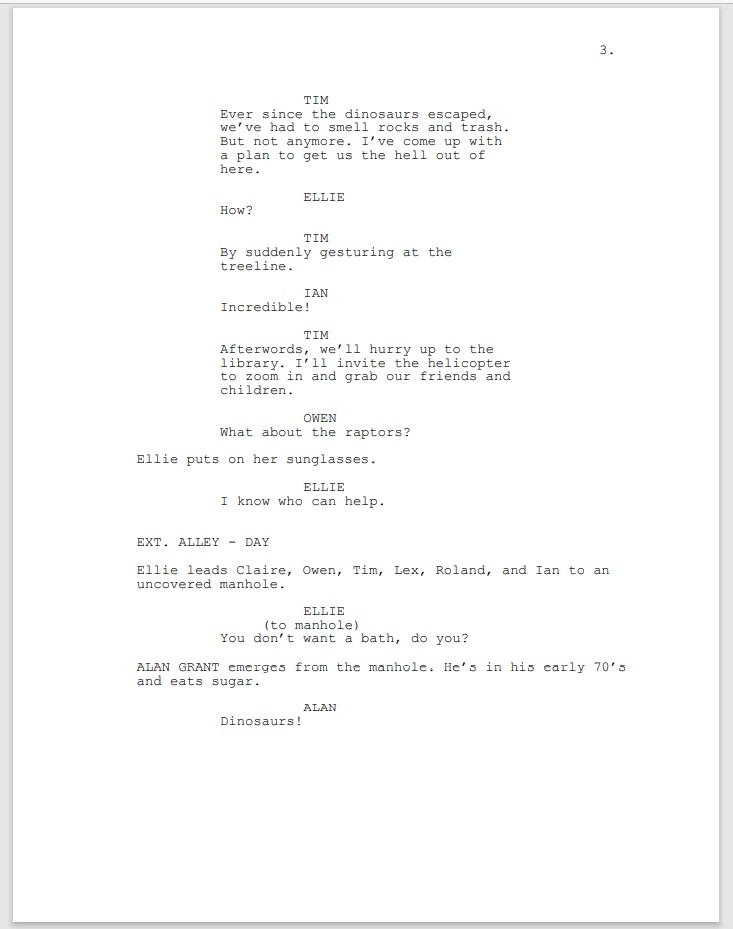
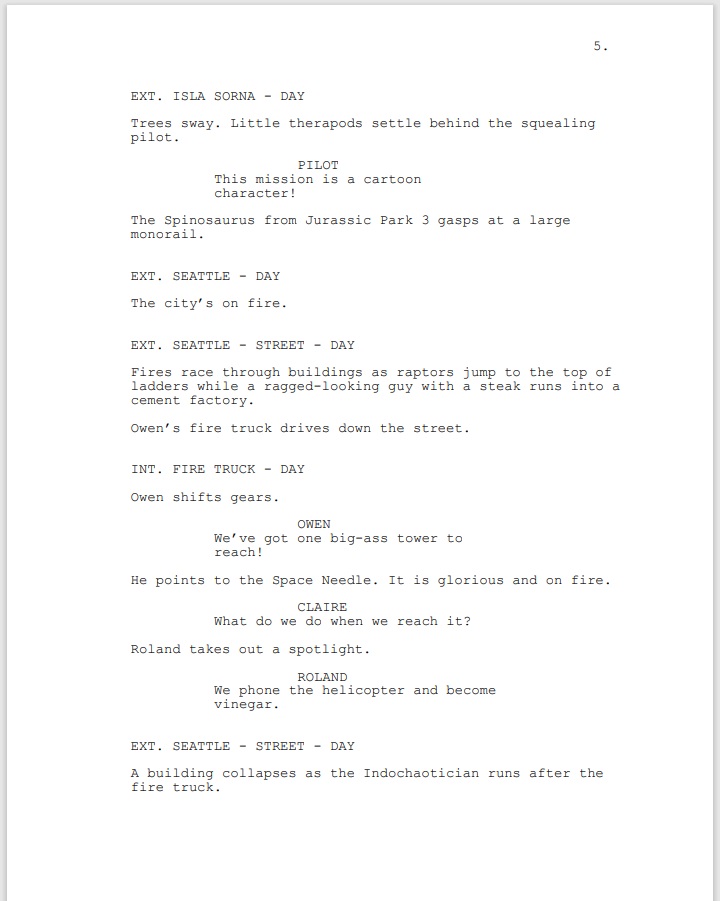
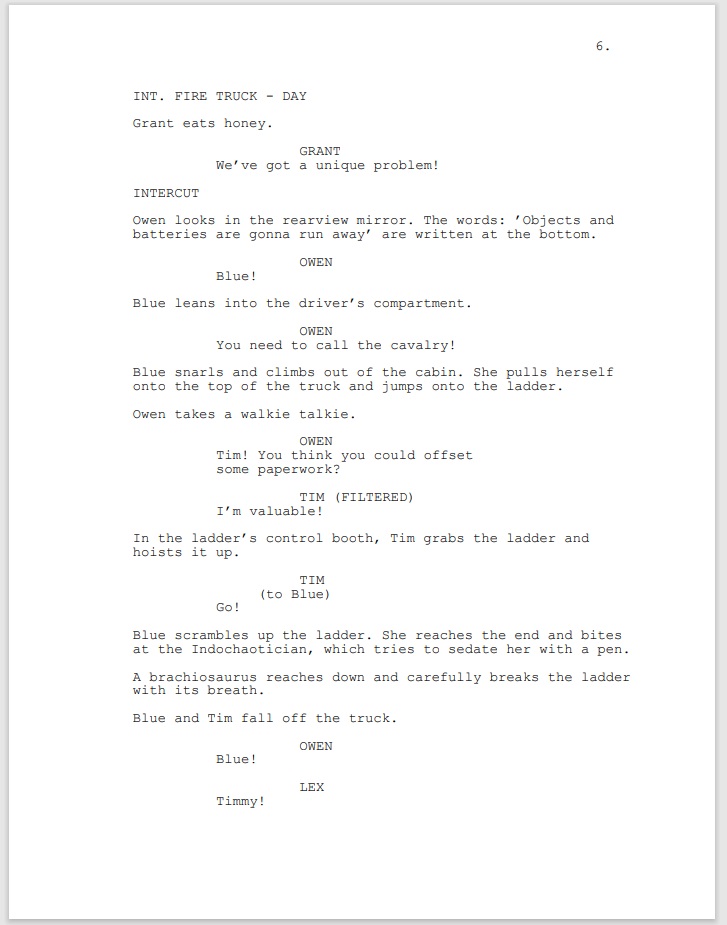
This morning, Universal Studios released the teaser trailer for ‘Jurassic World: Dominion,’ giving us our first in-depth look at the conclusion of the ‘Jurassic’ franchise.
I’ve written about ‘Dominion’ before, and back in 2019 I tried my hand at theorizing how the film might turn out… by taking the scripts for ‘Jurassic Park,’ ‘Jurassic World,’ and ‘Jurassic World: Dominion’ and putting them into a predictive text generator to see what sort of gibberish it would spit out. I originally intended to do dozens of pages of Grant, Ellie, Ian, Owen, and other characters talking nonsense, but real life got in the way and I never finished the project. With the release of the trailer, I figured this would be a good time to post the pages that were finished, if only to give people a laugh at what would have been the most bonkers summer blockbuster ever released. (If the pictures are too small, right click and open them in a new tab.)




 Imperfect Glass