What we can learn from The Onion’s interview with God

Of all the challenges that writers face in our craft, there’s one that sounds easy, but is anything but: How do you portray God? How do you put a face and a voice to The Creator Of Everything, especially when some ordinary person meets God. Let’s see how The Onion interprets such a meeting between us and our Creator:

Uhmm… Well, that was… something. Let’s dissect it and see what we can learn from one of The Onion’s most memorable videos.

Consider doing a shocking swerve

What’s so memorable about the video is that it starts off so innocently, complete with a dignified title screen and quiet piano music. We’re expecting a humanoid being to sit down before the interviewer (let’s name him Ted), and talk in a powerful, but gentle voice.

Then, seconds later, BAM, here comes an inter-dimensional being to take Ted on a fun adventure into madness.

As I noted in my critique of ‘Every 90’s commercial ever’, this kind of swerve is great for comedy, because luring our audience into expecting one thing, only to unexpectedly give them something else throws them off their feet, grabbing their interest as they try to make sense of what’s going on.

Consider having an encounter with the divine be pants-wettingly incomprehensible

When you imagine what God looks like, I’m betting the first things that comes to mind are either an old man in a white robe or a very bright light. What The Onion’s video does very well is portraying God more as a force of nature that is beyond anything we can make sense of.

For writers, try embracing that idea: Make your deity something beyond our comprehension. Make it so that even if your deity is benevolent, your character/s are so terrified that all they want to do is dive under the covers and cry for mommy to save them from this incomprehensible being who could destroy them in a nanosecond. By portraying a deity is an impersonal, incomprehensible being, you show your audience that you’re not going to be following traditions when it comes to portraying gods.

However, that impersonal power doesn’t have to be so terrifying: if your deity is benevolent, you can have them assist your character/s by using some of his/her/its power to stabilize their mind or counteract the effects of going mad. That shows that, despite being so far beyond its creations, your deity does care about them, and won’t just sit around passively while they go mad in its presence. Of course, if your deity doesn’t care, or is evil… well, helping your characters won’t be an issue.

Consider leaving it ambiguous if an encountered deity is malevolent or benevolent

While most people would assume that God is benevolent (or, at least, favorable to us mortals), we obviously can’t know for sure (assuming that God even exists). The Onion’s video, instead of portraying God as a beautiful, holy, benevolent being who loves us beyond all measure, goes for portraying God as a purple angel/skeleton thing that reduces Ted to a state of both sheer terror and unmatched ecstasy. We don’t know if God in the video is benevolent, malevolent, or something in between.

On the malevolent side, God turns into a hideous skeleton, makes Ted seemingly go mad with fear, and at one point seems to suck something out of his mouth. But on the benevolent side, God did show up for the interview, apparently grants Ted ultimate understanding about everything, and creates a beautiful tree after the interview is over, Either way, though, we don’t know if The Onion’s God is friendly, ticked off, or just messing around (or, as one Youtube user suggested, He’s just saying, ‘Thanks for having me’).

One pleasure of writing a god in our stories is the possibly of creating a being who is so removed from our notions of good and evil that its mortality is impossible to understand, similar to how ants, insects, and other small animals can’t possibly comprehend our own actions or the reasoning behind them. That opens up tremendous opportunities to explore morality, how it changes from culture to culture, or even if there is such a thing as absolute good and evil, or if it’s just something humanity has come up with. But there’s also another bonus to making your god morally ambiguous: When we can understand how a deity thinks, that god’s power and majesty is reduced. But when there’s a deity that we cannot understand in any way, it remains a mysterious, terrifying, and beautiful enigma. It’s the ultimate unknown, and leaves the door wide open for stories about characters trying to understand it.

The Takeaway

When writing about God (or a god), surprise your audience by portraying God not as a purely benevolent, humanoid being, but as something that can drive you mad trying to comprehend or understand, even if He/She/It is benevolent. Add more complexity by not showing if your god is benevolent, malevolent, or something in between.
Perfect Moments: ‘Mad Max: Out of Gas’

Once in a while, you come across a moment in a story that is so perfect that it stays in with you for years, or even a lifetime. These are moments that, in my opinion, are flawless; perfect gems of storytelling that cannot be improved in any way, and are a joy to treasure and revisit again and again.

***

The video:

‘Mad Max: Out of Gas’

Why it’s perfect:

The post-apocalyptic world of the ‘Mad Max’ universe is a crazy, dangerous, and awesome place, filled with action, crazed lunatics, and some of the most awesome looking vehicles ever to grace the silver screen. It’s a world of desperation and incredible action series as humanity fights to survive and gather all the gazzoline gasoline they need to fuel their engines of war.

But what if all the gazzoline gasoline ran out?

‘Mad Max: Out of Gas’ takes a look at what Max’s world would look life if all the gazzsoline gasoline ran out, and everyone still tried to fight the epic wars and battles of before, but on children’s tricycles. It’s the funniest parody of a post-apocalyptic world I’ve ever seen, and even made my parents – who aren’t action movie fans – laugh while watching.

This world may not be as cool as when it had cars, but it’s certainly a a lot funnier.

Favorite moments: ‘Mad Max Power Wheels’

We all have our favorite moments in movies, books, and games, moments that stay with us long after the story is over. This column is my attempt to examine my favorite moments and see why they stick with me.

***

The video:

Why it’s great:

Let’s pretend for a moment that you’re writing Hollywood’s next big film, the blockbuster that will finally earn you cinematic immortality and a big boost of friends on your Facebook page. But there’s problem: You’re writing a comedy, and you’re doing a big action scene of, say, soldiers attacking a fortress. The scene’s well-written, but it’s not funny, and nothing you do makes it work. What do you do?

Why not replace the soldiers with kids?

‘Mad Max Power Wheels’ is a near-perfect example of one of my favorite comedy tropes: Having children re-enact adult movies with a comedic bent. We expect to see little kids pretending to be police officers, paramedics, or firefighters when driving around in Power Wheels, not celebrating the release a of an R-rated post-apocalyptic movie by pretending to be hardened road warriors slaughtering each other for gazzoline gasoline. Yet, seeing that contrast between bloody death and ruin and innocent kids having lots of fun makes for comedy gold, and it only gets funnier the more mature, bloody, or gruesome said stories are. Captain Phillips, anyone?

What we can learn from ‘Water Fight’

Raise your hand if you’ve seen a car commercial that features the following:

*Some rich dude/gal drives their super-expensive luxury car that no ordinary person can afford out of their seventy gazillion dollar home.

*They drive through the empty streets of Los Angeles at night (which are conveniently empty of trash, homeless people, and homeless people having arguments with invisible aliens).

*They’re incredibly happy at their car that looks like every other car in every other car commercial since the 90’s that will one day either be crushed into scrap metal or become a pile of weed-covered rust in the backyard because its owner is a crippled, 90 year old man who is convinced that he will one day restore it, sell it, and become rich.

Sound familiar? I’d estimate that’s about 80% of all car commercials in the United States since the 90’s (the rest are either cars driving around Southern California hills while a creepy kid whispers, ‘zoom zoom’, and cowboys throwing things into pickup trucks while a guy yells, ‘Like a rock!’). With almost every car commercial being almost identical, it takes a lot to stand out. I can only think of three that do so; this one:

and this fake one (warning: This video contains language that is VERY not safe for work):

But the one that stands out for me is this one:

It may be short, but it has one great trick for writers to learn:

When doing a parody fight, have your characters treat it seriously:

I still remember watching this commercial for the first time and laughing at the absurdity of these Matrix-style tough guys going into battle with colorful water pistols, water guns, and water balloons (come to think of it, a remastered version of the Matrix trilogy where everyone wields water guns would be hilarious). Watching the commercial again, what strikes me the most is that the characters treat their situation with the utmost seriousness. They see nothing funny at all about trying to kill each other with H20.

In our own comedic stories, it can be tempting to have characters comment on the absurdity of the situations they’re in; a ‘wink at the audience’ moment, if you will. But I’ve come to realize that those moments should be avoided. When watching a scene unfold, our brains have a good idea of what to expect, but when an unexpected, comedic element is thrown it, it throws us off balance (in a good way), and we enjoy the novelty of seeing something we’ve seen done a hundred times be done in an absurd way.

Think of classic Hollywood parodies: ‘Airplane!’ ‘Monty Python and The Holy Grail’ ‘The Naked Gun’ trilogy. In all of them, their characters don’t see anything funny about the situations they’re going through. Had they laughed, pointed out the absurdity, or otherwise become aware of the parody elements, the films would have lost much of their humor. Thus, when writing our own comedy, perhaps the simplest rule to remember is to keep it straight… and that you probably shouldn’t bring a water pistol to a gun fight.


Favorite Moments: ‘My Slam Will Jam On’

We all have our favorite moments in movies, books, and games, moments that stay with us long after the story is over. This column is my attempt to examine my favorite moments and see why they stick with me.

***

The video

Why It’s Great

The 90’s were a magical time for cinema. From that era, we got such classics as ‘Terminator 2: Judgement Day,’ ‘Jurassic Park,’ ‘The Matrix,’ ‘Toy Story,’ and the juggernaut that was ‘Titanic’… and then we got ‘Space Jam’, which features Michael Jordon teaming up with the Loony Tunes to save them from being kidnapped by aliens by playing basketball.

Uhh… Yeah.

However, from this unlikely tale came a title song that has gone on to become a low-key, but steady internet legend, a song that can be mixed with anything. I myself only recently became aware of its existence, through one of the most unexpected mashups I’ve ever heard. It shouldn’t work; there’s no logical way a song about outer space basketball and doomed teenage romance on a sinking ship should work… but, incredibly, it does. I have no idea why, but… gosh dangit, this is one catchy song, and it is my sacred duty to expose it to as many people as possible so they, too, can weep at its glory.

Favorite Moments: ‘When Death Troopers Try Going Through a Drive-Thru’

We all have our favorite moments in movies, books, and games, moments that stay with us long after the story is over. This column is my attempt to examine my favorite moments and see why they stick with me.

***

The video

Why it’s great

Today’s video is another perfect example of fish-out-of-water comedy, by taking the Empire’s elite Death Troopers off the battlefield, and having one of them try to order fast food… and learning that his (her?) voice-scrambling helmet isn’t the best thing to wear when trying to talk with an ordinary person.

Another subtle nugget I didn’t notice at first when watching this video is that this is a great example of how even the most intimidating, faceless people in stories are still human underneath all their armor, complete with dreams, hobbies, and not liking certain foods. Keeping such things in mind can help us when we write henchmen or elite soldiers: They may be dangerous and dedicated to their cause, but there’s more to them than what organization they serve or what kind of armor they wear.

Favorite Moments: Pancakes!

We all have our favorite moments in movies, books, and games, moments that stay with us long after the story is over. This column is my attempt to examine my favorite moments and see why they stick with me.

***

The Movie

‘Cabin Fever’ (2002)

The Scene

Why it’s great

It’s a scene of a kid who wants pancakes, does karate moves, and then bites a guy while making wolf sounds, while his dad yells his name in slow motion. It’s so random, so out of place in a movie about a flesh-eating virus, and so bizarre that it breaks the time-space continuum and transcends the comprehension of mere mortals.

What? I need to write more? Well, it’s an example of how having a random scene that has nothing to do with the rest of the story can become the most memorable moment of that story, AKA, The Big Lipped Alligator Moment.

Now, if you’ll excuse me, I need to go satisfy a sudden hankering for pancakes.

Favorite Moments: ‘Conan the Librarian’

We all have our favorite moments in movies, books, and games, moments that stay with us long after the story is over. This column is my attempt to examine my favorite moments and see why they stick with me.

***

The Scene

Why it’s great

I’ve written before about my love of Fish Out Of Water humor, which makes this scene from ‘UHF’ one of my favorites from the film. Not only do we have a giant, muscle-bound barbarian plucked out of the dark ages and in the modern era (the 1980’s), but he also has a job that’s one of the least suited for his particular skills.

While having people from different time periods dropped into the modern age is always great for comedy, extra humor can be gained when they get modern jobs that don’t always mesh with their talents and abilities. Even better is when they throw themselves into those jobs without hesitation, striving to do their best. When you combine that formula with the almost endless types of characters from history to choose from, you’ve got a formula for comedy gold.


Perfect Moments: My favorite Christmas Moment

Because of the Christmas holiday, I’ll be taking a break from posting until January 3rd. But before then, I’d like to share my favorite piece of Christmas related media. It’s not a movie or a TV special, but – of all things – a commercial for Directv.

While Christmas traditions revolve around giving gifts, celebrating the birth of Jesus, and many festivities, the one aspect of the holiday that often gets overlooked is the wish for peace on earth, and goodwill to all.

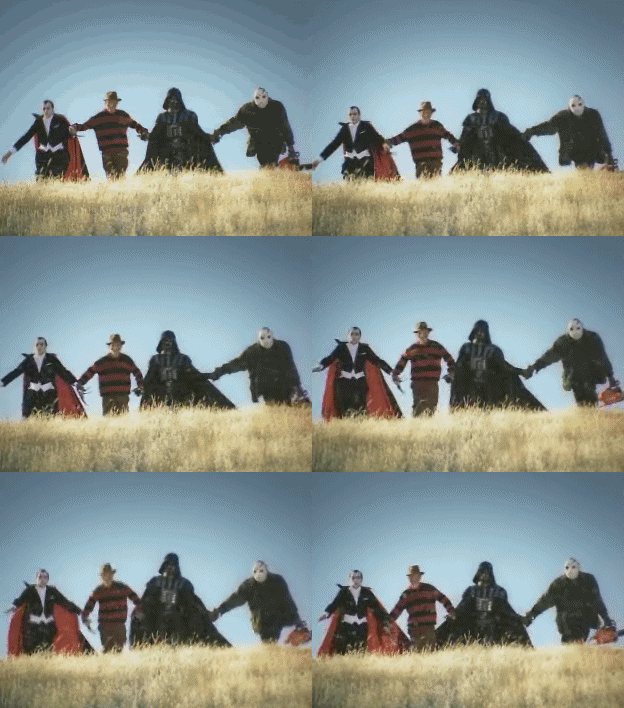
Imagine a world where there’s no evil or war. A world where everyone – including villans – are at peace with themselves and each other. It’s a dream that only gets more beautiful the older I get… but one that I know will almost certainly never happen. But thanks to this silly commercial, we can have a glimpse of what such a paradise might look like, where Darth Vader, Jason Vorhees, Freddy Kruger, Dracula, The Mummy, Chucky, Hannibal, and the girl from ‘The Ring’ celebrate Christmas with an ordinary family.

Is it cheesy? Yes. Is it goofy? Oh heck yes. There are other movies and stories that are more emotional, more heartwarming, and that inspire us to be grateful for all the wonderful things in our lives, including our loved ones. But this commercial shows us a world where peace, love, and goodwill reign, and everyone – including the most despicable of people – have turned to the light, and that’s why it’s my favorite piece of Christmas media.

Well, that, and seeing this once-in-a-lifetime image:

h39F3FDB7

(GIF from this page)

May you all have a wonderful and heartwarming holiday season.

Favorite Moments: The TRON Holiday Special

We all have our favorite moments in movies, books, and games, moments that stay with us long after the story is over. This column is my attempt to examine my favorite moments and see why they stick with me.

***

The Video

Why it’s great

No, this isn’t a long-lost relic from the 80’s that should have stayed lost: this Funny or Die video pokes fun at the Star Wars Holiday Special by imagining what might have happened if TRON had a special of its own. The answer? It would have been as terrible/awesome as it’s infamous real-world counterpart.

While my favorite moment is poor Santa being de-rezzed, the whole video is a great example of the Christmas Special trope, and why it’s a near-perfect formula for comedy gold:

1. Take any franchise and give it a Christmas special, no matter how absurd it might be (Can you imagine a Hellraiser Christmas? How about a Waterworld Christmas?).

2. Have your characters save Christmas.

3. Have said characters learn the True Meaning of Christmas (which may or may not involve Jesus, depending on your audience).

Imagine how hilarious it would be if Darth Vader had to deliver presents to all the good Stormtroopers on the Death Star and learn that it’s better to give than to receive. Or imagine Gandalf, Frodo, and the Fellowship traveling to Mordor to save Santa after he’s been kidnapped from Sauron. Or contemplate how amusing it would be for the Umbrella Corporation to feel the holiday spirit and work to make everyone’s Christmas a little merrier while simultaneously trying to destroy it with with zombies.

No matter what genre your franchise is, injecting some holiday cheer is a great way to make your audience laugh… even if said franchise involves giant, shapeshifting robots from beyond the stars.