We all have our favorite moments in movies, books, and games, moments that stay with us long after the story is over. This column is my attempt to examine my favorite moments and see why they stick with me.
***
The Movie: The Twilight Saga: Breaking Dawn – Part 2
The Scene:
Why It’s Great:
In these troubled times, we all need a break from the horrors and fear of life. There are many ways this can be done: Meditation, exercise, mindfulness, and knowing that, no matter what problems we face, they can be overcome in the end. But most doctors, if asked, would say that the best way to relieve stress is to watch vampire babies explode when tossed into bonfires.
You don’t need to know the context of why said baby is being chucked into a roaring fire, only that we watch a freaking vampire baby exploding, and that the actress chucking the baby puppet is trying her hardest not to laugh, turning this 4 second clip into comedy gold.
There comes a time where every parent must make vital choices regarding their children: how shall they be disciplined? What do I feed them? How do I balance work and spending time with them? And, most important of all: What order do they watch the Star Wars movies in on their first viewing?
Back in 2011, the internet went abuzz with the introduction of the Star Wars Machete order, an attempt to create a way for first-time viewers to watch the series in a particular order that would preserve the franchise’s biggest surprise (that Darth Vader is Luke’s Father), while still allowing the prequels to play a part. In short, you start with ‘A New Hope,’ then go to ‘Empire Strikes Back,’ and then go to ‘Attack of the Clones,’ and ‘Revenge of the Sith’ to see Anakin’s fall (while omitting ‘The Phantom Menace’, if you choose), and then finishing with ‘Return of the Jedi.’
Recently, I wondered if this idea of out-of-order-viewing could be applied to the Terminator series as well. With James Cameron revealing in an interview with Empire magazine last year that future Terminator movies will move away from Sarah Connor, John Connor, and the T-800, this means that story Terminator films have been telling for over 40 years – the quest to protect John Conner so he can defeat Skynet – has come to an end.
There’s just one problem: That story never got a conclusion.
‘Terminator 2: Judgment Day’ was meant to wrap the Terminator saga up with an open – but hopeful – ending. But since it made more money than the total GDP of several developing nations, we got four more movies that kept postponing Judgment Day and ending with the promise of more sequels. But the law of diminishing returns eventually took hold, and after the box office failure of ‘Dark Fate,’ we never got the movie that chronicled the destruction of Skynet and the ultimate triumph of humanity… until now.
After reading about Star Wars’ machete order, I’ve been wondering if such a tactic could be applied to the Terminator films, and began to ponder, brainstorm, and try to come up with a way that can re-tell the John Connor saga in a way that is logical, keeps as many of the films in as possible, and, most importantly, end the story for good without needing any more sequels or follow-ups. And to that end, I have created what I’ve dubbed, The Terminator Machete Timeline.
To begin, here’s the films included in this timeline, and the order in which we watch them:
1. The Terminator
2. Terminator: Dark Fate
3. Terminator 3: Rise of the Machines
4. Terminator: Salvation
5. Terminator 2: Judgment Day (extended cut)
While this may look confusing and nonsensical at first glance, I’ve come up with a backstory that connects these five films via the magic of time-travel in a way that, I believe, creates a new narrative that has a definitive beginning, middle, and, most importantly, a conclusive ending.
The Machete timeline begins with the one that started it all: ‘The Terminator.’
But when it ends with Sarah driving towards the mountains and the coming war, we then proceed not to ‘Judgment Day,’ but to ‘Dark Fate.’
In this dark future, John is killed, an aged Sarah learns about Legion, a new machine hellbent on destroying humanity, and Dani begins her journey to becoming the leader of the resistance and the savior of the human race.
But in the Machete timeline, this is where things change.
At the beginning of ‘Dark Fate,’ John is shocked to see the T-800. That’s understandable, considering he saw Uncle Bob melt himself into slag to stop Skynet from being created. But in the Machete timeline, Skynet sent back not only a T-1000 to kill a young John in 1995, but also a T-800 to act as a partner and as backup to his robot brethren. Thus, Sarah and John had to stop Cyberdyne while also trying to stop two Terminators working together trying to kill John. Against all odds, Sarah succeed (how she pulled it off will remain a riddle for the ages). Thus, when John is stunned at seeing the T-800, it’s not because he’s seeing his robot buddy again, but because he realizes that his old enemy has finally tracked him down, and this time, Sarah can’t save him.
At the end of the movie, Sarah and Dani drive off to prepare for the inevitable war against Legion. But as they drive, Sarah has an epiphany: she realizes that time travel will inevitably be created and put to use in the war against Legion… why not hijack that technology and use it to save John? But Sarah isn’t dumb: while she’ll do anything to save her son, she also knows that, no matter how many times an intelligent AI defense system is destroyed, another will inevitably take its place, meaning that a human-machine war is inevitable.
But what if it isn’t?
While training Dani on how to be both a warrior and a leader, Sarah tries to figure out how the inevitable war between humans and machines can be stopped, and eventually realizes that if humanity can move past the tribal instinct to have bigger, better weapons than your adversaries, then there will be no need for an AI military system, and Skynet will never be created.
Perhaps, Sarah realizes, John can be humanity’s savior without being a military commander. Maybe he can work to inspire humanity to use AI for benevolent purposes instead of as a weapon of war.
With her idea in motion, Sarah tells Dani her plan: When Legion develops time travel, Sarah will go back in time to save her son as a child and teach him to be a leader, not a warrior. If she succeeds, then Skynet will never be created, Legion won’t take its place, and the endless cycle of war between machines and humans will end. Dani – not wanting to lose her family or Grace – agrees to the plan. And so Sarah finishes Dani’s training, stockpiles supplies for Legion’s attack, and goes to hide in a bunker (presumably playing Angry Birds to pass the time).
When the war finally begins, Dani plays her role, becomes the leader of the Resistance, gets wounded, and Grace is augmented and goes back in time. Shortly afterwords, Sarah emerges and becomes augmented herself to ensure that her aging body will last long enough to complete her mission. Thus, with Dani and the rest of the Resistance watching, Sarah travels back in time to save her son… but because time travel is not a perfect science, the time machine malfunctions, and Sarah finds herself not in 1995, but in the year 2005, arriving just before the events of ‘Terminator 3: Rise of the Machines’ play out.
Having landed in a remote part of the world (say, somewhere in Asia), Sarah has no chance of reaching John in time to help him. She is, however, able to use her cybernetic implants to learn that Skynet is taking over the world’s computer systems and manages to evacuate to the wilds, where she survives Judgment Day. Once the dust clears, and the nuclear winter begins, Sarah starts out towards Los Angeles, knowing that John will establish his headquarters there. But with most of humanity’s jets, planes, and vehicles now either destroyed or running out fuel, Sarah’s journey takes several years; as she nears its end, the events of ‘Terminator: Salvation’ take place.
After John is evacuated from his assault on Skynet’s San Francisco headquarters, given a new heart, and prepares to head back into battle, Sarah finally catches up with her now-adult son and is reunited with him. Though shocked to see his now-augmented and elderly mother, an overjoyed John listens as Sarah recounts the events of ‘Dark Fate’ and explains that she’s trying to get back to 1995, and how she has to get a T-800, reprogram it, and send it back to be John’s protector instead of his killer: a young John will then realize that machines can learn to live peacefully with humans, and hopefully work to create a future where such a thing is only possible, but happening.
John and the Resistance agree to this plan. They manage to capture the T-850 that was going to kill John in 2032 (who’s organic covering has not aged to the point that it was in ‘Rise of the Machines’), and Sarah reprograms it with her implants. Skynet is defeated in a final battle and sends the T-1000 back, but the Resistance stops it from sending the original T-800 back, and instead send back the reprogrammed T-850, and the events of ‘Terminator 2: Judgment Day’ play out.
But before we reach the end of this timeline, we’re going to make one more change: instead of watching the theatrical cut, we instead watch the extended edition of the film, which ends with an alternate 2029 where Skynet was never built, Judgment Day never happened, John works to make benevolent AI the norm, and humanity’s future has never looked brighter.
Sarah’s time-traveling quest to save humanity has succeed, John has worked tirelessly to help machines and humanity live together in peace, and the original Sarah – un-augmented and now in her 60’s – can live her life in peace, with the only thing she has to fear in this future being hideous 2029 fashion.
***
And there you have it: The Terminator Machete Timeline. While ‘Terminator: Genysis,’ was not included in this timeline due to having little overall impact on the series as a whole, this timeline preserves all the other films and allows them to be part of one continuity, but it also does two things not present in the original series:
1. Sarah takes a far more active role in saving humanity, and succeeds in her quest, becoming even more heroic than she was in the original series. (albeit, off-screen)
2. By going with ‘Judgment Day’s alternate ending, this viewing order – combined with the backstory that connects the films – creates a story where Skynet is defeated not by force or by acts if violence, but by John fulfilling his role of humanity’s savior by being a leader in peacetime instead of a wartime commander, inspiring humanity to finally put aside the endless arms race that humanity has had for all of its existence, which means there’s no reason for Skynet to be created in the first place.
There’s also one more thing this continuity does: it gives Terminator fans an ending that truly finishes John’s story, ties up all the loose ends, and gives everyone – including those who were spared by Judgment day never happening – a happy ending.
As is often said in the films, there is no fate but what we make for ourselves: maybe part of that is not relying on a studio deciding to do the right thing and finish a story that should have ended long ago, but to take it upon ourselves to give that story the ending it deserves.
Or you could just stick with T1 and T2. That works too, I guess.
Every story has a cast of characters that we follow and watch and come to love… but what about the background characters? The nameless masses who rarely get our attention? This column examines my favorite background characters who deserve a moment in the spotlight.
***
The Movie:
‘The Lord of the Rings: The Two Towers’
The Character:
A zombie! (Maybe)
The Scene:
Why He Deserves A Moment In The Spotlight
Despite having watched all three Lord of the Rings movies dozens of times over the years, I’m still finding little moments I never noticed before, and this one may be the weirdest of them all: at 0:10 in the clip above, we can see Rohan soldiers barricading the door to the keep of Helm’s Deep. But if you pause the video at the right moment, you can see what looks shockingly like the pale, emancipated hand of a zombie.
I know this isn’t a zombie, but it sure looks line one, doesn’t it? Alternately, considering how the fingernails almost look like claws, it may also be the hand of a vampire; compare the hand here to Nosferatu’s hand from the upcoming 2024 remake:
While this is certainly the hand of a random soldier that’s stained with Uruk blood and covered in bruises, it’s still fun to imagine that an undead creature of the night came to defend the Rohirrim from Saruman’s hordes, and subsequently went on fun adventures with its new horse-buddies while guzzling mead, camping out in Dunharrow, fighting on the Pelennor Fields, and finally duking it out with orcs at the Black Gates, while never gaining any glory or being remembered by the masses. But he was still there, just out of sight, helping erect barricades and doing his part to save Middle-Earth and its people from Sauron.
Note: This post spoils the stories of the 2018 film Halloween and its two sequels: Halloween Kills and Halloween Ends. It also contains videos depicting fictional gore and violence that is not safe for work. It also contains a clip of a fictional character killing themselves.
It’s spooky season once more, and you know what that means: horror movies, slasher villains, and buckets of blood and gore. We’ve gotten a lot of horror franchises over the years, but only the classics endure, and the granddaddy of them is the Halloween franchise. While quite tame by today’s standards, the original was groundbreaking when it was release back in 1978, introducing the seemingly unkillable Michael Myers to silver screens everywhere, and beginning one of horror’s longest-running franchises.
Two years ago, David Gordon Green’s sequel trilogy – which acted as a direct followup to the original 1978 film – came to an end with Halloween Ends. Although the trilogy has gotten a mixed reception from fans, I think that, despite some narrative inconsistances, there’s a lot to like about the films. Here are eleven of my favorites:
11. Michael Meyers, Child Killer
While horror films can get away with a lot that other genres can’t, killing children is one of the things normally frowned upon. But Halloween, Kills, and Ends has no problem with Michael killing children.
While Michael was never even remotely a good guy, having him kill children in painful ways (I don’t even want to know what happened to the poor kid who wore that blood-drenched skull mask) shows viewers that he’s one killer who doesn’t mess around and is willing to kill anyone he comes across. Yet, even then he spares an infant in the first film, and we never find out why, further cementing that he’s a force of evil that doesn’t bother to explain itself to his victims.
10. Laurie and Michael’s Reunion
Throughout the first film of the sequel trilogy, we get to see how Laurie prepared herself for an inevitable rematch with Michael, and what follows isn’t so much a fight, but a one-man siege:
What I like about this even though Laurie has been preparing for this fight for years, she still can’t kill Michael with guns or brute force, and has to resort to trickery and help from her daughter and granddaughter, and even then it’s still not enough to kill Michael (who, at this point, is 61 years old).
One little thing that makes this scene even better is the moment when Laurie calls out for Ray: you can almost hear Michael thinking, “Wait a minute… I know that voice.” And then, turning his head, he sees Laurie through the door, recognizes the girl who got away so long ago, and decides to finish what he started back in ‘78.
9. Old Man Michael
One of my favorite things about the Halloween sequel trilogy is that the films acknowledge Michael’s age. Instead of trying to make him an eternally youthful man, Michael has aged to the point where he could collect social security checks and get senior discounts at the grocery store. By acknowledging that the bogeyman is getting old, it makes Michael’s kills all the more unique because we rarely get to see a senior-citizen slasher villain in stories, much less one who has three movies to play around in.
8. The Innocent Inmate’s Suicide
Though the trilogy is focused on horror and kills, it’s most emotional moment is when one of Michael’s fellow inmates from the asylum realizes that an enraged mob – who believes that he’s Michael – is going to tear him limb-from-limb. They can’t be stopped, they can’t be reasoned with, and the man – who is harmless and terrified – decides that the only thing he can do is jump to his death rather than face an even worse death at their hands.
Afterwords, the shock from all those present drives home how they’ve realized that their fear, paranoia, and desire to kill Michael have turned them into monsters on par with Michael himself.
7. Michael vs the Mob
The climax of ‘Kills’ sees Michael’s bloodiest, goriest, and highest body count in any of his films when he’s attacked by dozens of Haddonfield’s citizens.
He’s shot, clubbed, hit, beaten to the ground and seemingly defeated; it’d be a perfect ending to the series to have ordinary people unite and take Michael down for good… and then he lashes out, gets right back up, and kills everyone in the crowd.
Though the trilogy flip-flops on if Michael is supernatural or just a man, this scene proves that while Michael may look human, he is anything but.
6. Michael’s Evil Infecting Haddonfield
Though Michael is and always will be the face of the Halloween franchise, an idea that’s been brought up again and again is that evil always changes shape, and that killing Michael will mean that someone will eventually take his place. However, there’s another aspect of this that is subtly implied throughout the trilogy: that the evil within Michael corrupts everyone around it. When Michael returns to Haddonfield, the people there start to become paranoid and act violently to try and stop him, only succeeding in killing innocents and themselves, until Corey is seduced and corrupted in Ends, almost becoming Michael’s successor.
Michael may be a remorseless killer, but he is also a tumor that infects, corrupts, and destroys everyone around him. He’s a prime example of how evil can create a cycle of fear, death, and revenge that is almost impossible to stop.
5. Michael’s Supernatural Abilities
There’s been many theories on why Michael is so durable and hard to kill, and while Ends says that he’s just a man, I don’t think that’s true: Michael takes damage throughout the trilogy that would kill a man half his age and demonstrates endurance, durability, and strength beyond anything any normal person could endure: name any other man in his 60’s who can beat someone to death with their fists, he can crush a man’s head into pulp by smashing it with his boot, take a firehose of water to the chest without flinching, and hit someone with a baseball bat so hard that the bat itself is broken into two.
I’m of the theory that while Michael himself is human, the evil he contains makes him so much stronger and durable than any man could ever be, and while that power fades with age, it’s still always there, always driving him on, always giving him what he needs to continue his killing spree.
4. Michael vs the Firefighters
Michael gets into a lot of fights throughout the trilogy, but in terms of sheer ‘cool’ factor, this is my favorite:
Not only does this fight have a fantastic setting (taking place in front of a burning house), it demonstrates just how inhumanly strong Michael as as he takes down nine firemen who are armed with axes, firehoses, and even saws. But this fight is also a moment of awesome for the firefighters themselves: the moment they see Michael step outside, they instantly know who he is, but they don’t panic, run, or call for backup: instead, they stand their ground and fight. And while they all die, at least they go down fighting.
Fun fact: The house burning down during the scene? That was done for real, which meant that the filmmakers had about an hour to finish filming before the house collapsed. Thankfully, they did!
3. The Final Confrontation Between Laurie and Michael
The first sequel had a fight to the death between Laurie and Michael, but in my opinion, the final battle between the two in Ends is so much more gripping: Michael – now worn down from years of untreated injuries – comes to Laurie’s house and realizes she’s nearby. Laurie – who has given up on being a highly-trained survivalist – has no time to prepare as Michael comes for her, ending in a final, no-holds-barred beatdown between the two.
While the fight isn’t flashy or filled with fancy choreography, I love its atmosphere: this fight really feels like a final confrontation over 40 years in the making, both in-universe and out. Predator and Prey – both of whom are past their physical prime – fight to the death with nothing to lose and throw everything they have at each other, all backed with a near-apocalyptic soundtrack that makes things so much more intense. This is the last time Laurie and Michael will ever fight, and they give it their all. Many a fan has decried how Michael should have been able to kill her easily, but having Michael be old, worn out, and worn down from all the injuries he’s accumulated makes things more evenly matched between the two, and makes Laurie’s final victory all the more satisfying.
2. Michael is Killed For Good
There’s a saying in the world of comics: no one ever stays dead (except Uncle Ben), and the same can be said for slasher franchises: no matter how many times a villain is supposedly killed off for real, box office profits ensure he or she will always come back, no matter how convoluted the explanation may be. But while Michael will return for the inevitable reboot of the Halloween franchise, this timeline ends him in the most concrete way possible: by throwing his body into an industrial shredder and tearing him into bloody pulp.
There’s no way, NONE, that Michael can come back from this, and there’s one aspect of this scene that makes it so satisfying beyond seeing an evil man finally getting his just deserts: Throughout the series, Michael always comes back from every injury he takes. Whether it’s immediately, in a minute, a few hours, or even years, he always comes back, and I believe that Michael did not actually die in the fight with Laurie. Instead, he was so weakened from the loss of blood and his accumulated injuries that he couldn’t move, and while the evil possessing him was working to try and heal his body, the process couldn’t be completed when he was thrown into the shredder. Thus, Michael Myers truly died when the shredder tore him apart, and he felt all the pain that came with it: a far more just and deserved ending after all the lives Michael took, the fear he spread, and the suffering he inflicted on so many.
1. A Hopeful Ending
One reason I generally avoid horror films and franchises is the constant trope of downer endings where evil wins and nothing good comes from all the sacrifices, struggles, and suffering of the protagonists. Thankfully, Ends avoids this with a bittersweet, but hopeful ending:
After so many decades, Laurie finally kills Michael and frees both herself and Haddonfield from his reign of terror. While she cannot get back all the years and loved ones she’s lost, Laurie can now heal and create a new life for herself, complete with a new relationship with officer Hawkins. And best of all, in the final shots of the film, there’s no sound of Michael breathing. His mask remains, but the man – and the evil he carried – is truly gone, and it’s a great way to end the original Halloween timeline.
We all have our favorite moments in movies, books, and games, moments that stay with us long after the story is over. This column is my attempt to examine my favorite moments and see why they stick with me.
***
The Movie:
The scene, and why it’s great
One constant source of unintentional comedy in film is movies that are rushing to get to the end credits as quickly as possible. While great stories take the right amount of time – whether it’s a few minutes or a dozen – to wrap things up, say goodbye, and give characters closure, other stories say, ‘nah, screw that’ and just wrap things up in a few seconds. One of my favorite examples of this comes from ‘Dracula 3000,’ a story that re-imagines Bran Stoker’s timeless tale, but in space! Oh yeah, and Dracula is now called Orlock, and all vampires are now aliens who come from the planet Transylvania (yet dress up in the finest vampire apparel you can get from Spirit Halloween specially tailored for them by their fellow vampires)
As you might imagine, the film doesn’t have the best reputation. Most would say the best thing about it is the H.R. Giger inspired cover art, and maybe Coolio being in outer space. But for me, the best part is the final ten seconds. Behold:
On July 17th, 1987, the world of cinema was changed forever as humanity witnessed the cinematic spectacle of Jaws: The Revenge, a film that thrilled moviegoers, took the world by storm, and became the first movie to earn over a billion dollars at the box office, win every academy award, and be heralded by many as the stunning and moving conclusion to the Jaws saga… or, at least, that probably happened in a parallel universe. In ours, Jaws: The Revenge was such a critical and financial flop that the Jaws franchise dropped dead, continuing only in the form of the occasional video game, LEGO set, and clothing line.
But what if I told you that the Jaws series, while seemingly dead, is actually part of a much larger narrative that has continued to this day?
What if I told you that the Jaws series was actually part of the Terminator film series?
But how could a movie series about a family fighting shark after shark after shark share a world with time-traveling killer robots, you might ask? Simple: My theory is that the events of the Jaws series chronicle Skynet dispatching robotic Terminator-sharks to kill Sean and Michael Brody, who will eventually grow up to become high-ranking lieutenants in the Resistance, and – supported and helped by their parents – become invaluable in humanity winning the war against the machines.
Impossible, you might say; there’s no evidence to support such a theory. But when you examine all four Jaws films, there is! This evidence can be grouped into three categories:
*The behavior of the sharks in the series
*The appearance of the sharks in the series
*Time travel erasing the events of the third film from existence.
Shark Behavior
Let’s begin with the behavior of the sharks in all four films, and how they reveal that all six sharks (yes, six) are Terminators.
Jaws
*When hunting sharks, Quint fires harpoons into their skin, which are then tethered to barrels, which serves to tire the sharks out and prevent them from diving. However, the film’s shark can dive down and stay underwater even with three barrels attached to it, something which even Quint admits is impossible. Could a normal shark do that? No… but a robot shark from the future can!
*At the film’s climax, Brody defeats the shark by shooting an air tank in its mouth, causing both to explode.
*Early in the movie, the corpse of a killer whale is discovered with teeth marks that match that of a great white shark.
However, killer whales are natural predators of great white sharks due to their size, speed, and intelligence, and travel in pods, making it very unlikely (though not impossible) that the film’s shark could have killed this orca… unless it was a killer robot with an extremely powerful bite force that had to attack the orca to prevent damage to its outer skin that could reveal its metallic interior and blow its cover.
*The shark survives being next to an exploding boat. At such close range, a normal shark would have been blown up or killed by the resulting shockwave. Yet, this one survives without so much as a scratch.
*In perhaps the most irrefutable piece of evidence that the shark is a terminator, notice how when it tries to eat Michael, its metallic innards can clearly be seen!
*The shark is strong enough to not only stop a helicopter from taking off from the water, but is also able to overturn it.
*The shark is defeated by a massive jolt of electricity.
While this would kill an ordinary shark, it also makes sense that a Terminator could be killed by a massive, sustained current of electricity. While this has never been shown on-screen, The T-X in Terminator 3, and the T-800 in Terminator: Genysiswere momentarily incapacitated when exposed to an electric current. In Jaws 2, it’s conceivable that a stronger and more sustained current would short-circuit and destroy the terminator trying to kill Chief Brody.
Jaws 3
*Compared to the sharks in the previous two films, the sharks in this movie display an increasingly mechanical, non-lifelike appearance, something consistent with a robotic shark covered with a crude rubber skin.
*The smaller shark (a Terminator sent back with a larger unit to infiltrate small areas) is a very weak model; not only is unable to kill its chosen targets when it could have easily done so, but upon being stabbed by an incredibly lucky hit from Kay into a motor servo, the shark is paralyzed and unable to do anything.
Later, the continued exposure to salt water finally short-circuits the Terminator’s CPU and it becomes inoperable.
*When approaching the underwater control room, the main shark freezes up, appearing to glide into the windows, only opening its mouth at the last second. A normal, organic shark wouldn’t try to ram a building, much less just glide towards it, but a robot that’s glitching and experiencing mechanical problems certainly would.
*When stuck inside the control room after crashing through the glass, the shark doesn’t suffocate; Great White Sharks need to continuously keep moving in order to get oxygen through their gills, and since the shark can move around and attack for a few minutes without breathing (as well as swim backwards, which it did inside the filtration pipe, which is enormously difficult for a real Great White, even more so when the creature is suffocating), it is clearly a non-organic organism.
Jaws The Revenge
*In the opening scene, the shark purposefully damages a buoy to lure Sean out to the area, where it then attacks and kills him.
Seeing as Great Whites cannot lay traps for humans, the only way this makes sense if if the shark was a robot with knowledge that Sean was a police officer, and thus likely to be called out to deal with a damaged buoy.
*When Ellen, Michael, and his family fly to the Bahamas, it’s commonly assumed that the shark pursues them, a journey of about 1,359 miles, in a day or two. Even for a Terminator with nigh-infinite stamina, crossing that distance in that time is impossible. Thus, I would like to propose that there are not one, but two Terminator sharks in the film: One at Amity, and one in the Bahamas: when the Brody family leaves Amity, the Terminator stationed there (who got a visual ID on Michael, Ellen, Carla, and Thea) dispatches a message to its peer in the Bahamas, who is then ready and waiting when Michael and the others arrive.
*In the Bahamas, the shark repeatedly targets the Brody family and ignores other humans, even when it would be easy to kill them:
-The shark swims next to Jake’s minisub and, upon realizing that he’s not Michael, ignores him. Later, when Michael is piloting the same submarine, the shark immediately goes after him.
-When the shark pursues Michael through the ship, it rams a ladder at one point, briefly exposing it’s mechanical innards.
-The shark goes after Thea on the banana boat, but terminates the wrong person by mistake.
-The shark attacks Hoagie on his boat, but upon realizing that he’s not a Brody, lets him go.
-The shark attacks Jake and injures him, but, once again, notices that he isn’t a designated target and lets him go.
*Michael’s plan of using electrical impulses to disrupt the shark’s brain probably wouldn’t work in real life (I couldn’t find any information online if it would, so I’m leaning towards no), making the scene of the shark hopping around and roaring impossible under any circumstance.
However, the scene does work if the pulse is scrambling the Terminator’s CPU and internal circuitry, causing it to malfunction and act erratically, including making the aforementioned roaring; though rarely seen in the Terminator films, Terminators do have the ability to vocally mimic voices and presumably sounds. Perhaps the roar was on file if it really wanted to scare its victims.
*The shark has a heartbeat that can be picked up using sensors. However, the heartbeat momentarily stops just before Jake is attacked. Can an organic shark momentarily stop its heart? No. Can a terminator with an artificial heart do the same? Yes.
*When impaled by the boat at the climax, the shark explodes. Again, impossible for a real shark, but possible if Ellen hit an explosive component of the Terminator’s innards, like how Martin destroyed the Terminator in the first film.
The Shark’s Appearances
Now to the second piece of evidence: the shark’s appearance in all four films: Where T-800 and subsequent Terminators have perfect organic coverings, Terminator sharks… don’t.
Why is this? Having placed a priority on infiltrating human resistance groups on land, Skynet has little need to use aquatic Terminators, so much less effort is spent developing a perfect appearance for them. While they do have skin, blood, and internal organs to allow them to pass as sharks, they become noticeably more fake-looking as the series goes on, suggesting that Skynet is resorting to rush jobs in a desperate attempt to go after the Brody family before its defeat at the hands of the Resistance.
The Third Film Never Happening
While all four films take place in the same continuity, Sean and Michael look completely different in Revenge compared to the third film, complete with different careers (Mike was an engineer for Seaworld, but is then a marine research scientist). Why is that? Because Skynet managed to alter the timeline at one point strongly enough that the events of the third film never happened, erasing it from existence, and subsequently altering history so that Michael and Sean aged differently and followed different paths in life.
The idea of the past being altered to cause subsequent stories never take place has happened numerous Terminator films; Genysis erased Judgement Day, Rise of the Machines, and Salvation from continuity, while Dark Fate ignores every film that takes place after Judgement Day.
Problems With The Theory:
Despite the three lines of evidence mentioned above, there are still problems that need to be addressed:
1. Why didn’t Skynet just send back T-800’s to take out the Brody siblings like it did in the Terminator films?
-We don’t know how many T-800 and humanoid Terminators Skynet has. We also don’t know the energy requirements on sending a single infiltrator unit back in time, but considering how Skynet has sent only a handful throughout the films, it can be deduced that sending Terminators through time costs considerable resources, and thus Skynet can’t send tens of thousands through history to wipe out the Connors and their lieutenants.
Though they are valuable targets, the Brody family are not as high a priority as Sarah and John Connor. By wiping out the leader of the Resistance, Skynet has a much higher chance of winning its war against humanity, with everyone else in Connor’s line of command being secondary targets at best. Thus, it makes more sense to send advanced infiltrator units after the Connors, and less-advanced units like the Terminator sharks after everyone else.
2. Why do the Terminators in the first three films go after random people instead of exclusively targeting the Brodys?
-Skynet knows that the Brody family lived on Amity island, but because of records being lost on Judgement Day, Skynet does not know exactly where they lived or what they looked like. Thus, because it can’t spare valuable T-800’s to go after them, and can’t send cruder models like the T-600 (who would be easily detectable), the only logical choice is to dispatch multiple Terminator sharks through time to kill the Brodys, attacking people who fit the description of their targets (a middle-aged woman, man, and two adolescent boys) in the hope of chomping down on their targets. This is averted in the fourth film, where, as noted above, the first Terminator in Amity manages to get visual identification of Michael, Ellen, and Thea, and sends that information to its counterpart in the Bahamas.
3. If the shark in the first film is trying to kill the Brody family, why doesn’t the shark just ram the Orca and quickly kill everyone aboard?
-I admit that there is no easy answer to this problem. Perhaps due to being manufactured relatively quickly and being nowhere near as advanced as their landlocked peers, the Terminator sharks might be vulnerable to the effects of salt water and subsequently find their CPUs glitching out at random moments, forcing them to retreat in order to try and correct the problem, only returning when they are back to 100% operational efficiency. Thus, the reason the Terminator in Jaws doesn’t just ram the boat and sink it instantly is because these glitches are happening more and more frequently, forcing it to retreat more often. This also explains why the Terminator swims right by Michael in the first film when it could have easily killed him.
Conclusion
While the aforementioned problem does put a dent in this theory (along with other little nitpicks, such as the Terminator killing a fish for no reason in Jaws 3), adding up the three bodies of evidence still produces a very strong case that the Jaws and Terminator films take place in the same universe. Though silly, this theory has the advantage of retroactively helping improve the quality of the sequels by resolving plot holes, production errors, and the nonsensical idea of sharks seeking revenge on specific individuals (while roaring).
But most importantly, the sequels – long-seen as inferior and unnecessary followups to the original film – can now be seen as important parts of a larger, two-franchise narrative, where a family unknowingly fights off and defeats the agents of a malevolent supercomputer that wants to kill them before they can help save humanity. While Martin and Sean are ultimately killed (indirectly, in Martin’s instance), Michael and Ellen make it through and survive to one day join the Resistance and save the human race. And when viewed in this light, the Jaws series is given something it hasn’t had since 1987: a fitting and satisfying conclusion that ties everything together, and ends the saga of the Brody family on a high note.
Every story has a cast of characters that we follow and watch and come to love… but what about the background characters? The nameless masses who rarely get our attention? This column examines my favorite background characters who deserve a moment in the spotlight.
The Movie:
‘White House Down’
The Character:
A fighter pilot who needs to rethink their career choices
The Scene:
(the pilot in question appears at 1:18 in the lower left part of the screen)
Why They Deserve A Moment In The Spotlight
I’m a sucker for background characters who… aren’t good at their jobs. And while I think this guy takes the cake for that title, the unseen fighter pilot in this clip comes in a close second: As one of two fighter pilots escorting Air Force One, you’d think that they would be highly trained, capable, and able to defend the President of the United States from any incoming threats. While audiences expect background guard characters to be bad a their jobs and fall with little to no effort, it’s a nice surprise when it turns out that they’re actually competent and know what they’re doing (Like Unknown Hero Agent Man) and can defend the main characters. So when an ICBM rockets towards Air Force One, our pilot notices the threat on their radar and immediately takes action, deploying flares to confuse the missile’s guidance system, causing it to veer harmlessly off course, saving the president and – by extension – America!
Just kidding! The pilot doesn’t do anything as the big missile shoots up and blasts Air Force One into scrap metal. Only then does the pilot (presumably) yell, “Deploying countermeasures!” fire off their flares, and then heroically fly away as fast as possible while Air Force One plunges to its doom. While they would no doubt be fired and given a very stern talking-to by their commander, the pilot could hopefully reflect on their failures, resolve to do better, and finally realize that, at the end of the day, the real countermeasures were the friends we made along the way.
The year is 1999, and a new Star Wars movie was coming out for the first time in 16 years. To say that people were excited is putting it mildly; no film since – not even the sequel trilogy – has come close to the anticipation the world had for Menace. No matter where you went, you were bombarded with commercials, promotions, toys, and this thing. And on May 19th, my family and I went to the theater, took our seats, and were caught up in the thunderous cheers of the audience as the title finally appeared… And then we were informed that the taxation of intergalactic trade routes was in dispute.
Uh oh.
Two hours later, we walked out into the night, and I was… satisfied. The Phantom Menace wasn’t the masterpiece of escapism I had hoped it would be, but I still liked it. Unfortunately, a lot of other people didn’t, and the film became synonymous with everything that was wrong with Star Wars, becoming the butt of a great many (admittedly hilarious) jokes.
Yet, as the decades have passed, views towards The Phantom Menace have softened, to the point where many in the Star Wars fandom look back on it fondly. Thus, in the spirit of celebrating the film’s 25th anniversary, here are 10 great things about The Phantom Menace.
1. It tells a new story
If The Phantom Menace was made today, it would lean heavily on nostalgia and familiar story beats from previous films (as The Force Awakens would do decades later), but George Lucas didn’t do that. Instead, he told a new story about the twilight of a democratic republic that was rotting away from within, a logical counterpart to the original trilogy’s saga of fighting to save the galaxy from a fascist empire. And while we do get some returning characters and locations from the original trilogy, almost everything else in Menace – from Naboo, Coruscant, Luke and Leia’s mom, a look at how the galaxy’s government runs, and our very first look at the Jedi order – are fresh and unique. Even if the story didn’t quite work out as fans had wanted, Lucas is to be commended for trying something new and not just re-telling a story that had already told.
2. Qui-Gon Jinn
While it’s great to see Obi-Wan Kenobi in his younger years (played wonderfully by Ewan Mcgregor), my favorite character of Menace is his tutor, Qui-Gon Jinn. Jinn is a fascinating Jedi who, instead of the orthodox Obi-Wan and dogmatic Yoda, seeks to follow the spirit of Jedi law instead of its letter. He believes in focusing on the moment, listening to the Force, and doing what’s right, regardless of what others think, even if it involves bending the rules to achieve a greater good. But most of all, he’s a good man who doesn’t talk down to others:
With Liam Neeson’s warmth, focus, authority, and just a touch of mischievousness, Qui-Gon remains my favorite Jedi in the Star Wars saga.
3. Anakin Skywalker
Much has been written over the years about how ill-advised it was to have Anakin Skywalker be a 9 year old kid in Menace, and even more has been written about Jake Lloyd’s portrayal of the galaxy’s most infamous Jedi. While I agree that it probably would have been better to introduce him as a teenager, I still think Anakin’s fine in the film; he is, after all, a 9 year old boy and acts like it. And much like how even Sauron was not evil in the beginning, I liked seeing the boy who would be Vader as an innocent kid who – despite being a slave his whole life – is still compassionate and helps total strangers without any thought of reward. It’s a refreshing reminder that Vader didn’t start out as an evil little brat who enjoyed force-choking other kids who stole his blue milk at lunchtime, but an ordinary person who could do either great good or great evil.
4. The Prophecy of the Chosen One
Perhaps no other trope has been done to death than prophecies about chosen ones who will save the world, and Star Wars has its own with the prophecy of the one who will bring balance to the Force. But Menace smartly and cleverly uses this trope to add a whole new layer of depth to Anakin. In the original trilogy, he was little more than glorified muscle for the Emperor, but here we learn that he was created by the Force itself to bring balance, turning Vader into a tragic figure who could have been the most powerful and most famous Force user in history, but became a cripple who lost everything due to his fear of loss. This twist is an excellent example of a prequel enriching a previous story by adding more complexity that originally didn’t exist, letting us see beloved characters in a new light that makes them even more compelling than before.
5. The Jedi Order aren’t the heroes we thought they were
Throughout the original trilogy, the Jedi were revered as mythical beacons of truth, justice, and the American way. In Menace, we finally see them in their heyday… and discover that they’re a dogmatic, self-righteous cult. While the corruption and fallibility of the Jedi would be explored in subsequent movies (and get really torn apart in The Last Jedi decades later), Menace shows how, as the Republic became corrupt and decayed from within, so too, did the Jedi order, and nowhere is this more telling than when the Jedi council tests Anakin:
Rather than being compassionate and understanding towards this little boy who has do to leave everyone and everything he’s ever known to follow a dream, they treat him with contempt and refuse to take him on because he’s too old, revealing that the Jedi – for all intents and purposes – brainwash children into their order without giving them a choice on if they want to join or not. And in one of the saga’s biggest twists of irony, this lack of compassion and decency towards Anakin sows the seeds of the council’s own destruction at his hands years later. (Notice the death-glare Anakin gives Mace when he says that Anakin won’t be trained.)
The Last Jedi may have been mocked for trying to subvert audience expectations, but Menace did it first by making the Jedi order horribly flawed instead of morally pure defenders of the light. While their individual members may be good beings dedicated to doing what’s right, their organization was as decayed as the Republic they served.
6. The Beauty of Naboo
While Tatooine once again comes back to showcase its endless seas of sand, dirt, and rock, Menace takes us to two new planets: Coruscant and Naboo. Coruscant is a breathtaking example of a city-planet, but Naboo easily takes the award for the most beautiful planet in the Star Wars universe.
With beautiful rolling green hills, towering waterfalls, Byzantine buildings, and Baroque/Rococco interiors, Naboo is a gorgeous example of a sci-fi society that has achieved harmony with nature, and becoming a place you’d actually want to visit and live in. (Yeah, electing pre-teens to be their leaders is an odd quirk, but eh.)
7. The Podrace
If someone asked you to imagine The Phantom Menace with a single scene, the climactic lightsaber fight at the end would probably come to mind. But coming in close behind would probably be the podrace, and with good reason: ILM pulled out all the stops to create a fast-paced, exciting, outer-space remake of the legendary chariot scene from Ben-Hur, and they succeeded.
While its story purpose is a bit silly (Anakin needs to win so that his new friends can get a new engine for their spaceship), the sequence is a visual and audio marvel, and gives Anakin a chance to show off his mechanical and piloting skills. It’s a scene like no other in the Star Wars saga, and a thrill ride no matter how may times you see it.
8. Sio Bibble
There’s a politician in the Star Wars universe named Sio Bibble who looks like he’s a human-sized gnome. I love it!
9. Duel of the Fates
It may still be affectionately mocked 25 years after it was released, but The Phantom Menace does one thing perfectly, and that’s the legendary battle between Obi-Wan, Qui-Gon, and Darth Maul at the film’s climax. Before the film came out, lightsaber fights were slow, grounded, and realistic duels between inexperienced moisture farmers, old men, and asthmatic space cyborgs. But here, George Lucas showed what duels were like between Force-users in their prime with jumping, flipping, and multiple combatants, double-bladed lightsabers, and one of the most incredible pieces of music John Williams has ever composed. Lucas succeeded so well that this type of fighting remains the standard in all Star Wars media to this day, and the fight itself remains arguably the most epic in any of the films.
But beyond the exciting visuals and music, there’s a deeper theme at work here: This fight isn’t just about Jedi fighting Sith, but is a duel for the fate of Anakin’s soul. If Qui-Gon won, he could have potentially helped Anakin stay in the light… but Obi-Wan was left to take up Anakin’s training, a move that, as he will admit to Luke many years later, had disastrous consequences for the galaxy.
10. The Phantom Menace
Though there are deaths, military occupations, and Anakin leaving his mother, The Phantom Menace is a lighthearted story that ends on a happy note: Naboo is liberated, Darth Maul is vanquished, The Trade Federation can kiss their trade franchise goodbye, and Anakin begins his Jedi training… but as the film’s credits come to an end, and the final, quiet notes of Anakin’s theme fades out, we hear the distant echo of Darth Vader breathing.
For years, I’ve just enjoyed it as a chilling easter egg reminding us of Anakin’s dark destiny, but it wasn’t until recently that I realized that, in a way, Anakin himself is the Phantom Menace. Though Palpatine is the greatest evil in the Star Wars galaxy and has started his plan to gain ultimate power, it’s Anakin who will destroy the Jedi, terrorize the galaxy, and, in the end, kill Palpatine. He’s the ultimate threat to everyone in the film, and no one – not even Palpatine himself – suspects this. Thus, hearing Vader’s breathing is a reminder that while Palpatine is the one calling the shots, it’s Anakin who will bring them all down.
Those are my favorite ten things about The Phantom Menace. What are yours? Sound out below in the comments!
If you could choose one fictional place to live in, what would it be? Would you go live in Hogwarts? A penthouse somewhere on Coruscant? Or maybe getting your very own Hobbit-hole in the Shire is more up your alley? Anyone who’s fallen in love with a book, a movie, or a game has fantasized about living in a particularly loved location; here are ten of my favorites.
10. The Matrix (The Matrix franchise)
Image created by me using Deviantart’s DreamUp AI art generator.
Why I’d love to live there: Wait a minute! you might say; why would you want to live inside the Matrix?! Isn’t it a prison for humanity? Well, the first six were, but the Matrix I’m referring to would be one that takes place after the film series, where humanity is aware that they live in virtual reality, but they and the machines are no longer at war. While the machines work to rebuild the surface of the Earth to make it habitable for humans again, humanity chills out in the Matrix to give the machines the power they need, and thanks to their world being virtual, people can now alter it so that they can choose how they look, what clothes they wear, and have increased physical abilities, including – if you’re lucky – flight! And since real estate isn’t an issue, humanity could finally reach a state where everyone is housed and poverty is eliminated forever. Yeah, it may be all digital trickery, but as Morpheus pointed out, your mind would make it real.
Potential drawbacks: While I think everyone would love being able to bend the laws of physics, the possibility of people abusing these new abilities is very high. While most people would be content to be able to fly around in the digital world, abusers, criminals, sociopaths, and bullies would abuse their new powers, and conflicts could become even more dangerous than they are now. So while the Matrix would be very cool, it could also be very dangerous.
9. The Enterprise D (Star Trek: The Next Generation)
Image: Paramount Pictures
Why I’d love to live there: The Enterprise D is a huge spaceship filled with all the wonders the 24th century has to offer, including one of the greatest fictional devices ever created: the holodeck, a place where almost any fantasy you can dream up can come to life. And when you’re not living out your favorite daydreams, you can visit the arboretum, watch the stars from Ten Forward, enjoy a stroll through the ship while listening to the hum of the engines, and visit the onboard dolphins. (No, really, there are dolphins on the Enterprise.) Accommodations are nice, too; if you can snag one of the officer’s quarters, you get a lovely view of space and funky iridescent bedding! Coupled with the ship’s enormous size, and the timeless 80’s sci-fi design, you’d have a nice place to call home.
Potential drawbacks: As Q so memorably pointed out, space is no place for the timid: Being assimilated by the Borg, being dissolved by giant crystal entities, encountering space anomalies that turn you into monkeys or trap you inside a never-ending time loop, and any other number of galactic hazards are some of the things you might encounter, so if you want to live on the Enterprise, maybe do so when it becomes a museum ship.
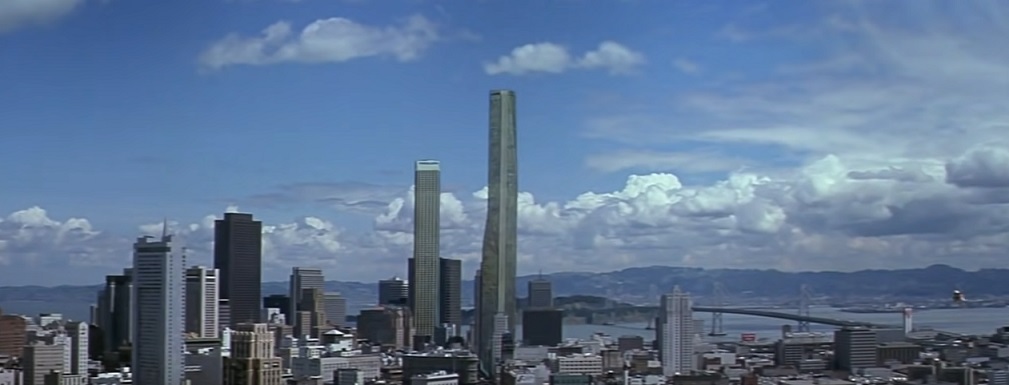
8. The Glass Tower (The Towering Inferno)
Image: 20th Century Fox/Warner Bros.
Why I’d love to live there: The Glass Tower is, in my opinion, one of the most beautiful skyscrapers ever to appear in film. Not only is the gold exterior a beautiful, simple, timeless look, but the interior has a wonderfully charming 70’s decor, right down to the interior elevators. But the big perk is the views: no matter where you live in the tower, you would get breathtaking views of the city, the bay, and the surrounding areas.
Potential drawbacks: Well, there is the itsy, bitsy, tiny fact that the tower catches on fire due to faulty wiring due to cut corners and cost saving measures during construction. And considering that the tower is in San Francisco, your monthly rent would be about 18 trillion dollars. So unless you magically get a free, lifetime lease, you’d have to be quite rich to live there.
7. Mêlée Island (The Secret of Monkey Island)
Image: Lucasfilm Games
Why I’d love to live there: As a night owl, the never-ending nightlife of Melee Island (It’s always 10 PM), is a big plus for me, as is the peaceful town and wilderness to explore: nothing can hurt you here, there are plenty of shops to visit, and the island’s vast forests are beautiful to walk through without fear of wild animals and other threats.
Potential drawbacks: As this is also a pirate town in the 1700’s, you don’t have things like electricity, the internet, movies, or TV shows to keep you occupied on Melee Island, so once you’ve explored and seen everything, there’s not much else to do.
6. Equestria (My Little Pony: Friendship is Magic)
Image: Hasbro
Why I’d love to live there: Who says you have to live somewhere with nothing but humanoids to keep you company? Equestria is a land filled with adorable ponies who are happy to be your friend, and there are plenty of places to live with them, from towns to deserts, palaces and islands, and even floating cities, all but guaranteeing that you’ll find somewhere you like. Plus, Equestria is watched over by a benevolent monarch who has ruled it for over 1,000 years without succumbing to madness or becoming a dictator; if only we were blessed with leaders that good.
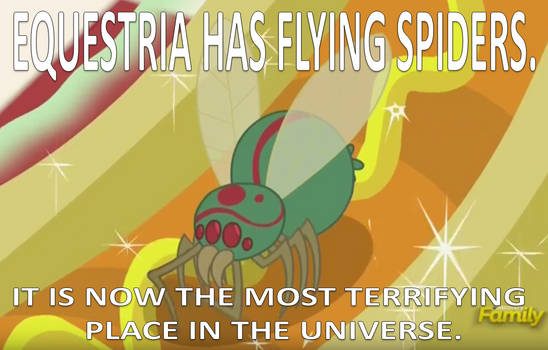
Potential drawbacks: Magic is real in this universe, and while there are beneficial spells, there’s also plenty of harmful and destructive spells that can brainwash you, turn you into other creatures, or kill you. And despite having lots of friendly ponies to live with, there are also lots of unfriendly ponies and monsters who either want to eat you or conquer the world, and have the ability to do so thanks to aforementioned magic. Oh yeah, and there are flying spiders.
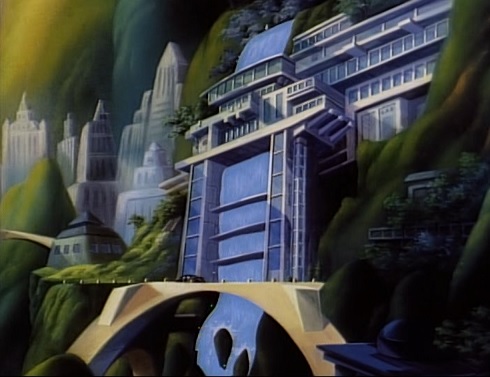
5. Cape Suzette (Talespin)
Image: Disney
Why I’d love to live there: Saturday morning cartoons of my childhood had lots of cool fictional places where adventures took place, but the only one I’d like to live in as an adult would be Cape Suzette from Disney’s Talespin. Set in a fictional 1930’s inhabited by anthropomorphic animals, Suzette is a sequestered, art-deco metropolis nestled in a towering mountain range and a beautiful cove, making it the perfect hub for the adventurous type. But the biggest draw is the apartment of Rebecca Cunningham:
Image: Disney
Even as a little kid, I thought her place was incredible, and as an adult it’s a strong contender for the most beautiful fictional apartment I’ve ever seen. Assuming money wasn’t a problem, this is where I’d love to live!
Potential drawbacks: Aside from being the only human in the city, you’d have to contend with raids by air-pirates, and every trip outside of the city’s boundaries is fraught with danger. There’s also the fact that the city’s de-facto ruler is a ruthless tiger who isn’t afraid to do anything and everything to increase his own wealth and power, so if he decided to ruin your life, there’s a strong chance he could get away with it.
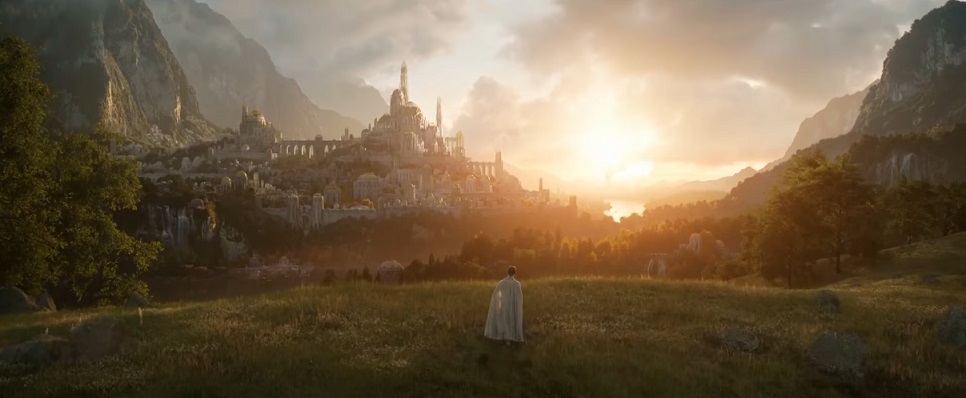
4. Valinor (The Silmarillion/ The Lord of the Rings)
Image: Amazon Studios
Why I’d love to live there: Valinor, the land of Middle-Earth’s gods, is one of the most fascinating places to me in JRR Tolkien’s universe, and the one place I’d love above all others to visit, or, better yet, live in: being free from evil, you could explore all its wonders, from the tallest mountains in existence, to the most majestic trees in creation, and the magical Gardens of Lórien, the most beautiful place in all of Arda. And if you wanted to, you could even visit the Halls of Mandos, the dwelling place of the dead; that sounds fun, right? But one of the most amazing draws would be living amongst elves and the gods themselves, beings who helped shape and create Arda and have seen the creator god – Eru – face to face.
Potential drawbacks: It’s said many times throughout Tolkien’s mythology – and by Tolkien himself – that mortals cannot live in Valinor because their lives would be greatly shortened due to the overwhelming magical power of the island, and they’d die cursing that they alone aged while everything around them seemed to never change. Yet, Frodo, Sam, and Gimili lived there in a state of peace and healing, suggesting that mortals can stay in the blessed realm if they accept death and don’t seek immortality. Thus, any would-be-mortal-resident would have to decide if living among elves, gods, and all their wonders is worth a greatly-reduced lifespan.
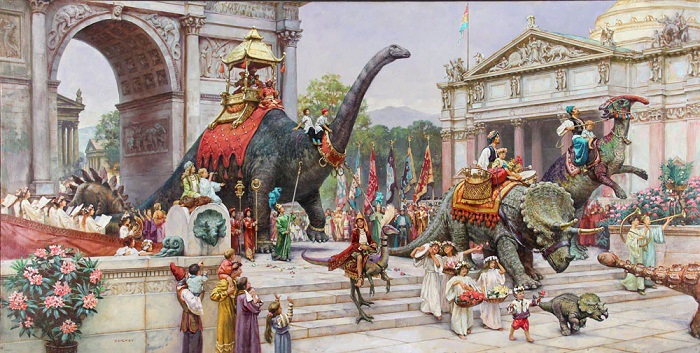
3. Dinotopia (The Dinotopia series by James Gurney)
Image: James Gurney
Why I’d love to live there: IT’S A UTOPIA WHERE HUMANS LIVE SIDE BY SIDE WITH DINOSAURS HOLY S**T THAT IS AWESOME.
Ahem; sorry.
To tone down my inner child, Dinotopia is one of the most wondrous, peaceful, utopian places I’ve ever found in fiction. A place where dinosaurs have survived to the present day and live peacefully with humans in cities, towns, jungles, mountaintop temples, and seaside communities, all brought to life by James Gurney’s beautiful artwork. For children and adults alike, it’s a place so many would love to call home, myself among them.
Potential drawbacks: Encountering carnivores who are not afraid to embrace their more savage side. Thankfully, you have to go out of your way to encounter them, so the threat is minimal, meaning that most of Dinotopia is one of the safer places on this list.
2. The Culture (The Culture series by Iain Banks)
Image created by me using Deviantart’s DreamUp AI image generator
Why I’d love to live there: When it comes to utopias in fiction, The Culture is arguably the one that probably gets closest to making one that you’d actually want to live in: A highly advanced, post-scarcity society where benevolent AI’s keep society running, allowing citizens of the Culture to do literally anything they want, as long as it doesn’t hurt or harm other individuals. With a high value on personal liberty and freedom, as well as technology that allows individuals to live up to 400 years (or even longer), people living in the Culture have it made: You can pursue all your passions, dreams, and hobbies as much as you want without worrying about having to pay the bills. Sweet!
Potential drawbacks: While the Culture does run into occasional problems and even more advanced civilizations dwelling in the cosmos, there really aren’t any hazards or drawbacks its citizens have to worry about; some would say that the Minds (the aforementioned AI’s that keep the Culture running) run a surveillance state, even if it is a completely benevolent one, but when you look at all the benefits the Culture’s technology can offer, and almost unlimited freedom everyone enjoys, the Culture is as close to an earthly heaven as you can get. And speaking of paradise…
1. Heaven
Image created by me with Deviantart’s DreamUp AI image generator
Why I’d love to live there: While we will likely never know for sure if there is continued existence after death (though considering the volume of near death experiences and other otherworldly phenomena reported throughout the centuries, I’m in the ‘there’s probably something after we die’ camp), Heaven, as seen in countless books, movies, TV shows, and video games, would be the absolute perfect place to live: a realm of peace, joy, and bliss, where all your dreams can come true, and where you can live without any of the negative parts of Earthy life, like death, aging, paying the bills, late-stage capitalism that puts the acquisition of money above human well being, etc. Plus, assuming the Supreme Being is benevolent and all-loving, you can chill out with God; who wouldn’t want to do that?! (I’ve always loved how in the book, ‘David Vs. God,’ you can even go surfing with God!)
There are countless versions of Heaven in fiction, but I especially like the version presented in the online webcomic, ‘The Order of the Stick,’: essentially, you get to enjoy every earthly delight you want, and when you’ve had your fill you get to go further up into Paradise to greater and greater joys.
Potential drawbacks: Depending on the rules of which universe you’re in (such as the movie, ‘What Dreams May Come’), the worst part of living in Heaven is the possibility that your loved ones don’t make it in, which would make living there hell. But since stories featuring getting into Heaven at the end tend to be more on the positive side, the odds of that happening are low, and the possibility remains that said loved ones can still eventually get there, even if they have to be rescued/fight their way out of Hell/the Underworld, etc.
Those are my favorite fictional places to live in; what are yours? Tell us your favorite fictional living places in the comments below!
I loved the part where Godzilla said, “It’s nap time!” and took three naps during the movie.
I was so touched when that veterinary guy said, “It’s veterinary time!” and did dental work on Kong.
I also liked the part where the tree said, “It’s tree time!” and totally ate that guy.
I was so touched when Kong said, “It’s dinner time!” and gave mini-Kong some Purina sea serpent chow.
I loved the part where the Iwi said, “…” and stared ominously at everyone.
I cheered when mini-Kong said, “It’s murdrin’ time!” and murdered his fellow homicidal rage-apes with really big rocks.
I especially loved the part where Mothra said, “It’s Mothra time!” and Mothrad’ all over those homicidal rage apes in the crystal kingdom in the center of the Earth while gravity was cancelled due to pouring red liquid inside another liquid which turned some crystals on.
But most of all, I cheered when Kong said, “It’s democracy time!” and brought democracy to all the homicidal rage apes in their lava prison in the center of the Earth after killing the Skar King like Jason did to that girl in the movie where he went to space. At least, I think Kong brought democracy to the rage apes. America!
Truly, this was a movie of all time. 10,000,000 stars out of 10.






 Imperfect Glass