My 30 Favorite Moments From The Jurassic Park Saga

Last year marked the 30th anniversary of Jurassic Park, one of the most important, and influential movies of the 90’s. With stellar performances, a great story, amazing visuals, and a breathtaking musical score, Jurassic Park remains a timeless classic that is as enjoyable and thrilling today. While it would be customary to do a retrospective of the film (albeit, a year late), the recent announcement of an upcoming seventh film gave me the idea to go through the series and list my favorite moments from all six films up to this point.

30. Finding Eric’s Camera

Anyone can relate to parents wanting to save their child from danger, but Jurassic Park 3 has a great scene that emphasizes the fear that the Kirbys have about their missing son. While traveling through Isla Sorna’s jungle, the group finds the parachute that Ben and Eric used for their ill-advised tour, along with Eric’s camera, allowing them to see what happened leading up to the crash. It’s harrowing seeing Eric and Ben’s horror at realizing that they’re going to crash, and moving seeing Amanda clutching Eric’s life preserver, powerless to stop something that already happened.

Then, to make this scene even more harrowing, we get a very effective jump scare of Ben’s decomposing corpse. While the Jurassic series often pushes it’s PG-13 rating, it’s surprising that something this gory made it into the finished film (and inspired a lot of fan theories about what happened to Ben; the current consensus is that he died from internal bleeding due to injuries sustained from the crash and rapidly decomposed in the tropical climate.)

29. Alan!

The Jurassic series has had its ups and downs over the years, and Alan’s dream of a velociraptor talking to him in the third film has been touted as the series’ worst moment. Yet, I’ve always loved it: it’s logical that Alan would have nightmares about what he went through on Isla Nublar, and I love the humor of seeing a dinosaur casually talking to him (complete with its claws holding onto the seat in front of it), and it’s impressive how the filmmakers managed to make the animatronic lip-synch Billy’s voice (its tongue even moves!). It may be a goofy moment, but I like it.

28. Escape From Malta

Leading up to ‘Dominion,’ I had hoped that we would get scenes of dinosaurs running amok in urban areas, but, alas, the Malta sequence is the only part of the film that embraces that idea. Still, it’s not a bad scene, and I especially like the climax, which features Owen racing after Kayla’s plane as it takes off while being pursued by two Atrociraptors. We’ve got a very effective ticking clock (the plane taking off), a dangerous threat (two tireless raptors who can keep pace with a motorcycle), and a clever way of getting rid of them once Owen’s onboard (letting the sliding motorcycle knock the last one out of the plane and into the ocean). Great stuff!

27. To Free or Not To Free

One of the most dramatic moments in any story is the point of no return, a line that, once crossed, is impossible to undo, and ‘Fallen Kingdom’ has a great one: with all the dinosaurs at the Lockwood Estate at risk of being gassed to death, Claire has to choose whether to set them free, or leave them to die. As Owen says, if she pushes the button to free them, there is no turning back. Then, in a subversion, Claire chooses to let them die… only for Maisie to then free them, dooming humanity to having to live with carnivorous dinosaurs running about and eating people, cementing her as the greatest force of evil in the Jurassic universe.

‘Fallen Kingdom’ is admirable for willing to break the saga’s status quo, but this moment is the one that truly separates the ‘Escaping from a dinosaur infested island’ era from ‘Dinosaurs running amok all over the planet’ era in a way that cannot be undone, and the film’s to be commended for having the courage to go through with it.

26. Return to the Visitor’s Center

Over the years, I’ve come to appreciate how Jurassic World does its own thing instead of trying to be a remake of Jurassic Park, a rarity in all the legacy sequels we’ve gotten over the past several years. But there’s a moment where Zach and Grey come across the ruins of the original visitor center from the first film, and what follows is a nostalgia-filled trip back through time as they go through the rotunda, the dining room, and then come across those famous goggles and the very same jeeps that Alan and co. rode in when they first arrived at the island.

While this scene may be fan service, it’s fan service with a point, giving the kids a way to get back to the main park. And as someone who was only seven when the first movie came out, I had a lump in my throat going back to where it all started. World set out to tell its own story, but it didn’t forget what came before, and that it’s okay to visit the past every now and then.

25. The Indominus Rex Breaks Out Of Its Paddock

When introducing a new villain, any story has to give them a big moment to prove how dangerous they are. Jurassic Park had Rexy breaking out of her pen, destroying a car, and eating a lawyer. Jurassic Park 3 had the Spinosaurus tear a plane to shreds and kill a T-Rex, and Jurassic World’s introduction to the Indominus showcases not only its strength and power, but its intelligence: it not only lured people into its pen by making them believe she escaped, but also deliberately waited to eat the security guard, so as to let him realize how he was already dead and couldn’t do anything about it. Even better is that we get to see Owen’s resourcefulness is by having him douse himself with motor oil to make the Indominus find him unappetizing, cementing his status as a smart, no-nonsense guy, and a worthy heir to Alan Grant as a dinosaur expert/action hero.

While this scene does have quite a few lapses in logic, it’s a memorable introduction to the series’ newest apex predator.

24. Claire Escapes The Therizinosaurus

When compared to the first, second, and even third films, the Jurassic World trilogy was light on horror, especially Dominion. But this scene more than makes up for it, where Claire comes face to face with the Therizinosaurus, a truly bizarre dinosaur that looks like the offspring of Freddy Kruger and a demented ostrich. Half-blind and hyper-violent, this plant eater acts like a slasher villain, slowly and methodically walking after Claire as she scrambles to reach safety, knowing full well that if the thing catches up to her, she’s dead. Unfolding without any dialogue, and scored by a haunting drone, this is chilling stuff.

23. Indominus Rex vs Ingen Soldiers

Despite the series as a whole being about the conflict of man vs dinosaur, the Jurassic series has surprisingly few scenes of humans actually fighting dinosaurs. Taking inspiration from ‘Aliens,’ this scene showcases how such an encounter might go, and while things would have gone differently if the soldiers had rocket launchers, high-caliber rifles, and the like, it still shows us just how dangerous the Indominus is; so much so that, after this scene, the goal is no longer to contain the beast, but to evacuate the park before it can kill anyone else.

22. The Raptor Jump Scare

In my opinion, this is the best jump scare in the Jurassic series. By showing Sarah looking outside the shed and not seeing anything, you expect that it’s safe for Kelly to get out of the shed… only for a raptor to nosedive into the hole seconds later. I still remember jumping in my seat when that happened, along with most of the audience!

21. The Ringtone of Doom

I’ve written before how much I love this scene, and it remains Jurassic Park 3’s most clever moment: by having Eric hear the jingle from his dad’s phone, he thinks his parents are nearby, and turns out to be right, leading to the two groups being reunited, only to realize that no one has the satellite phone… at which point it goes off again, revealing that the phone is inside the Spinosaurus’ stomach, and that said beast is patiently watching the reunion.

This is a brilliant moment because at this point the audience has forgotten about the satellite phone and thinks that Paul Kirby still has it, only to realize with the others that he doesn’t. Having the jingle be so cheerful happy and uplifting also creates a funny contrast to the dire situation, making it the icing on a great scene.

20. The Spinosaurus Destroys the Plane

Built up as the new super-predator of the franchise and successor to the T-Rex, the Spinosaurus needed to make a big first impression, and boy did it ever. Not only does it frighten off two battle-hardened mercenaries (and their booking agent), but it survives being rammed by a plane, and then tears the plane apart like it was made out of cardboard, forcing Alan and the others to run for their lives. It’s a great introduction to the power and strength this beast has, and shows the audience that this newcomer is just as fearsome as the rexes who came before it.

19. Retrieving the Bone Sample

One thing I wish the Jurassic series did more often was lean heavily into the horror angle of humans trying to escape dinosaurs, something that primarily happens only in the first film. Fallen Kingdom comes close, though, with an opening scene that’s not only a great way to start the movie, but also is an effective mini-horror film in its own right. Not only is it … *groan* … a dark and stormy night, but the deaths are so unnerving. Not only do we not see the submarine crew’s deaths, leaving the horrifying details to our imagination (according to the junior novelization, the submarine was swallowed, meaning they were going to die screaming in the Mosasaurus‘ stomach), but then the radio operator, who just narrowly avoided being left behind to die, then gets eaten alive by the Mosasaurus, too. These deaths prey on our primal fears of being eaten, and very well to boot.

18. The Dying Apatosaur

For a series focused on dinosaurs attempting to eat humans, and humans trying not to be eaten, there aren’t many moments of the two interacting that doesn’t involve violence. This is one of the more touching moments, if a sad one; as any pet owner can attest, when an animal is hurt, you just want to help it, even if all you can do is just be with it as it dies, as Owen and Claire do, and in the process, Claire realizes that the dinosaurs in the park aren’t just attractions to be used for profit, but living beings, starting her journey from a typical money-focused executive to dinosaur advocate.

17. The Boat Attack

While the actual climax of Jurassic Park 3 is… not as exciting as it should have been, there’s no denying that the boat attack scene beforehand is a great way to wrap things up: having a battle on a boat during a storm at night was a nice chance of scenery from the visitor center of the first film and the San Diego chase in the second. The tension of Alan trying to call Ellie is great, and Paul Kirby gets his chance to shine by risking his life to draw the Spinosaurus away from everyone else, letting Grant drive it away via a flare gun, nicely echoing how he distracted Rexy with a flare in the first film. The whole scene is arguably ‘3’s best scene, and a good way to wrap things up and send the Spinosaurus off in style.

16. Nighttime Visitor in San Diego

Like so many others, I had high hopes that Dominion would have dinosaurs roaming through forests, parks, and neighborhoods, where panicked ordinary people would fight to survive against prehistoric predators. What I didn’t know is that the the scene of the Bull T-Rex wandering through a neighborhood at night was the best we were ever going to get.

There’s something so eerie about seeing this enormous dinosaur walking through the empty, silent streets, and it’s easy to imagine the terror of someone going out for a late-night walk, only to come face to face with this thing and not knowing what to do. And then we get to see an ordinary family dealing with a dinosaur in their backyard with shock, disbelief, and screams of terror.

While the Rex’s subsequent rampage through the streets of San Diego is fantastic, I prefer this scene for its more intimate, quiet, and intense atmosphere, and how it serves as a bittersweet reminder of what Dominion could have been.

15. The Death of the Brachiosaurus

If you want to get the tear ducts flowing in a story, kill off a beloved animal. Nowhere is that more true than this, the saddest scene in the entire Jurassic series, and the only time I almost cried. After the exhilaration of seeing Claire, Owen, and Franklin managing to escape Nublar before it’s engulfed in lava, we’re suddenly hit with seeing a Brachiosaurus arriving at the docks just a minute too late. What makes it worse is that she clearly knows that humans are friendly, and all but begs for them to come back and save her before she’s engulfed in smoke and fire. And to twist the knife in as deeply as possible, ‘Kingdom’s director, J.A. Boynetta, confirmed that this is the exact same Brachiosaurus Alan, Ellie, and Ian saw when they arrived on the island in 1993. She was the first dinosaur we ever saw, and now she’s the last one we see as Isla Nublar is destroyed. She was there for the beginning of Jurassic Park, and the was there for its end, in the saddest possible way

14. Jurassic Park’s Ending

After all the action, the horror, and the struggle to survive, Jurassic Park ends not with a bang, but with a quiet, thoughtful scene of everyone in the helicopter as it flies away to safety. Not a word is spoken, yet so much is said: Hammond reflects on the death of his dream, Alan realizes that he doesn’t dislike kids anymore, and then, looking out on the pelicans outside the helicopter, the film reminds us that, even though dinosaurs don’t belong in our world, their descendants live on, all backed by a wonderfully quiet, almost lullaby-like piece of music by John Williams, and a flight into the sunset. A perfect ending to a near perfect film.

13. Alan, Ellie, and Ian Reunite

In a movie filled to the brim with dinosaurs, it’s surprising to me how one of my favorite scenes in Dominion is when Ian, Alan, and Ellie reunite for the first time in almost thirty years. As a kid who fell in love with the original movie back in the day, seeing these three again is like reuniting with friends you haven’t seen for decades, and discovering that they still get along well and are as charismatic and charming as ever. And it’s amazing to think that this, to my knowledge, the ONLY time in a theatrically released legacy sequel where all of the original protagonists come back, are played by the same actors, and share the screen at the same time, something that the Matrix, Indiana Jones, and even Star Wars series couldn’t pull off.

12. Hammond Realizes that his Dream is Dead

Jurassic Park is full of scenes that you don’t care about when you’re a kid, but that hit much harder when you’re an adult. Remembering Petticoat lane is one of them, and arguably hits the hardest, as it’s Hammond’s turning point in the story. Here, he explains why he made Jurassic Park in the first place, and in the process shows who he really is as a person: Someone who isn’t interested in money, but a dream, and who still believes it can work despite everything that’s happened. But then Ellie points out that despite all the technological marvels at John’s command, the park has still failed and people are dying as a result. The resulting silence from John – done so beautifully by Richard Attenborough – sells that no matter how badly he doesn’t want to believe it, he realizes that Ellie is right: his dream isn’t going to work, and people are dying because of his mistakes. This is the moment that John’s dream truly dies… and he turns away from trying to save it, and focuses only on saving as many lives as he can.

This is, in my opinion, one of the most moving scenes in the entire series, and one of its best character moments, all set to a beautifully bittersweet lullaby courtesy of John Williams.

11. Hammond’s Dream Comes True

What if Jurassic Park was a success? It’s an idea that fans tossed about for years after the first movie was released, and World lets us see exactly how it would turn out, and it’s a blast! Seeing the park fully operational, the visitor’s center being open, the getting a brief glimpse of Rexy eating a goat, kids playing with baby dinosaurs, and above all, showing everyone having a wonderful time is a heartwarming way to show that John Hammond’s dream did come true, and it was everyone he could have hoped it to be… even if it’s not going to last.

10. Roland Tembo vs the Bull

Though it takes a while for him to appear, Roland Tembo establishes in his very first scene that he’s a no-nonsense, experienced hunter who has faced the most dangerous beasts nature has to offer. But it isn’t until late in The Lost World that Tembo truly demonstrates that experience with the bull T-Rex. Alone, and wielding only a tranquilizer gun, he demonstrates how he has nerves of titanium as he shoots the bull, then calmly backs away while reloading as a very pissed off dinosaur starts after him. If I was going onto a dinosaur-infested island and had to choose only one person to take with me, Tembo would be my man.

9. Hearing the T-Rexes roar

As an 11 year old kid, I was the perfect age to go see The Lost World in theaters, which I did with my friends after celebrating my 11th birthday (complete with Lost World-themed paper plates, cups, and the like), and the one thing I was looking forward to most was seeing the T-rex again. And just like the first film, The Lost World takes its time before revealing the island’s apex predator, letting us stew in anticipation. And then this happens:

I remember freezing up when I heard that roar in theaters and realizing that my favorite dinosaurs were about to show up. As an adult, I still love this scene, and consider it the best ‘oh shit’ moment in the series: we know the T-rexes are coming, and they’re pissed.

8. Attack on the Trailers

Matching the intensity of Rexy’s attack on the cruisers in the first film was always going to be a tall order, but The Lost World lives up to it with two Tyrannosaurs attacking Ian and Co’s (very cool) trailer. But the Rexes aren’t attacking with the mindless determination of animals wanting food: the Rexes are attacking the trailers as payback for Ian and his companions seemingly kidnapping their child. The dinosaurs effortlessly overturn the back half and then shove the trailers off a cliff, showing how even humanity’s most advanced machines and vehicles are no match for the destructive might of two of nature’s most terrifying predators. Then, after Eddy’s heroic efforts to save his friends, they come back and kill him in the goriest death in the series, capping off one of the most intense and nail-biting scenes in the franchise.

7. Hammond Says Goodbye to Jurassic Park

As a kid, you love Jurassic Park for the dinosaurs. When you’re an adult, you still love the dinosaurs, but you also learn to love the human characters and their journeys, and none of them have a stronger journey than Hammond. He starts out as a cheerful, good-natured, and naive businessman before realizing that his dream was never going to work, and that people have died because of it. While he’s wise enough to accept this and work to save as many lives as he can, the end of Hammond’s journey is, for me, the saddest moment in the film, and the series as a whole: On the precipice of being evacuated to safety, John stops to look back at the park he’s spent so many years creating. And like his realization that it wasn’t going to work after talking with Ellie, Richard Attenborough conveys Hammond’s regret, heartache, and grief without a single word, all backed up by John William’s beautifully bittersweet music, and the quiet call of the Brachiosaurus. It’s so wonderfully, beautifully heartbreaking.

6. The Philosophical Discussions about the Park

Much has been written over the years about the World trilogy’s attempt to engage in philosophical discussions about the ethics of breeding dinosaurs and playing god, but those efforts were doomed to fail. Why? Because the first film has the best philosophical debate about those issues. Up to this point, everyone is still in awe at what they’re seeing at Isla Nublar, yet there are hints everywhere that not everything is as perfect as it appears: from Grant and Co. escaping from the science ride, to Ian pointing out that life cannot be controlled, and how the raptors are more intelligent than they should be. Then comes lunch, where Hammond’s endless enthusiasm and eagerness to open a park full of dinosaurs for people everywhere to enjoy, runs into its first real test as Ian, Ellie, and Grant make excellent points that maybe this isn’t such a great idea, and that it might not have been better to do it in the first place… and with the benefit of hindsight, we see how all of them are right.

One other reason I like this scene so much when watching it with adult eyes is Hammond telling Gennaro that everyone in the world has the right to enjoy seeing the dinosaurs. This solidifies that he is not a greedy man who only wants money, but to really share something wonderful with others. If only we had more entrepreneurs and CEO’s like that in both fiction and real life.

5. Two Generations Against the Giganotosaurus

One of the biggest draws of Dominion, was seeing two generations of Jurassic survivors meeting each other, and it lives up to the hype. And unlike so many other ‘two generations meet’ scenes in other legacy sequels, there’s no competition or competing with each other: Both the Park and World generations get along just fine, and their first scene after meeting each other for the first time is to team up to survive being stalked by the Giganotosaurus. Everyone gets a moment to shine, from Owen and Claire getting into hand-to-claw combat with the Giga, to Alan pulling Ian to safety, and Ian facing the beast head-on to buy the others time to break into the outpost. Dominion may not be that great of a film, but this scene is so much fun.

4. Rexy’s Breakout

From the moment Hammond gleefully tells Alan and Ellie that Jurassic Park has a T-rex, the audience is left waiting for it’s appearance; if a Brachiosaurus is brought back to life so beautifully on screen, how will the T-rex be handled? We have to wait for that moment to arrive, but the buildup is never frustrating or annoying, and the closer we get to the rex’s appearance, the more excited we become. And then, when we finally see the poor goat, we know the moment’s here, and the film doesn’t disappoint: if the introduction of the Brachiosaurus inspired awe and wonder, than Rexy (the name given to the Rex by the fandom at large) inspires terror and fear at seeing one of the most powerful animals to ever live walking the earth. And her attack on the cruisers is a masterpiece of tight editing, outstanding sound effects, phenomenal CGI, and a complete lack of music, showing us what would would really happen if humans came face to face with such a dangerous animal.

Even now, over thirty years after it was released, the scene is as powerful now as it was then; Rexy’s breakout is the scariest scene in the franchise, one of the greatest film scenes of the 90’s, and arguably one of the greatest dinosaur scenes ever put to film.

3. Rexy vs the Giga

As the climax and supposed end to the Jurassic saga, Dominion needed to go big for its climax, and it doesn’t disappoint, featuring a showdown between Rexy and the Giga in Biosyn’s courtyard surrounded by a forest fire, while the two generations of survivors try to escape and get to safety.

While this finale is similar to the climax of World, we have the added bonus of seeing Alan, Ellie, and Ian in action once again (love that shot of the three of them standing before the Giga), and what’s at stake: If they all fail to escape with Dr. Wu, any hope of stopping the locusts are lost, which means that they will eat the world’s wheat, leading to mass starvation across the globe. But they make it, the Giga is defeated, and Rexy, having fought her last battle, is allowed to finally retire and live out her days in peace in the Biosyn sanctuary. Yes, there are some issues with the scene (the camera work isn’t the best), the Spinosaurus doesn’t show up like many fans wanted it to, and the Giga doesn’t deserve the death it gets, but gosh dangit, I’m a sucker for dinosaur vs. dinosaur fights, and seeing Jurassic’s longest-lasting dinosaur, three of its best characters, and the spectacular arena all at once still makes this a fun scene.

Plus, as an added bonus, the film solidifies that while Rexy may be old (at this point in the films she’s 34, where the oldest known T-Rex in real life was 30), she can still win fights against younger, stronger opponents by using her wits and cleverness instead of brute strength and speed.

2. Rexy vs the Indominus Rex

When we’re kids, we all have our favorite characters from books and movies, and one of the greatest pleasures in life is having those same characters come back when we’re adults and be as awesome as they ever were. Jurassic World has one such moment near the climax, where Claire has run out of options to stop the Indominus Rex: soldiers didn’t work; a helicopter assault didn’t work. Trained velociraptors didn’t work, and now she has only one, final, desperate option… releasing Jurassic World’s T-Rex. And this isn’t some random T-Rex; this is Rexy, the same T-Rex from the first film, coming back after 22 years to save the day once again.

There are scarier moments in the Jurassic series, more majestic moments, and more moving moments. But none of them are as fun as this; The last time I had seen Rexy, I had been in grade school. Since then, I had gone through grade school, high school, and graduated from college, and as I watched her emerge from the darkness of her paddock to the shouts and cheers of the audience – mine included – all those years just melted away, and for four glorious minutes I was seven years old again, watching my favorite childhood dinosaur saving the day once more, and it. Was. AWESOME.

But what could top this, the most awesome moment of the series? Easy…

1. Welcome to Jurassic Park

29 years. Six movies. Countless video games, and one animated series has produced so many incredible moments in the Jurassic Park franchise, but no scene is as famous, iconic, and above all, awe-inspiring as the moment that started it all… the moment we finally see a dinosaur.

For the very first time, we had a photo-realistic, computer-generated animal on screen, and it is completely believable. Not only is the visual effects, music, and acting of this scene great, but it has something more important: the all-consuming awe of seeing something impossibly beautiful, to the point where even Ian, the cynical nihilist, can’t help but smile in wonder, all building to a crescendo when Alan, Ellie, and John see dinosaurs roaming the Earth for the first tine in 66 million years.

Every sequel in the series since has tried to re-capture the awe and wonder of seeing dinosaurs, but nothing can top this, my favorite scene of the Jurassic saga, one of the greatest movie moments of the 90’s, and one of the most famous in cinema history.

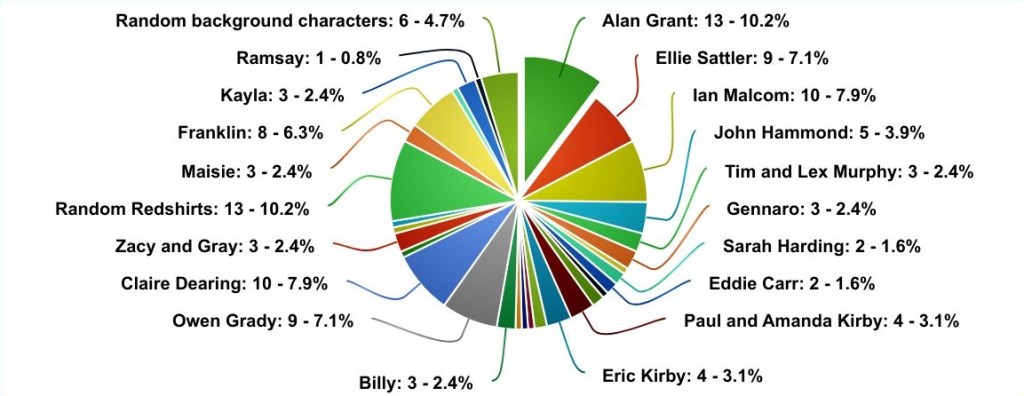
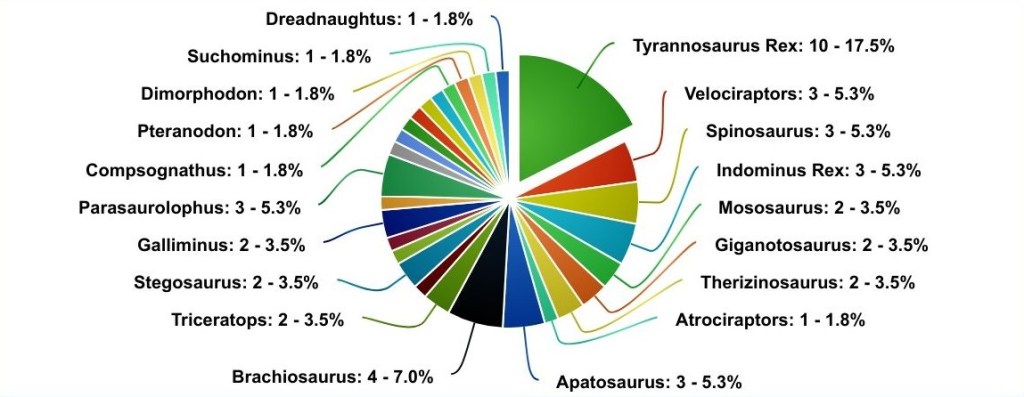
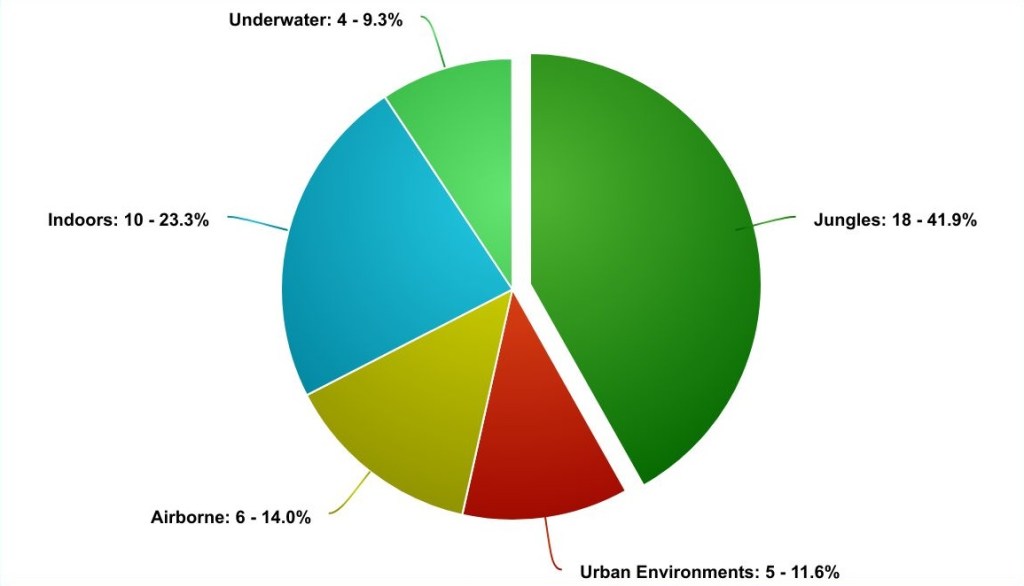
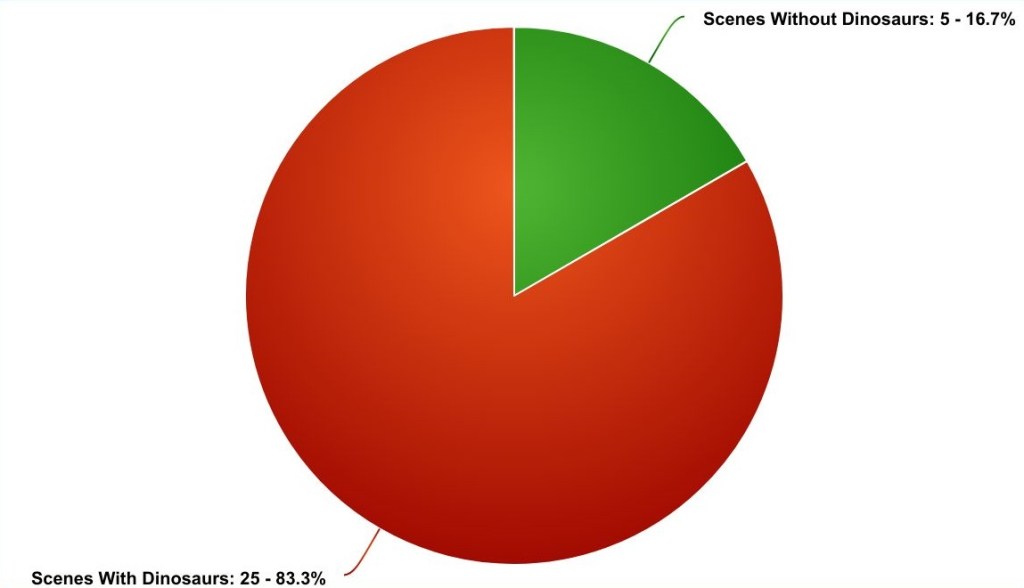
For extra fun, here’s a breakdown of all the characters, dinosaurs, locations, and vehicles featured in the list:

Films with the Most Moments:

Characters Who Appear the Most:
Dinosaurs Who Appear The Most:
Movie Environments that Show Up the Most:
Vehicles That Show Up the Most:

The Type of Weather In the Scenes:

The Time of Day in the Scenes:

Comparison of Scenes That Have Dinosaurs vs No Dinosaurs:
Thus, if I were to take the data from these graphs, plug it into an AI script generator, it would probably come out with a story like this:

Alan Grant, Ian Malcom, and Claire Dearing – along with a group of expendable mercenaries – journey into the jungles of Jurassic Park between the events of the first and second film with a fleet of planes carrying a lot of jeeps. While on the island, they have to endure repeated attacks by Brachiosaurs, Apatosaurs, and Parasaurolophus’ as they are stressed out by rampaging Tyrannosaurs, Spinosaurs, and velociraptors. Eventually, the island is engulfed in fire, and Alan, Ian, and Claire escape in a helicopter and decide that it really isn’t worth it to keep coming back to islands filled with dinosaurs.

Let’s Speculate About The Next Jurassic World Film

Well… That didn’t last long.

For those of you who didn’t follow ‘Jurassic World: Dominion,’ it was set up as the grand finale to the Jurassic Park/World franchise. It was the end of an era, the conclusion of a storyline that had gone on for almost 30 years. It was a big moment, and a chance for Universal to wrap everything, end the story of how man should have made an island filled with cloned condors instead of prehistoric meat-eaters, and let everyone walk into the sunset… and then we got a movie about a cloned girl and some really hungry bugs.

Needless to say, I was… not very happy about that.

Of course, the ‘Jurassic’ series wasn’t going to stay dead and gone, not when each film continuously raked in that sweet, sweet box office money. Yesterday, word broke that, yes, the franchise will continue with a new movie, and screenwriter of the first two films David Koepp is coming back to write the script (which is apparently so far along that the movie could be filmed and out next year). While reports are flip-flopping between if this is a complete reboot of the series, or a continuation from ‘Dominion,’ all of them say that Chris Pratt and other ‘World’ trilogy characters aren’t coming back, and neither are the trio from the original film (which is a shame; their chemistry and charisma were one of ‘Dominion’s highlights). Either way, this new film is apparently intended as a fresh start. But what’s that start going to look like?

My track record of trying to guess the story of upcoming blockbusters is… not good at all, but hey, why not give it another try?

So, what do we know about the next film? Aside from it not having any returning characters… well, nothing. But I think one thing the film won’t do is try to up the stakes: Before it came out, many – including myself – thought that ‘Dominion’ would focus on if dinosaurs or humans were going to end up having dominion over the planet. It… didn’t, but to be fair, a world-wide famine that could lead to the end of civilization as we know it is a pretty big threat. So where do you go from such a big threat, storywise? Two options come to mind:

1. Up the stakes and have the world be at risk again from an even bigger threat.

2. Go for a smaller-scale, self-contained story

Personally, I think option 2 is the smarter choice, as going smaller and more intimate would work better than a globe-trotting adventure is a way for audiences to take a break and recuperate from world-ending stories. And even better, we already have two examples of this formula at work: ‘Battle at Big Rock’ and the prologue to ‘Dominion’

Both shorts work beautifully as stand-alone mini adventures that only require a basic knowledge of other films in the series. The smaller scope lets the story and the viewer focus more on the characters and their journeys instead of a cast of dozens with CGI action scenes every few minutes. That, I think, is the smart path for Jurassic 5 to take… but there’s one path in particular that would satisfy long-time fans of the series like myself, and those who want a clean break. What’s this path? Well, it involves two old friends who haven’t been seen for years: Tim and Lex Murphy.

Imagine the scene: It’s a few years after the events of ‘Dominion’ and dinosaurs continue to spread across the Earth. Tim and Lex are now all grown up with families of their own, and one weekend they all meet up at a remote camp for a family reunion where they catch up and have some fun together. But wouldn’t you know it, those pesky dinosaurs decide to ruin everything, trapping Tim, Lex, and their families at this remote location. Now, far from help and without any weapons that can kill the dinosaurs, Tim and Lex have to once again face the creatures that almost killed them as children in order to save their own children, using only their wits and quick-thinking against prehistoric predators who want them for dinner.

I think this is the perfect path for the ‘Jurassic’ saga to go: You get a small-scale story that has a minimal connection to what has come before (allowing for a soft reboot) while also bringing back two fan-favorite characters to once again run away from dinosaurs, and revisit the sci-fi horror atmosphere of the first film. If Universal can do something those lines, it can be a satisfying palette cleanser to wash away all those hungry bugs and help the series go in a good direction… or Universal could take inspiration from Jason Vorhees, and send the dinosaurs to outer space. That’d probably doom the series for good, but it’d be pretty awesome, too.

Why Haven’t All The Dinosaurs Been Killed Yet?: The Logistics Of A Cool – But Implausible – Inter-Species Conflict

A few weeks ago, I watched ‘Jurassic World: Battle at Big Rock,’ a short film that gives us a glimpse at how humans and dinosaurs are interacting in the wake of ‘Jurassic World: Fallen Kingdom’s ending.

Having been given a taste of what the third Jurassic World film might be like, I tried to imagine how things could get worse from this point out. Currently there are five concrete facts known about ‘Jurassic World 3’s story:

1. Claire, Owen, and Maisie will be back.

2. Alan Grant, Ellie Sattler, and Ian Malcom are coming back as well.

3. The story will take place around the globe.

4. Dinosaurs being created, sold, and spread around the world.

5. It will not be about a world war between dinosaurs and humans.

Despite the last fact being confirmed, I’m guessing that there will still be a major conflict between humans and dinosaurs, and an inevitable battle to see which species will have the privilege of survival. There is, however, one huge problem with this plot: At the end of ‘Fallen Kingdom,’ approximately 67 dinosaurs escaped into the wild. ‘Battle at Big Rock’ tells us that:

*The dinosaurs have been in the wild for a year.

*Their presence is known to the public at large.

*People are willing to go camping with their families when giant carnivores are running around (?!).

With that in mind, there’s one important question that must be answered: Why haven’t the dinosaurs been killed yet? From a public safety standpoint, these dinosaurs are an invasive species and a massive menace to public health. It’s only logical that authorities would want to take these creatures out as quickly as possible to ensure public safety. But why haven’t they? Five possibilities come to mind:

1. Authorities have not gone after the dinosaurs.

2. Authorities are hunting them down, but are having a difficult time locating them.

3. The dinosaurs have been tagged and are allowed to roam free within a limited area.

4. Shady individuals are bribing/threatening government officials to let the dinosaurs run free.

5. The public wants the dinosaurs to run free.

The first option is highly unlikely: whenever a bear or other dangerous animal is loose near communities, it’s quickly hunted down. If there was, say, an allosaurus or a tyrannosaurus rex stomping around a national park or suburban community, they’d be hunted down as quickly as possible, and if the authorities were slow to do so, then mobs of armed civilians would take up the task, not wanting their children or loved ones to become Purina Dinosaur Chow.

The second option is more reasonable, but still unlikely. We have technology and weapons that not only allow us to kill any dinosaur we come across, but to also track them down; finding the heat signature of a T-Rex or Triceratops with infrared cameras on a helicopter would be a relatively simple matter (though it’d be more difficult to track smaller dinosaurs, like the compies, and finding that mosasaur and the pteradactals would be neigh-impossible considering they could be swimming and flying anywhere on Earth), and military-grade weapons would make short work of even the thickest dinosaur hide. An ankylosaurus might be among the most heavily armored dinosaurs, but I doubt it would survive a rocket to the face.

The third option is the most likely, but is not without its flaws: as noted earlier, dinosaurs are an invasive species, and while a plant eater might be allowed to walk about freely with a tracking beacon, a house-sized carnivore who needs to eat hundreds of pounds of meat a day would still be a massive public safety hazard, and would be tracked down as quickly as possible and shot.

The fourth option, as silly as it sounds, could be at play in some areas: In this day and age, corruption runs rampant in governments, and the thought of shady companies/organizations who want the dinosaurs to survive for whatever reason would deploy threats or bribes to force various officials to look the other way. The problem with this, though, is that the inevitable public backlash against prehistoric carnivores running free would eventually become too great for even bribed officials to ignore; history shows that, when the public demands something for long enough, and loudly enough, governments eventually cave, no matter how corrupt they are.

The fifth and final option has people wanting the dinosaurs to roam wild and free and sing songs in the sun all day long… which means it’s probably environmentalists, hippies, and children who would take this option. But the problem is that they’re likely to be a minority, with the majority of people wanting their families and children to stay safe from murdersauruses running about in the woods.

With all that said, which option is the most likely one? While we’ll have to wait until 2021 to find out, I’m guessing the answer is a mix of 3 and 4 with a sprinkle of 5 thrown in: The authorities are going after the dinosaurs, but because of public affection for the beasts, authorities have decided to tag and track the herbivores, allowing them to roam free while warning the public that they may encounter said beasts in the wild. But while the authorities go after carnivores, the beasts somehow manage to escape capture, thanks to people who want them to be free, such as Eco-terrorists who work to remove tracking chips, or threaten people who try to tag said carnivores.

Of course, this is all speculation. I could be wrong on all of these, or may have just correctly guessed how things are going in the ‘Jurassic’ universe. But this scenario does provide a valuable lesson for writers of speculative fiction where unusual animals are released into the present day: There needs to be a very good reason why they aren’t wiped out quickly by humanity and our drones, guns, helicopters, tanks, and the like. Perhaps the animals are shapeshifters, or perhaps they reproduce at an astonishing rate, or have hides that are almost impervious to our weaponry. Simply having them run free without a good explanation of how they survive won’t work in our modern era; going back to the 6osih dinosaurs now roaming the wild, we have to contend that they face 7 and a half billion people, billions of guns, and every military on earth. To survive, each dinosaur – including the compies – must kill approximately 124,758,064 people to win the inevitable dinosaur war. Coupled with the fact that we have helicopters, heat-seeking missiles, high-caliber weapons, and an unmatched talent for wiping out entire species when we put our hearts and minds to it, the logical outcome of such a war is that the dinosaurs are slaughtered within a week or two, with only the compies surviving and thriving due to their small size, speed, ability to hide almost anywhere, and (presumably) fast reproduction speed.

The bottom line? Before we release animals into the wider world in our stories, it’s always a good idea to sit down, take a few minutes, and figure why they’re not blown to kingdom come by the most bloodthirsty species on the planet – us.

Favorite Moments: Jurassic World Battle Royale

We all have our favorite moments in movies, books, and games, moments that stay with us long after the story is over. This column is my attempt to examine my favorite moments and see why they stick with me.

***

The Video

Why it’s great

Here’s an interesting mental exercise to try when you’ve finished your next book or screenplay: If all the characters in your story were put into an enclosed area and forced to fight to the death, who would win?

That’s the premise behind this video, which features every dinosaur in the game, ‘Jurassic World Evolution’ (up to that point) released into a single, large enclosure to fight for survival, and see who would come out on top. As you might imagine, it’s… well, it gets pretty chaotic as herbivores and carnivores duke it out to see who wins the privilege of being the last one standing, to have the privilege of being lord of all they survey, to stand tall on Isla Nublar and bellow forth their call of triumph as they’re pelted with popcorn by gawking tourists for the rest of their lives.

While I’ve always found massive free-for all battles fascinating, it wasn’t until this video that I realized why: The fewer contestants there are, the higher the drama gets, and if one of your favorite characters is among the last few standing, you’ll hope against hope that they’ll survive (I was rooting for the Spinosaurus and the T-rex), even though fortunes can turn in an instant, and death is only one mistake away.

What we can learn from ‘The Last Sharknado: It’s About Time!’

METADATA-START

45 weeks ago, we took a look at ‘Sharknado 5: Global Swarming’, and now, at long last, it’s time to take a look at the final film in the venerable series: ‘The Last Sharknado: It’s About Time!’

After five long years of sharknados taking out cites, going into space, becoming radioactive, and destroying the world, the series finally comes to an end with ‘The Last Sharknado: It’s About Time!’ which, having exhausted all other possibilities, sends the title monster back through time (the only other sensible option would have it going to the afterlife), with surfer-rurned-barternder-turned-sharknado killer Fin Shepard on a journey to stop the sharknados for good. Let’s journey along to see what valuable story lessons we can learn by watching sharks terrorize people throughout history.

Avoid abandoning a greater-scope villain after establishing them

In the previous film, ‘Global Swarming,’ we learned that the sharknados were not just a freak of nature, but were created by a malevolent shark god that Fin and friends (I never get tired of writing that) set out to stop. While they did stop the sharknados at the end of the fifth film (at the cost of every other human alive), it’s odd that the shark god isn’t mentioned in ‘It’s About Time’.

When we introduce a supernatural threat – or any threat so big that it effectively becomes the main antagonist for a franchise – it’s imperative not to have that threat dropped so quickly, especially when it’s a supernatural one. It’s logical to think that Fin would have to take out the shark god to prevent any further sharknados from being made, but its nowhere to be found. If our own greater-scope villains need to be dropped, a good reason needs to be established instead of never mentioning them again, hoping that audiences won’t notice. They will.

Establish solid rules for time travel, lest audiences get hopelessly confused

While traveling through time offers nearly endless possibilities for exciting storytelling, it can quickly become a mess of intersecting timelines, cause and effect, and how actions in the past affect the future (and that’s without getting into the grandfather paradox). ‘It’s About Time’ tries to make things simple by stating that everyone can only travel back in time once, but then it has Gil continuously going through different eras. When it comes to time travel, it’s best to make things as simple as possible. Better to have our audiences focus on the fun shenanigans going on, then wondering how such things are possible.

When doing time travel, consider bringing back minor characters for big roles

One of the things that ‘It’s About Time’ does best is bringing back minor characters for bigger roles in the story, like Bryan and Skye. While they may have served as cannon fodder in their original appearances, or had a small role that didn’t affect the story all that much, we don’t expect much from them. They’re background characters, ones who don’t take the spotlight. Thus, when they come back as main characters, they become underdogs who have a chance to shine and help save the day. Even better is if they’re in a completely new time and location (like the prehistoric era), as not only do they have to contend with being in the spotlight, but now they also have to try and survive in an environment they’re not familiar with.

Consider having monsters and antagonists from the future battle people from the past

One of the most enjoyable aspects of time travel stories is seeing people and technologies from different eras interact with one another. How, for example, would a modern-day person fare in the Revolutionary War era? Or in Ancient Egypt? How do technologically disadvantaged people fight off opponents from a different era? ‘It’s About Time’ has medieval knights, Revolutionary War soldiers, and Cowboys fight off sharks, and those battles are easily the highlights of the movie.

The reason these fights are so interesting is that the people of the past are automatically the underdog and have to fight harder to win. Cowboys have the advantage of guns when fighting sharks, but revolutionary war soldiers only have muskets, while knights are stuck with swords and bows, which makes audiences wonder how on earth they’re going to win. An even cleverer version of this trope is to have the people of the past take advantage of futuristic tech: When sharknados attack Revolutionary America, the British use a sharknado to gain an advantage in their war, almost changing the course of history in their favor.

When writing historical characters in time travel stories, the more authentic they are, the funnier they are

Another draw of time travel stories is being able to use famous people throughout history and put them in exciting fights and teamups with monsters and people from other times in history. Part of this draw is seeing how someone from one era coping with another, and how they would react to, say, modern weapons and technology. However, for this trope to be most useful, it’s important to make historical characters as accurate as possible; much of the humor/awesome factor in their appearances is that they take things seriously. While comedic or light-hearted time travel stories can make famous people goofballs (Think ‘Bill and Ted’), it is possible to go too far: When Finn and his friends go to the Revolutionary War era, I was excited at the thought of seeing George Washington fighting a sharknado. Instead, we get a man who’s more interested in taking a nap and cracking jokes instead of fighting or taking the situation seriously.

Consider having someone alter history in a time travel story, even when they know it’ll hurt them

While ‘It’s About Time’ engages in all the standard time-travel tropes (meeting famous figures, having historical characters and groups fight monsters from other eras, etc.) and get into debates about changing the future to avert a personal catastrophe (Nova trying to save his grandfather), the film smartly changes things up by giving Finn an impossible choice: He has a chance to stop sharknados forever by traveling through time, but at the cost of losing his son, who will never be born, and even be erased from Finn’s memory.

So often, time travel stories are about changing the future for the better, or preserving it, but rarely do we see stories where travelers doing the right thing know they will suffer greatly, even if its for the greater good. By having our characters lose something important to them, whether it’s a loved one, a job, or a dream, and being willing to let them go to save so many others, we give them an unparalleled chance to shine and show how brave and heroic they can be.

If it fits the theme of a series, there’s nothing wrong with a happy ending

It’s a classic trope: The characters of a story manage to succeed in their fight. They achieve their goals, get what they want, and live happily ever after. It’s so overused that it’s a scenario that could easily turn into a parody, and many stories try to subvert it by using a darker, or more bittersweet ending where not everything is right or well. But there’s nothing wrong with a happy ending, especially if it’s well-earned, and the end of the Sharknado series has a very well-earned one indeed: Fin manages to restart history and create a timeline where sharknados don’t exist, saving all his friends and acquaintances, and even Gil, with the very last shot of the series has Al Roker declaring that it’s going to be a beautiful day with nothing unusual going on. It’s a satisfying conclusion that ties everything up, and gives everyone a happy ending without any tease or hint of further adventures, giving the characters – and us – closure.

And so, after a year, we finally finish our marathon of all the Sharknado films. Turn in next week, when we’ll do an analysis of the series as a whole.

What we can learn from: ‘Wizards of the Lost Kingdom 2’

Wizardsofthelostkingdom2cover

Two weeks ago, we took a look at the 80’s fantasy film, ‘Wizards of the Lost Kingdom,’ a flawed film that had a lot to teach writers on approaching fantasy tropes. When I saw that a sequel had been made, I was curious to see if it had learned from the mistakes of its predecessor, and after watching I can say that while the end result is… well, while not a classic film, or a well-made one (it features the most obvious rubber snakes in film history), it is an improvement, if only a little. I was especially pleased to see that ‘Wizards 2’ corrects the lack of a focused plot: instead of a vague goal and random events, our protagonists here have a clear, achievable goal from the beginning and a general knowledge of what they’ll face. As a whole, ‘Wizards 2’ is better than the first, including a few genuinely clever ideas, but you’ll probably get the most entertainment out of watching it on ‘Mystery Science Theater 3000.’

Now, strap on your sword, and let’s return to the world of Argentian sword-and-magic epics to see what we can learn from the last tale set in the world of Axeholme.

Avoid doing a follow up that invalidates everything your heroes did the last time around

In most stories, victories, triumphs, and success are hard-won, bought with sweat, blood, and tears. Heroes fight, struggle, and strain to achieve their goals… which makes it especially cruel when a sequel invalidates everything they achieved. ‘Wizards 2’ (which has no characters or locations from the first film) starts with the kingdom getting into yet another war, and killing everyone from the first film.

In our own stories, doing a ‘all of it was for nothing’ sequel isn’t the wisest course of action if we want to keep fans satisfied; if a sequel makes the first pointless, who’s to say a second sequel will do the same to the first? It also retroactively harms the previous story, making rewatches or re-reads feel futile, as we know that everything we’re seeing the protagonists do will be for naught.

Consider having a grade Z mentor for your hero

In fiction, having wise, knowledgeable mentors is a standard story trope, both for helping guide the hero on the journey, and for explaining to the audience how the world and its various traits (such as magic) work. One thing ‘Wizards 2’ does well is invert that by having Caedmon – Tyor’s mentor – be not very wise, or even powerful. He’s a discount Obi-Wan who initially doesn’t even want to help Tyor due to feeling inadequate and not up to the task, but still takes up the mantle, even if his magic isn’t all that great (like turning straw into dung instead of gold).

In our own stories, having a mentor be a less-than-ideal candidate adds a unique spin on the typical student and master relationship, in that both don’t really know what they’re doing, and both have to learn and grow during the course of the story.

Consider not dumbing down your bad guys because they’re in a family movie

We’ve seen it so many times: Whenever the Chosen One (inevitably a young boy or girl) comes across an evil lord or a minion of the evil lord, said villains never just try to kill the child, instead gloating, mocking, and all but allowing themselves to be inevitably defeating in an embarrassing way (bonus points if they yell “This cannot be!” in the process). ‘Wizards 2’ is no exception, as the evil sorcerers Tyor faces are… well, either defeated too easily (Loki), give up too easily (Freya), don’t even try to take him on when they’re obviously more powerful (Donar), with only Zarz putting up an actual fight, but not taking obvious opportunities to kill Tyor when the moment arises.

Considering how family-friendly fantasy films wouldn’t take kindly to showing dark lords killing children, and making them incompetent makes the hero’s quest feel too easy, what’s a writer to do? I believe the answer is simple… don’t dumb down the villains. As an example, take what I consider to be one of the best villains ever to appear in a child’s film: Sharptooth from the 1988 film, ‘The Land Before Time’

https://youtu.be/zSYcMmxrm4Q

In both of these clips, Sharptooth doesn’t mess around with Littlefoot and his friends. He sets out to eat them, no matter the cost, forcing Littlefoot and his friends to work together and rely on their wits to defeat him. When they finally achieve their victory, it feels well earned. Now, compare Sharptooth to all the villains on ‘Wizards 2’, and they don’t present any threat, and their inevitable defeats don’t feel earned at all.

Bottom line: Make your villains dangerous. Make them so determined to get their goals that they treat young Chosen Ones as adversaries to be disposed of, not played with, unless it’s to mess with their minds and weaken them.

Consider having characters in a fantasy treat our everyday objects as bizarre, frightening things

In fantasy, writers have the unique opportunity to take the ordinary and turn them into mysterious objects for their characters. A remote control becomes a summoning device for long-gone monsters. A cell phone becomes a holy device to contact the gods, and an ordinary piece of fruit becomes something bizarre and dangerous. In ‘Wizards 2’ ‘s most (intentionally) amusing scene, Tyor tries to turn a rock into a sausage, but accidentally creates a banana, which neither he or Caedmon recognize, and immediately throw away.

The biggest opportunity this trope presents to writers is letting us play around with everyday items, allowing us to either get a good look at how silly they can be, or, better yet, get an opportunity for some great humor. We, the audience, know the true nature of everyday, harmless objects, but characters don’t, and that can lead to some good laughs.

Consider limiting the number of places that must be freed/ bad guys that must be fought

‘Wizards 2’ takes the well-tread trope of having its characters go to three separate places to gather three separate things, and defeat three evil characters in each. Nothing wrong with such an idea, but the problem comes that the movie is only an hour and twenty minutes, and we don’t have much time to get to know each location before heading off to the next kingdom/item.

In our own stories, consider limiting the number of kingdoms to be liberated, dark lords to be fought, and items to be gathered. If there are too many, we risk rushing the story, never giving the audience the chance to slow down and take things in before the ending shows up. Perhaps there’s only one kingdom to save, or there’s only two bad guys, and only one item to find. The fewer we have of each, the more time can be spent on them.

Don’t have your Chosen One have everything given to him

An important part of any quest, Chosen One or not – is having the protagonists grow from their experiences, whether they end in success or failure. As in life, it’s okay to give them advice from other people in the story, but there’s a fine line between helping and telling them what to do in every situation that comes up. ‘Wizards 2’ has a problem with Tyor’s allies bailing him out, and even telling him exactly what he needs to do instead of letting him figure it out himself. While it makes sense to save his life when he’s in mortal danger, having a disembodied voice say “No, do this’ or ‘No, do that’ feels like cheating. It’s especially egregious at the climax, where Caedmon has numerous opportunities to actually fight and stop Zarz, but doesn’t, instead telling Tyor to arm himself instead of whacking Zarz or setting his robe on fire to distract him.

In our own stories, by all means, have allies help the protagonists, but also leave room for your main characters to try their own things and learn from their own experiences. They may reach victory more quickly if they’re shown the path, but it’s more satisfying for them to put in the effort and figure out the way to it.

Consider forcing your characters to defeat a villain without using violence

My favorite moment in ‘Wizards 2’ comes at the climax, where Tyor faces Duran and Zarz, but has a delima: if he kills them, he’ll become evil and join them, forcing him to try and find a way to win without resorting to violence. This presents an interesting challenge, where the key to Tyor’s victory lies in his wits, cleverness, and morals, instead of strength and bloodlust.

While audiences expect the climaxes of fantasy films to include fighting and weapons slamming into one another, trying something different can help make your story stand out. Having to do something other than violence helps authors come up with creative victories and resolutions, and I would argue that giving Tyor this situation is ‘Wizards 2’ ’s most creative moment… had the movie not proceeded to ignore it and have Tyor kill both Duran and Zarz without any consequences. Whoops.

Consider having the student become the master to her/his mentor

In an amusing twist, Caedmon becomes the student to the now powerful Tyon at the end of the film after defeating the sorcerers and reuniting the Powers of Creation, leaving the two set off on more adventures together. It’s not everyday we get to see this kind of inversion, especially when the mentor survives the story (can you imagine Obi-Wan becoming Luke’s student at the end of ‘A New Hope’? Me neither). Because of its uncommon nature, it opens up all sorts of interesting avenues and ideas for a relationship between two individuals, making the story as a whole more interesting.

The Takeaway

Be very careful choosing to do a sequel to a story that invalidates everything the protagonists did (but if said story wasn’t too good, you can turn this to your advantage). Regardless of what you choose, consider having your protagonists be baffled by everyday objects common to us, be mentored by a less-than-ideal mentor, and face off against villains who won’t treat young, ‘Chosen Ones’ differently than any other enemy, while limiting the number of those villains and their kingdoms to a reasonable amount to avoid rushing through all of them. When the time comes for the final conflict, consider forcing the hero to try and resolve it without killing, while not telling the protagonist everything he needs to do, and then switching positions between the mentor and the student to mix their relationship up