Slow and Focused, Fast and Furious: A Comparison of Two Lightsaber Duels

When fans go see a new film set in the Star Wars saga, they expect to certain elements: spaceships, the Force, Jedi and Sith, space battles, and the inevitable lightsaber duel at the film’s climax. It’s the last that’s perhaps most looked forward to, where the filmmakers to let their creativity shine with excellently choreography, exciting backdrops, and emotional intensity. Yet, it’s easy to forget that the world’s first experience with lightsabers in ‘A New Hope’ was watching a 59 year old space wizard and an asthmatic cyborg poking at each other and doing unnecessary spins on the Death Star. Compared to the duels that came in the prequel and sequel trilogies, the first lightsaber fight in history is charmingly quaint.

But what if the first lightsaber fight of the Star Wars saga was more frantic, chaotic, and dangerous? Thanks to a dedicated fan (fans?), we finally have an answer with ‘Scene 38 Reimagined,’ a remake that uses CGI to allow Obi-Wan and Vader to be faster, more maneuverable, and destructive during their fight.

When I fist learned of the remake back in 2017, I was excited to see how it would turn out, as the trailer showed a fight that seemed to strike an ideal balance between the hard-hitting, rougher duels of the original trilogy, and the flashy (but enjoyable) extravagance of the prequel trilogy. And while the end result is indeed impressive, I noticed that something was missing. Puzzled, I rewatched the video a few times before realizing what it was: the fight’s emotional core.

In the original fight, the focus of the duel is on the emotional state between Obi-Wan and Vader. It’s the first time they’ve seen each other in 20 years. They were once friends and allies who fought to save the Galactic Republic, but are now enemies, and the focus of the fight isn’t on their skills or how powerful their blows are. In fact, most of the fighting is with words: Vader, wanting revenge on Obi-Wan for their duel on Mustafar, tries to crush Obi-Wan’s spirit, proclaiming his power and mastery over the Force. Obi-Wan, however, isn’t moved. He easily brushes off Vader’s taunts and sacrifices himself to help Luke and the others escape.

The reimagined fight, however, takes a different approach. While the verbal spars are still present, a greater focus is placed on the fight itself. And what a fight it is! Lightsabers slice into walls, fires are ignited, punches and headbutts are thrown, the Force is used to hurl both combatants around, and every attack is faster and more powerful than in 1977. It’s a visual treat, and an exciting reimagening of what might have been, had George Lucas possessed the resources to make something dazzling and visceral.

However, there’s a trade-off here: With the cruder lightsaber effects of the time, ‘A New Hope’ had to focus on the emotional aspect of Obi-Wan and Vader fighting. The reimagening’s focus on better, flashier visuals, which, in my opinion, takes the focus away from why the two are fighting. It’s still a fun sequence, but in my opinion, the quieter, more focused fight in the original packs more of an emotional punch. As the sayings go, bigger is not always better, and less is sometimes more: An emotional, intimate focus is what makes the Obi-Wan and Vader fight so compelling, not how they’re great swordfighters.

For writers, the big lesson that comes from comparing the two scenes is that the emotional context behind a fight is more important than the fight itself. All the fanciest moves, the best fight choreography, and the best visual effects money can buy will only get you so far if your audience isn’t invested in what’s going on. Conversely, if your audience is invested in seeing two characters fight each other, you’ll have a much better chance of creating a great fight that will stick with them for years.

Favorite Moments: ‘Jason takes NASA’

We all have our favorite moments in movies, books, and games, moments that stay with us long after the story is over. This column is my attempt to examine my favorite moments and see why they stick with me.

***

The video:

Why it’s great:

Years before he blasted off into outer space and became an undead cyborg, Jason Voorhees’ exploits were confined to terra firma. But in 1995, MADTV had Jason head off to the stars. While quite tame by ‘Friday’ standards, this is still a great little clip (especially the mission controller having to constantly revise his inspirational mantra based on Jason’s bodycount), and one can’t help but wonder if the writers of ‘Jason X’ saw this sketch and thought to themselves, ‘hey, that’s not a bad idea!’. Whether it happened or not, it’s amusing how this sketch unknowingly predicted the future of the ‘Friday’ franchise, thus becoming a great example of media unknowingly predicting something that would later come true.

Three Fridays: A Comparison of ‘Friday the 13’ – Finale

For the past few decades, Hollywood has increasingly remade or rebooted its more famous stories at an ever-increasing rate. While this can be attributed to cashing in on brand-name recognition or nostalgia (or creative bankruptcy, as some might say), it does allow us to see how a story can be told in two different ways, for better or worse. Sometimes the remake is an almost straight-up copy, while the other goes for a radically different interpretation. Even rarer is the example of one story told more than twice, or even three times (how many Spider-Man origin stories do we have, now?). The original ‘Friday the 13th’ falls into that elusive category.

Over the past three weeks, we’ve taken a look at the three adaptions of Jason’s origin story. If, by chance you missed them, here’s some handy links:

The 1980 film

The 2009 remake

The 2019 comic

When comparing all three, one major factor keeps coming up: When you take away everything connecting the stories to the franchise at large, they are largely generic slasher tales: Everything else about them, the remote location, young adults being picked off one by one, a mysterious killer, the final girl, etc. can be found in any horror, slasher, or thriller. But what elevates the 1980 and 2019 versions is their killer, Ms. Voorhees. Unlike so many other slasher villains (including her son), she elevates herself not by being a bloodthirsty savage with an absurd body count, but by being a sympathetic killer, a mother consumed by grief and rage who wants both vengeance and to spare other children from the stupidity of horny camp counselors.

Thus, the ultimate takeaway from the original ‘Friday’ is the importance of giving our killers more motivation beyond, ‘kill, kill, KILL!’ Unless we’re writing inhuman monsters like a shark, an alien, or an elder god from a forgotten faith, it’s imperative to give them a relatable objective. Maybe they’re killing to avenge loved ones, or to get revenge on those who wronged them. They might kill because they’re mentally ill and believe they’re pleasing their overcontrolling parents. Maybe they’ve come from the future to kill all those who will one day be part of a dictatorship that rules the world. Perhaps they’re killing to prevent people from finding an ancient and dangerous artifact that could destroy the world. Or maybe they’re convinced they’re doing God’s will and killing people they think God hates.

Whatever the reason for embarking on a murder spree, giving killers a motivation we can understand helps us make them stand out, even if the story they’re in is typical and unremarkable. There will always be room for killers who are unknowable forces of pure evil (Michael Meyers comes to mind), but those who we can help our readers identify with will stay with them long after the killings end.

Favorite Moments: Goofy Alien Resurrection Subtitles

We all have our favorite moments in movies, books, and games, moments that stay with us long after the story is over. This column is my attempt to examine my favorite moments and see why they stick with me.

***

The video:

Why it’s great:

I can’t say why this is great without spoiling it: Make sure closed captioning is turned on and press play (Note that this video is not safe for work).

Done?

What I adore about this video isn’t the clip itself, but the fact that whoever wrote the captions for for it decided to go nuts and turn the scene of Xenomorphs killing one of their own to escape a cell into them arguing about Five Nights at Freddy’s and eventually resorting to cursing in internet slang.

What makes these captions so bizzare is that Movie Clips is a company that legally hosts clips from movies and TV shows for fans to watch. Taking a scene and using wildly inaccurate subtitles conjures the image of a disgruntled employee deciding to have some fun behind his or her boss’ backs. I, for one, am glad that he or she did, as it takes a serious scene showcasing alien intelligence and remakes it as a comedy that turns the terrifying Xenomorph into cursing, slang-using aliens who hate the Five Nights at Freddy’s franchise. Even better, it retroactively making it easy to imagine aliens in previous films being immature jerks saying, “Comin’ to kill ya, LOL,’ ‘Haha u ded,’ and the like whenever they kill someone, which adds a whole new layer of entertainment to this long-running franchise.

Bravo to you, anonymous caption writer!

Three Fridays: A Comparison of ‘Friday the 13th’ – Part 3

Four months ago, I had no interest in the Friday the 13th series. Yes, I had seen ‘Freddy vs Jason’ on a whim, and I knew that Jason was a near-invincible zombie killer who had slaughtered hundreds of horny teenagers over the years, but that was the extent of my knowledge and interest in his movies. But as I mentioned in my overview of the 1980 movie, I came across a fan-made adaptation of said film. Out of curiosity, I gave it a try, and was hooked, making me curious to see how it compared to the film and the 2009 remake. Today, we’re going to take a look a this adaptation: A fan comic re-imagening the events of ‘Friday the 13th’:
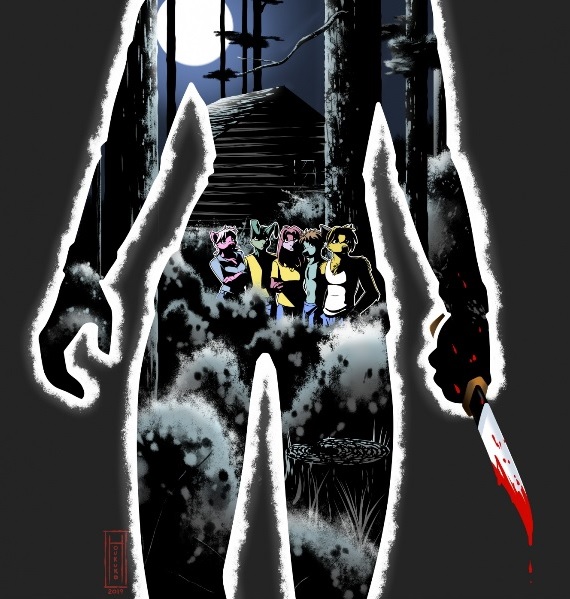
F13Cover

Click here to read the comic

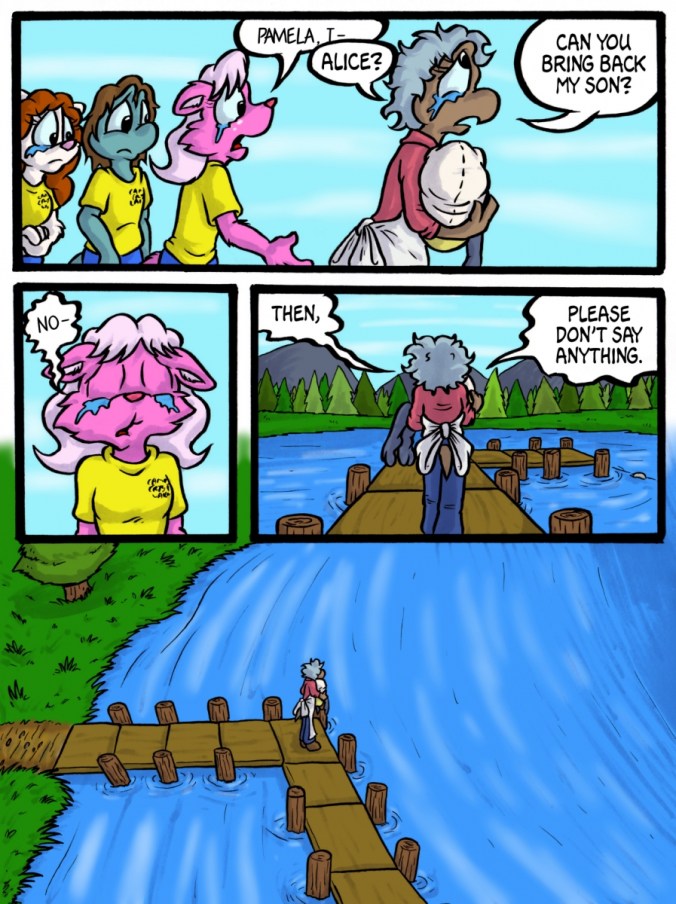
This comic, created by artist David Hopkins – a furry artist best known for his long running web comic, ‘Jack’ – immediately stands out because the cast are no longer human, but anthropomorphic animals. But don’t let the sight of cute cartoon animals in people clothes fool you: This is easily the bloodiest take on the original ‘Friday’ story. Much like the 1980 movie, the comic tells the origin story of Jason Voorhees and his mother. And, like the best remakes, it takes the original story and reinterprets it in interesting ways. Here, there’s no twenty-year gap between Jason’s death and his mother’s rampage, and unlike the 1980 and 2009 films, where Jason only pops up after Pamela is killed, both of them work together throughout the story to kill counselors, acting like a ghoulish version of Bonnie and Clyde. The other, most significant addition to this take on the story is it’s religious tone: While Jason’s survival was unexplained in the original film, his resurrection here is due to Pamela making a deal with the devil to bring him back to life (in a smart move, the devil is never heard or seen, making him an unseen menace).

The compressed timeline and supernatural elements gives this version of ‘Friday’ refreshingly different from the original, but what elevates it above being a simple slasher story is how most of its focus is on Pamela Voorhees. While she infamously only appeared in the final act of the original film without any foreshadowing, the comic makes her the main character instead of the counselors, letting us learn much more about her: In this interpretation, Pamela is a former member of a group of devil worshippers who eventually left and became a Christian, who then suffers from a horrific crisis of faith when Jason dies, and then backsliding when her pleas to God to bring Jason back aren’t answered.

This expanded focus on Pamela turns her from an already compelling and relatable character into a complex, fascinating individual who is bloodthirsty and ruthless, deeply loving, misguided, and even regretful about what she’s done. It’s easy to understand and related to her pain and goals for vengeance, even as she kills innocent counselors in truly horrific ways.

F13080clr150

Yet, despite all the horror and the gore here, there’s a strong undercurrent of innocence and tragedy here: there are no true villains in the story, only victims. Yes, Pamela stabs, burns, impales, and disembowels teenagers, but only to bring her son back, and ensure that no other children will die from the counselor’s stupidity. The counselors, while having severe lapses in judgement, aren’t evil and care about the kids under their care. Jason becomes a killer, but only at his mother’s urging. And in the end, Pamela has a moment of clarity about what she’s done, but dies and is damned. Jason loses his mother, and Alice is left shell-shocked and a nervous wreck. No one wins, and everyone suffers, turning ‘Friday’ into a tragedy of poor choices, suffering, and loss… but, you know, with cartoon animals!

While I prefer this comic over the 1980 and 2009 films, it does have a few missteps: At one point, Pamela tells Jason that they can kill everyone in the world, which doesn’t make much sense for a woman who initially only wanted to leave Crystal Lake with Jason, and then wanted to get revenge on a specific group of individuals for letting Jason die. Pamela’s famous scene, where she seems to channel Jason while trying to kill Alice doesn’t make any sense here: the film implied that Pamela was losing her mind, but in the comic Jason is right outside the building, making the line and Pamela’s seeming possession unnecessary and confusing.

Still, despite these missteps, this adaptation of ‘Friday’ elevates itself above standard slasher fare by focusing on Pamela and giving her a depth and richness that the films haven’t. Coupled with the grotesque, bloody kills, tight focus, and good pacing, this re-imagining of Jason’s origins is, in my opinion, the best of the three ‘Friday’ origin stories. If you’re looking for a slasher story with an uncommon depth, or a great ‘Friday’ tale, this will easily satisfy that need.
F13024clr150.jpg

Now that we’ve taken a look at all three of Jason’s origin stories, all that remains is to done final summary of them all and see what lessons they offer for the writer, a task we’ll dive into next week.

If you’d like to see more of David Hopkins’ work, you can visit his Furaffinity page here. If you’d like to read his JACK webcomic, you can do so here.

(All art on this page is posted with permission from Mr. Hopkins)

Perfect Moments: A Shadow On The Wall

Once in a while, you come across a moment in a story that is so perfect that it stays in with you for years, or even a lifetime. These are moments that, in my opinion, are flawless; perfect gems of storytelling that cannot be improved in any way, and are a joy to treasure and revisit again and again.

***

The Movie

‘Signs.’

The Moment

Why it’s perfect

No matter the project, and no matter what medium, all storytellers face one problem when telling a story: How do you tell your audience everything they need to know about the main character within the first third of your story? There are countless ways to do so (Many, many, many, many, ways, actually), but I want to take a look at one of my favorite introductions, one that accomplishes so much despite showing so little.

2002’s ‘Signs’ opens with a man waking up in bed inside a house near a cornfield. He listens to see if someone else is awake, picks up some socks, brushes his teeth, and then hears a little girl scream. It sounds boring, but when he’s brushing his teeth, we initially don’t see Graham, just the door to the bathroom and the wall beside it. But on that wall is the faded outline of a vanished crucifix.

In an instant, that outline tells us that something terrible happened to this man, something that made him turn his back on his faith. We don’t know what that event is, but after seeing a family picture of him with a woman who doesn’t appear in the scene, it’s easy to guess. Coupled with the silence of the scene, the dim lighting, and the feeling of loneliness, we know this man has been through a lot, turning him into an underdog who’s trying to recover, but has seemingly given up and has resigned himself to just existing.

I’m still amazed how one tiny detail can tell so much about someone. When done correctly, such a trait can tell us the main problem the character is going to try and overcome, or tell us a lot about their history. Consider the following scenarios and what they tell us:

*We’re in a home. There’s a photo of a a woman and a young girl on the mantlepiece, but we can just faintly see the edges of someone’s pants on the edge of the photo, which looks like it was ripped.

*An old, out-of-shape man eats a microwavable meal for one in his tiny, filthy apartment. On a wall behind him are newspaper clippings and framed magazine covers about a star baseball player who was legendary in his day.

*A group of terrified explorers enters an enormous cave and finds it piled high with hundreds, if not thousands of bones of giant creatures, many covered in gashes. They hear something growling from deeper within the cave.

All three tell us something about characters: The first might revolve around a disgraced husband. The second, an old man who longs for the days when people cared about him, and the third, an unseen beast who has been around a long time, and clearly dangerous. When utilized properly, such small details can reveal so much about a character, even before they appear or talk. In my opinion, that cross in ‘Signs’ is one of the best examples on how to do it right – and in under a minute, no less!

Three Fridays: A Comparison of ‘Friday the 13th’ – Part 2

When I finished taking a look at the original ‘Friday the 13th’ last week, I hoped that the 2009 remake would offer a new twist or angle on the story, or perhaps a new idea that would add to the Jason mythos. And at first glance, it sounded like the movie had everything going for it: a bigger budget, a bigger scope, and including elements from the first few films. Thus, with the disappointment of the original still fresh in my mind, I started the remake, hopeful that I’d get a more exciting version of Jason’s origins.

After a very quick recap of Pamela’s attempt to kill horny teenagers at Camp Crystal Lake, ’13th’ wastes no time in getting to the basics: young adults head out to a remote lake, get drunk, get high, get naked, have premarital sex, and die at Jason’s hands. A familiar formula, but it isn’t a bad thing. I was impressed at how quickly the film got to the killing, and it was quickly made clear that Jason doesn’t mess around: in the span of a few minutes, he wipes out everyone in the small group of horny, drug-seeking young adults in gruesome fashion, including bear traps, machetes, and a particularly horrible, drawn-out death for an unfortunate young woman in a sleeping bag.

And then the opening title appeared; I had been so sucked into the opening act that I was shocked to realize that the film hadn’t even started yet! Now excited, I watched as the movie started up, glad to see that things were going well.

An hour and a half later, I watched the end credits, crushed at being disappointed once again.

As a modern remake and reboot for the Friday the 13th series, ‘Friday’ is a return to the classic elements of the franchise: Camp Crystal Lake, Jason killing with his machete, and his eventual defeat at the hands of a lone, young woman, all in an attempt to leave behind the over-the-top silliness that the franchise became known for, culminating in Jason’s trip to outer space, and facing off against Freddy Kruger. A little housecleaning isn’t a bad move in and of itself: When a series heads back to its roots, it’s a chance for a clean start, and to introduce the series to new fans while honoring what came before and keeping series traditions for the returning fans.

Sadly, however, ‘Friday’s attempts to strip away the over-the-top elements of the franchise also takes away much of what made Jason memorable. Yes, he may have become ridiculous in his later outings, but a demonically-possessed, cyborg zombie Jason is far more interesting to watch, especially when he uses his superhuman durability and strength to perform wildly inventive kills. But by removing the silliness and Jason’s enhanced abilities, ‘Friday’ unfortunately turns itself into a routine slasher movie. As with the original, if we were to take away Jason and Camp Crystal Lake, there would be little left to distinguish itself from its peers: Most of the kills – which revolve around being stabbed, slashed, and impaled with a machete, shot with an arrow, or being stabbed with various items – feel routine and unimaginative (with the exception of the aforementioned sleeping bag kill). The story feels routine, and aside from his new ability to run, Jason himself feels like almost any other slasher villain in hundreds of other horror movies: Just a normal man in a mask who’s strong and tough to kill.

When the credits were rolling, I was struck by how I had to focus to recall any memorable moments that stuck with me, those, ‘that was so cool!’ scenes that we love sharing with our friends later on. To my surprise, the only thing that stuck with me was that I like how the main character, Clay, is a person with a strong, believable reason to go to the hunting grounds of a serial killer (he’s looking for his missing sister), and that, even better, he manages to find and rescue her… until Jason bursts out of the lake at the end of the movie, presumably killing her, and making his whole quest pointless.

While I was hopeful that the 2009 remake of ‘Friday’ would correct the mistakes of its predecessor, I was disappointed to find that it was little more than your typical horror flick, one that happened to have Jason Voorhees in it. It did have a faster pace, more action, more kills, and more of everything to keep our attention (I didn’t fast-forward through it), but there was nothing particularly memorable about it.

But not all is lost; there exists one more version of Friday the 13th, a fan-made version that, in my opinion, tells the best version of Jason’s origin story. Come back next week, where we’ll take a look at this adaptation, which isn’t what you’d expect.


Favorite Moments: Game of Chairs

We all have our favorite moments in movies, books, and games, moments that stay with us long after the story is over. This column is my attempt to examine my favorite moments and see why they stick with me.

***

The video:

Why it’s great:

It’s Sesame Street poking fun of Game of Thrones.

Okay, I guess I’ll have to do more than post a sentence I never thought I’d write. What makes this sketch by Sesame Street great is that it manages to do three things at once:

1. Do a G-rated parody of an R-rated franchise.

2. Make it educational and entertaining at the same time.

3. Throw in plenty of in-jokes that only adult watchers of ‘Thrones’ would get that would fly over the heads of younger viewers.

It’s Reason # 3 that really makes this sketch shine: What 8 year old is going to catch the in-jokes about the bloodiest wedding in human history, the death of the most irritating teenage monarch ever, decapitation, and so much more? None, I’d warrant. You can almost hear the writers giggling as they turn R-rated horror into G-rated jokes, and on a children’s educational show, no less!


Three Fridays: A Comparison of ‘Friday the 13th’ – Part 1

When it comes to horror franchises, few are as well known as Friday the 13th. Created in 1980, this series has gone on to include twelve films, countless books, comics, action figures, and video games, not to mention spawning the legendary Jason Vorhees, who remains one of cinema’s most famous slasher villains, with over two hundred (!) kills to his name.

Yet, even with its prestigious history, I’ve never sat down to watch all the films, the one exception being ‘Freddy vs Jason.’ I thought it was a fun film, but it didn’t get me interested in watching the rest of Jason’s filmography. All that changed, though, when I took a look at a recent, fan-made interpretation of the 1980 film, which made me curious to see how it fared to both the original, and the 2009 remake, leading to the rare scenario of being able to see the same story being told three different ways.

For the next few weeks, I’ll be taking a look at all three interpretations: The 1980 original, the 2009 remake, and a 2019 fan-made version that I’ll keep a secret for now. If you haven’t seen the original film, I’d recommend not reading any further until you have, as this series will spoil major plot details.

With all that said, let’s begin with the film that started it all: 1980’s, ‘Friday the 13th’

As said so memorably in 1962’s ‘Lawrence of Arabia’ and 2012’s, ‘Prometheus,’ “Big things have small beginnings,” perfectly sums up Jason’s first big-screen outing, a small-scale slasher flick that finds camp counselors facing certain death when stranded at a small summer camp in a remote forest. Thanks to pop-culture osmosis, I knew all the twists before watching the film: that Jason is barely in the film, that his mother is the killer, and that everyone but one girl dies. Still, knowing the plot before seeing a movie isn’t always going to ruin it: I knew how ‘Alien’ and ‘The Shining’ turned out before watching them, and they were still scary, effective films that became personal favorites.

I’m afraid the same can’t be said for ‘Friday.’

For all the praise put upon it as one of the best films in the series (or the best, depending on who you’re talking to), I found ‘Friday’ to be surprisingly dull. It gets off to a good start, with a camp counselor named Annie heading off to Camp Crystal Lake…  only to be killed before she even reaches the front gate. Killing off who you think is going to be the main character in the first act is a great way to suck people in, and I was eager to see how the film went from there. Regrettably, I was disappointed that ‘Friday’ follows the standard trope of building up doomed teenagers before killing them off in an isolated location. There’s nothing wrong with that (and Crystal Lake at night in a thunderstorm is an effective horror setting), but the film’s glacial pace results in numerous periods of boredom, to the point where I even fast-forwarded to get to the inevitable killings, which are quite tame compared to what came later in the series (the arrow-through-the-throat kill is quite memorable, though).

While ‘Friday’ was mostly a disappointment for me, it does have one element that saves it from the pile of over-hyped movies: Pamela Vorhees, Jason’s mother. At first glance, a middle-aged woman with no fighting skills or unique abilities doesn’t sound like a compelling villain, but Pamela elevates herself with one of the most sympathetic backstories to be found in slasher cinema: A mother who lost her only child due to negligence, who is driven by unimaginable pain to get revenge on those who let him die, and stop other children from suffering the fate her son did. I can think of few other killers in cinema who are so sympathetically evil; Pamela’s so easy to relate to, even if we don’t agree with her killing innocent counselors who had nothing to do with Jason’s death. And to twist the knife even further, the revelation that Jason is still alive means that all her killings and her twisted quest for justice was all for nothing, turning the film into a tragedy where nobody wins, nobody gets justice, and all the suffering everyone goes through was for nothing.

Wow.

When looking at ‘Friday’, both as the start of a franchise, and as a standalone movie, it’s my opinion that it isn’t very good. If it was removed from the ‘Friday’ franchise and stripped of it’s historical status, ‘Friday’ would probably be remembered as a rather standard slasher film that would struggle to stand out among its peers. Still, Pamela’s effective performance saves ‘Friday’ from being a complete disappointment.

While ‘Friday’ isn’t a good film, in my opinion, it does deserve to be recognized for its villain, and for starting one of the most famous slasher franchises in history… well, that, and the hilarity of knowing that Pamela’s little boy will one day blast off into outer space and hack people to death on a space station as an undead demonic cyborg.

Tune in next week, where we’ll take a look at the 2009 remake of ‘Friday’ and see what a modern-day take on Jason’s origin has to offer.

Favorite Moments: The Lion King (low budget)

We all have our favorite moments in movies, books, and games, moments that stay with us long after the story is over. This column is my attempt to examine my favorite moments and see why they stick with me.

***

The video:


Why it’s great:

If you were a little kid during the 90’s, you were probably traumatized by seeing Mufasa fall to his death in ‘The Lion King’. I should know; I was one of those kids who was heartbroken at seeing him become wilderbeast roadkill, and another unfortunate victim in Disney’s never-ending quest to kill all parents.

So, naturally, someone had to take the scene and remake it in 3D, but with incredibly silly animation that looks like it was saved from an animation student’s recycle bin, making another great example of how taking a dramatic scene and interpreting it with silly, amateur production values can make for comedy gold.