Every story has a cast of characters that we follow and watch and come to love… but what about the background characters? The nameless masses who rarely get our attention? This column examines my favorite background characters who deserve a moment in the spotlight.
***
The Show:
‘Stranger Things: Season 4’
The Character:
Agent Harmon
The Scene:
Why He Deserves A Moment In The Spotlight
Recently, I watched all four seasons of Stranger Things, a show with a great many characters both major and minor, but one of whom stands out as one of the most awesome redshirts you’ll ever see on TV.
For those of you who are unaware, a Redshirt is a minor, typically unnamed character in a movie, show, or book who exists sorely to die and establish how dangerous a situation is for the main characters. Named after the famous crewmembers from Star Trek, they’ve become a joke in pop culture, and I was expecting the two government agents in the fourth season of Stranger Things to be the same.
Boy, was I wrong.
When military spooks break into Will and Jonathan’s house to kill them, I thought agent Harmon would quickly fall like his partner, leaving the boys to fend for themselves. But to my surprise, Harmon immediately morphed from an overweight, lazy, tv-watching agent into a stone-cold warrior who fearlessly takes on an entire squad of soldiers with only a pistol and wins. Granted, he doesn’t kill them all, but he does stop them from getting Will and the others, ensuring that they escape to find Eleven.
What’s so great about this scene is that even though we know so little about Harmon, we quickly become invested in his struggle because we subconsciously know he doesn’t have plot armor and could die at any time, making his fight even more engaging than the main characters who we know are going to survive until the climax of the story. He’s a redshirt who temporarily becomes a main character, one who is responsible for keeping the others alive… but, sadly, at the cost of his life.
Rest in peace, Harmon (AKA, Unknown Agent Hero Man). We only knew you for a few minutes, but if you had gone to the Upside Down with the others in the season finale, you’d have killed Vecna in seconds with that legendary pistol of yours and saved the world.
NOTE: This post spoils pretty much all of ‘Independence Day: Resurgence’. If you haven’t seen it yet… well, today is as good a day as any to see it!
Ah, the 4th of July: A time for barbecues, patriotism, and watching movies about aliens invading earth on America’s birthday. I’m talking, of course, about 1996’s ‘Independence Day,’ one of the biggest blockbusters of the 90’s. Considering how much of a success it was, it’s surprising that it took Hollywood twenty years to give us a sequel, ‘Independence Day: Resurgence.’
Unfortunately, ‘Resurgence’ didn’t repeat the success of its predecessor, and quickly faded from view, taking with it any hopes of any further sequels. Yet, despite its lackluster reception by audiences and critics alike, I’d say that, when compared to the many legacy sequels we’ve gotten since then, ‘Resurgence’ is one of the better ones. In honor of the film’s 6th anniversary, I’d like to list (in no particular order) 11 things ‘Resurgence’ does well.
1. The setting
Reflecting the passage of time in our world, ‘Resurgence’ takes place 20 years after the event of the original, and features a world where humanity has not only rebuilt itself in the aftermath of the war of 96, but also reverse-engineered and integrated alien technology into our societies to grant us hover technology, laser blasters, and casual space travel, among other things. But even better, coming together to defeat the harvesters has resulted in humanity putting aside our differences and enjoying twenty years of world peace.
It’s so rare these days to see a sequel where life is unquestionably better for everyone after the events of a previous movie, and this kind of optimism is a welcome change from countless films where the world may have been saved, but is still a dark and dreary place.
2. Almost all the original cast are back, and have large roles in the story.
When legacy sequels bring back original characters, they usually take a backseat to forgettable newcomers. ‘Resurgence,’ bucks that trend, though, by having almost all of the original cast return from the first film and making them integral to the story, from President Whitmore being a key figure in the fight against the harvesters, David being the leading expert on alien technology, and Dylan and Patricia stepping up to fight the harvesters like their parents did. Even side characters, like Julius, Jasmine, and even General Grey get their moments to shine; as a fan of the original film, I was so happy to see all my favorite characters come back after twenty years and still be treated with respect, so much so that the public still adores Whitmore, and little kids want David’s autograph. Goofy? Yes. Heartwarming? Also yes.
3. The film doesn’t negate the accomplishments of the original.
If there’s one common flaw to be found in legacy sequels, it’s the infuriating tendency to undo the accomplishments, resolutions, and happy endings found in our favorite films for the sake of starting a new conflict (see: John Conner being killed off in the first three minutes of Terminator: Dark Fate, the rise of an even more evil empire in the Star Wars sequels, a new Matrix enslaving humanity, etc.) and rendering everything our heroes did pointless and meaningless. Thankfully, ‘Resurgence’ is arguably the one legacy sequel that completely averts this trope, as Earth has enjoyed twenty years of peace, prosperity, and technological advancements, thanks to the efforts of everyone in the original film. That means that, when going back to rewatch the original movie, we know that all the pain, suffering, and sacrifices endured by the characters do pay off, and lead to lasting change that benefits so many people, rather than knowing that all those efforts will be rendered meaningless.
4. The adventures of Julius
Many reviewers have correctly pointed out that Julius doesn’t have much to do in ‘Resurgence,’ and that his subplot of leading some kids to safety ultimately doesn’t contribute anything to the story. While I agree with this critique, his story allows us to see the more personal, intimate side of an alien invasion, with ordinary people dealing with gas shortages, children losing their parents, and just trying to find safety as everything falls apart. Plus, you could also say that, thanks to Julius, he provided the bus that allowed him, David, the kids, and David’s assistant to escape the harvester queen at the climax, meaning that Julius ultimately ends up helping save his son’s life, while also helping bring hope and comfort to some scared teenagers and pre-teens. That, I think, is a worthy outcome to a road trip at the end of the world.
5. Whitmore’s sacrifice
Poor James Whitmore doesn’t have it easy in ‘Resurgence.’ After rising to become one of the most badass fictional presidents in cinema (helped by having given one of the best speeches in film history), we see him as an older, wearier, and worn-down shell of his former self, a man plagued with mental issues and who needs a cane just to walk around. Yet, as the film goes on, James finds his old strength and once again rises to help humanity once more, culminating in him confronting the harvester queen – the source of all the mental pain he’s suffered for so many years – and sacrificing his life to stop her.
But wait a minute, you might say; James’ sacrifice fails to kill the Queen! And you’d be right… but James did destroy the Queen’s ship, critically damaged her shield, and forced her out into the open, where she was vulnerable and attacked by others, ultimately leading to her death, none of which would have happened if he hadn’t sacrificed himself. Thus, James manages to save humanity from aliens a second time, complete with a great pre-mortmen one liner to boot.
6. It introduces a new faction of aliens
It would have been easy for ‘Resurgence’ to focus its story only on the harvesters; after all, we came to see our favorite characters once again fighting them to save the Earth, and we would have still gotten a good, focused story. But ‘Resurgence’ introduces the spheres, a new species of alien that’s friendly to humanity, one that’s thousands of years ahead of us in terms of technology.
With the sphere, ‘Resurgence’ expands the lore of Independence Day by revealing that the harvesters are a much greater threat than we believed, and that they’ve destroyed countless worlds. And not only that, but there are other species that have been fighting back against them, and that it is possible to defeat the harvesters for good. Now that’s good world-building.
7. Dikembe Umbutu, warrior extraordinaire
If I’m being honest, most of the newcomers in ‘Resurgence’ don’t make much of an impression… save for Dikembe, a veteran of a ten year ground war against the harvesters in Africa, making him a warrior skilled enough that he can take down a harvester in a one-on-one fight with nothing but two machetes. And while he’s not the warmest or most personable of people, Dikembe is a reliable ally who isn’t afraid to help when it’s needed, and to give praise to those who do their part who fight to stop the harvesters. If only one newcomer were to be kept in ‘Resurgence’ while all others were deleted, I would pick this guy.
8. Steven Hiller’s Action Figure
This one is cheating just a little, as it only happens in the film’s novelization, but at the hospital that Jasmine works in, one of the patients – a little boy suffering from cancer – can’t sleep without having his favorite action figure by his side. What is it? A figure of Jasmine’s husband, Steven Hiller, who was so memorably played by Will Smith in the original film. It’s a moment that should be unspeakably goofy… and yet, it works. I just love the idea that Steven is so beloved by the world after all that he did that action figures were made of him; makes you wonder if there are figures of James, David, and all the other heroes of the original film.
9. The Harvester Queen
While the harvesters in the first film were more like the Borg in that they had no leader, ‘Resurgence’ gives us a harvester queen to be the film’s antagonist. And like the xenomorph queen from the ‘Alien’ movies, this queen doesn’t mess around, personally leading the attack on Earth, causing destruction on a scale that the original attack couldn’t even dream of, wiping out all of Earth’s defenses, and beginning the process of drilling down to the planet’s core, an act that would destroy Earth and humanity. And if that wasn’t enough, the queen is then revealed to be a skyscraper-sized colossus who single-handily attacks Area 51; it’s only by sheer luck and grit that humanity manages to take her out.
No matter how you may look at the movie, it cannot be denied that the harvester queen is an incredibly dangerous, determined, and smart antagonist who does not fool around and almost single-handily wiped out humanity by herself.
10. James and Grey’s reunion
It’s a very brief moment, but when James is rushing to warn Earth about the impending alien invasion, he spots his old friend, General Grey. At this point in the story, Whitmore is desperate to get his message out. His mental illness is driving him to act regardless of the consequences, but he still respects Grey enough to stop for just a few moments to acknowledge him. Without any words, it conveys the bond the two share, and the respect they have for one another. It’s a lovely moment, made all the more bittersweet with the knowledge that Grey’s actor, Robert Loggia, was suffering from Alzheimer’s during filming (he passed away shortly before the movie’s release, and the film is dedicated to his memory).
11. The Invasion of Earth
Regardless of what you may think about his storytelling abilities, there’s no denying that Roland Emmerich is a master of presenting disasters on screen, and in my opinion, the arrival of the harvester Queen’s ship to Earth is among his best work: we get a ship the size of the Atlantic Ocean effortlessly demolishing part of the Moon, then arriving on the planet, sucking up entire cities and dumping them down on other cities in addition to causing enormous tidal waves that topple oil rigs and send ships flying. The massive amount of destruction is awe-inspiring, and I just love the shots of Singapore getting ripped from its foundations and getting sucked up into the sky.
It took over 20 years to get ‘Resurgence,’ but it was worth waiting that long to see some of the most creative destruction Emmerich has ever made. What about you? Are there any other moments or elements of ‘Resurgence’ that work well for you? If so, shout them out in the comments!
If you’re going to make grand finale to a franchise that explores the futility of humanity playing god by bringing dinosaurs back to life and suffering the consequences, don’t make your finale be focused on a cloned girl trying to find her place in a world that’s under siege by locusts. That would be just silly!
With the conclusion of 2004’s, Resident Evil: Apocalypse, the Resident Evil film series was in a unique position: because of Apocalypse’s open ending, future movies could either stick to the story, characters, and settings of the games, or forge a new path that wasn’t tethered to its source material. While the safest option was the former, the series went with the latter, but with a twist: it would take characters, monsters, and ideas from the games, but explore what would happen if the T-virus escaped into the wider world instead of being stopped time and time again.
The answer? Disaster.
Picking up five years after the events of Apocalypse, Extinction drops us into a world where the T-virus escaped Raccoon city and spread worldwide, causing billions of people to turn into zombies and turning the planet into a barren wasteland on the brink of total collapse. Now, Alice and the few remaining survivors struggle not only to escape the undead, but end the pandemic once and for all (and presumably struggle to find toilet paper). It’s a great setup for (what was supposed to be) a series finale, so let’s see what worked, and what didn’t.
What does the story do well?
It has an opening that sucks the viewer in right away
If there’s one thing that Extinction does truly well, it’s getting the audience’s attention from the very start by having Alice wake up in the shower from the mansion from the first film.
But this can’t be; the mansion was destroyed when Raccoon City was nuked. And then when Alice leaves the main room, she enters the famous laser hallway, and then a hospital hallway, leaving us to wonder if this a dream, a flashback, or something else… only to discover that Alice is actually a clone going through a murder training simulation run by Dr. Issacs.
By showing the audience something familiar, yet mixing up to play with expectations, the movie gets their attention immediately and makes them want to see more.
It has a unique twist on a zombie virus
Most zombie movies have their respective virus turn people (and the occasional animal) into zombies; Extinction mixes things up by having the virus affect water and vegetation as well, something I don’t recall any other zombie film doing.
Granted, this idea is retconned out in future films (and it does bring up the question of if there are undead plants that desire to eat the flesh of the living), but it’s a fascinating idea that makes the T-virus a truly diabolical threat to humanity: by wiping out plants, then herbivores, then carnivores, and eventually the entire food chain, it means that humanity will inevitably go extinct, lending even more urgency to find a cure.
It has a clearly defined goal for the characters
Extinction continues the Resident Evil film series’ tradition of giving the characters a clear, concrete goal to work towards. Here, it’s to reach a settlement in Alaska that’s free of infection, a safe haven in a world that’s dying. By making the film’s goal have a clearly defined finish line, it gives both the characters and the audience something to focus on instead of just meandering around.
The comic relief character has become more mature
While Apocalypse had it’s share of problems, one of the most egregious was making LJ little more than a walking cliche of the trash-talking, sassy black gangster. Thankfully, Extinction corrects this; while LJ is still the story’s comic relief and cracks a few jokes, he’s much more serious this time around, focusing on doing his part for the convoy, trying to save people, and mourning his girlfriend after she dies. You really sense that LJ has gone through a lot in five years and has grown as an individual… which makes it all the sadder when he (and we) realize that his death is inevitable after being bitten by a zombie in the first act.
The post-apocalyptic convoy gets along with each other and has a good leader
One small thing I like about Extinction is the lack of conflict among the survivors in Claire Redfield’s convoy: there’s no infighting, squabbling, or backstabbing. After countless post-apocalyptic tales where everyone is at each other’s throats, it’s a welcome change to have a similar story where people can get along and work together. This also extends to the convoy’s leader, Claire, who – instead of being a tribal warlord who rules through threats and fears – treats those under her care with respect, is honest with them about difficult decisions they have to make, seeks their input before making those decisions, and works hard to keep everyone safe, even if it means charging into battle instead of letting others fight for her.
It has a unique monster that relies on numbers instead of strength
Aside from the zombies themselves, the Resident Evil film series likes to focus on individual monsters to antagonize the heroes; while Extinction does feature a Tyrant at the climax, it is unique in all the films in that it has monsters that rely on sheer numbers to win instead of being bullet sponges, and that’s the undead crows.
While it would be fairly easy to kill a single crow in a fight to the death, having hundreds attack the convoy makes them a much bigger threat that’s impossible to stop with bullets or conventional weapons, making them into a truly unique enemy in the series.
It has a great setting for the final act
Compared to the dark, gloomy settings of the two previous films, Extinction spends most of its runtime in the desert during bright, sunny days. But at the end, Alice has to got into another underground facility to face off against a heavily-mutated Dr. Issacs and save humanity. But it’s not that the facility is deep underground that makes it so compelling: by the time Alice arrives, the place has been wrecked and torn apart by Issacs. There’s no one left alive, all the lights are flickering on and off, and evidence of Issac’s rampage are everywhere. Alice knows that Issacs is somewhere in the facility, and it’s just her against him. And, smartly, the film holds off on showing him as long as it can, letting our minds race and wonder just how grotesque he must look after mutating and inflicting so much carnage.
This buildup is surprisingly suspenseful, and arguably the tensest sequence in the entire series. Having the final battle take place in a replica of the mansion from the first film is also a clever way to end the series where it began (sorta), and using the laser hallway to finish off Issac once and for all is a great example of why bringing back fan favorites to save the day is always a win.
It tones down Project Alice
Compared to the previous film where Alice was an arrogant Mary Sue who could take on anything that came her way with ease, Extinction learns from those mistakes and tones her down considerably, making Alice more subdued and getting rid of her ‘I don’t give a shit’ attitude. And unlike the last movie, the other characters have more opportunities to have their own action scenes and moments to shine without Alice coming in to steal her thunder.
While she’s still the main character and still the focus of this film’s universe, Alice feels more like a normal person, and that’s a welcome change from the previous film.
What could have been improved?
Issacs could have had a more logical plan throughout the film
Dr. Issac’s plan of domesticating zombies to create a loyal work force to rebuild the world is not only silly, but flies in the face of all logic: Considering how the T-Virus has brought humanity to the brink of extinction and turned the world into an uninhabitable wasteland, you’d think that Issacs would realize it makes more sense to destroy the T-virus and everything it’s infected instead of creating zombie butlers, zombie farmworkers, and zombie retail employees, which could have led to an interesting conflict between him and Alice: both groups would want to save the world, but Alice and her companions wouldn’t trust Umbrella or Issacs, a relationship that could have had all sorts of compelling drama. That’s also not factoring in the nonsensical ‘tests’ he has the Alice clones go through. (Why not just grow one and regularly extract her blood instead of wasting an unimaginable amount of resources putting dozens of them through unwinnable deathtraps?)
This point could be negated, however, if we theorize that Issacs is actually using his research as a mask to create an army of super-zombies that he alone will be in control of, allowing him to overthrow Umbrella and become the sole ruler of Earth. It’s still a silly plan, but a bit more logical and reinforces his sociopathic nature.
LJ’s inevitable death could have been explored more deeply
Near the end of the first act, LJ is bitten by a zombie while investigating an abandoned motel and hides this from the others, progressively becoming sicker until he finally succumbs at the end of the second act and bites Carlos before being killed. And while it’s depressing to see the admittingly charming LJ die an undignified death (In the original script LJ actually accompanied Alice into Issac’s underground compact), the movie misses the opportunity to have LJ confess to the others that he’s been bitten, and the drama that would come from that: perhaps the convoy would have decided to let him live long enough in the hopes of finding an antidote, with LJ determined to do as much as he can to help the others before he succumbs. But instead, we get him hiding his zombie bite, which makes the other characters look quite dumb for not realizing that he’s getting progressively sicker and weaker.
The secret facility could have been guarded by more than a single chain-link fence
This has little impact on the story, but it’s improbable that Issac’s super-secret, camouflaged underground fortress is protected from billions of zombies by a single chainlink fence. How it hasn’t been breached after five years of zombies banging against it is beyond me!
It could have cut down on the number of characters
It’s a tale as old as time: a zombie movie comes out, and it’s filled with lots of expendable characters who are only there to be killed off by the undead, and Extinction makes the same mistake of introducing lots of new characters without giving us reasons to care about them. K-Mart, for example, is a teenager who was found in a K-Mart and… that’s all we know about her. Similarly, all we know about Betty is that she’s the group’s medic, LJ’s girlfriend, and the two care about each other.
To the film’s credit, it doesn’t try to make us care about everyone, instead letting most of the convoy’s survivors be nameless masses to be eaten, but it would have been better to cut down on the new characters. Instead of a multi-vehicle convoy with dozens of people in it, perhaps it could be a three-vehicle convoy with a dozen people maximum, giving the story a bit of breathing room to let us get to know them better.
It could have removed the cliffhanger ending
When originally created, Extinction was billed as being the final installment in the Resident Evil film franchise, complete with Alice learning that she can wipe out the virus for good near the end of the movie. Yet, instead of cutting to ten years later where the undead are gone and nature is healing, Extinction ends with Alice waking up her clone buddies in preparation for an assault on Umbrella’s Tokyo headquarters. While this ending would have worked if the series had ended (the main conflict is resolved and Alice has everything she needs to wipe out the virus and bring justice to Umbrella), Extinction doesn’t feel like the end; the story clearly isn’t over, and there’s more to come (an idea that would be revisited later in the series to better effect).
Personally, I find Extinction to be the best of the original trilogy: it manages to achieve a respectable balance between plot and action (along with somereally greatmusic), as well as trying to tell it’s own unique story while being faithful to the spirit of the games. It doesn’t do anything overly well, but neither does it falter too much, making a solid, respectable B movie, and would have made a satisfying end to the series… but the truckloads of money it got at the box office ensured that it would rise once more and continue on. Come back next time, where we’ll head into the franchise’s second half with ‘Resident Evil: Afterlife.’
With a little over a month to go until ‘Jurassic World: Dominion’ is released, we’ve got trailers, screenshots, interviews, toys, and articles galore to keep ‘Jurassic’ fans excited until the big day when the cinematic journey that began almost thirty years ago finally comes to an end. But even with a plethora of material to wet the appetite, there’s still plenty to theorize and ponder about how this final chapter will come to an end, including how the Netflix animated series, ‘Camp Cretaceous’ will tie into the film as well.
While the killer robots, drones, and invisible force fields get more attention throughout the season, I think this communication device is arguably the most important invention in the ‘Jurassic’ franchise. Just think about it: With this device, people and dinosaurs can communicate with one another. We can actually talk to dinosaurs! And with ‘Dominion’ director Colin Trevorrow having said that notonly does season four of the show tie into ‘Dominion,’ but that ‘Dominion’ is a film about how both humans and dinosaurs will have to adjust to living amongst one another, I think this device will play a vital role in the story, possibly going something like this:
At the finale of ‘Dominion,’ Alan, Ian, Ellie, Owen, Claire, and their allies will have to take on the Giganotosaurus. Given that the Prologue established a rivalry and inevitable rematch between Rexy and the Giga, it’s all but certain that the two of them are going to fight at the finale. And, given her age (in human years, Rexy would be a little over 100), it’s highly likely that she’ll be injured or initially unable to win. And unlike in ‘Jurassic World,’ Blue isn’t going to come to the rescue. Who, will, then?
Humans.
With everything on the line, and the Giganotosaurus on the verge of victory, Dr. Grant will find Dr. Turner’s communication device (or one identical to it), come face to face with with the dinosaur that almost ate him back in 1993, and, for the first time in history, a human will talk with a T-Rex in a way that it can understand. Grant will communicate to Rexy that he and the others will help her fight the Giga, and realizing that she needs help, Rexy will team up with them. But it won’t end there: Grant will use the same device to communicate with other dinosaurs, such as Blue and the Spinosaurus (oh, how I’d love to see it come back to the big screen), leading to a massive, ‘Avengers Endgame’ style alliance of humans and dinosaurs going up against the Giganotosaurs and finally defeating it. And afterwords, humanity will use the device to communicate with the dinosaurs, and finally lead to a new era where both species share the planet and find a way to peacefully coexist.
If my theory is correct, I think it would be a beautiful way to end the ‘Jurassic’ story, which has been about how our efforts to play god and control nature will inevitably fail. But now, we seek to work with nature and find harmony and equilibrium with the beings we have brought back from extinction. While there will still be conflicts and problems between the two species, it will be a better ending than if one side gains total victory over the other, or if both sides destroy the world, and we learn at the end that the whole series has secretly been a prequel to the post-dinosaur apocalypse story, ‘The Flintstones.’
Every story has a cast of characters that we follow and watch and come to love… but what about the background characters? The nameless masses who rarely get our attention? This column examines my favorite background characters who deserve a moment in the spotlight.
***
The Game:
‘Wolfenstein II – The New Colossus’
The Character:
A tip-toeing Nazi soldier.
The Scene:
(The soldier appears at 2:03)
Why He Deserves A Moment In The Spotlight
In the opening of 2017’s, ‘Wolfenstein: The New Colossus,’ the player’s enormous U-boat hideout is boarded by dozens of Nazi commandos intent on killing him and his allies. At one point, the player meets up with Set, a Jewish scientist, who defends both of them with the use of a microwave-lined hallway, which obliterates multiple Nazis as they blindly run through it. But near the end, one soldier realizes that something’s not right about the hallway and stops to consider his next course of action, which is to carefully – and hilariously – tippy-toe through the hallway… only to be blown up like everyone else.
The common Nazi in ‘The New Colossus’ exists (as they rightfully should) to be mowed down by the hundreds. Players expect them to be little more than cannon fodder, which makes moments like these great because it gives individual soldiers a little personality and makes them stand out in a crowd of characters we’re conditioned not to care about… but because this soldier’s still part of the most monstrous regime ever to exist in human history, we laugh at his explosive death instead of mourning him, because f*** Nazis.
NOTE: Although they are quoted and discussed in an academic manner, this article contains both written and video examples of vulgar language and is not safe for work.
Can swearing ever be funny? When played for drama, the Precision F-Strike can easily be one of the more shocking and memorable moments of a film, but when played for comedy, it’s often the funniest, as comedy Legend John Cleese would attest. To quote TvTropes:
“John Cleese… once described this trope in an interview, by explaining that the art of making swear words funny is to avoid using them… until the exact moment in the script when it will be most effective. A comedy with gratuitous swearing ends up desensitizing the audience to the words in question, meaning they lose a lot of their amusement. But if you go for fifty minutes without a single swear word, then suddenly have a character say “shit”, the swear word becomes instantly more amusing because the audience has been conditioned not to expect it up to that point.”
After thinking about this, I’ve come to the realization that Mr. Cleese is correct; after all, some of the most memorable swear words in cinema happen because you don’t expect them. Thus, to celebrate the times where vulgar language can add so much to a scene, I thought it’d be fun to share my amusing uses of swear words in films. Some were done intentionally, others less so, and some are the result of goofy writing or hilarious acting, and some may be the result of mondegreen (a phenomena where a word or phrase is misheard or misunderstood and interpreted as something else), but they are all memorable and good for a chuckle.
Honorable Mention 1: Harry Potter and the Deathly Hallows Part 2
It’s not a swear word, but if you listen closely at 2:48, you can hear what sounds like Voldermort’s otherworldly voice whispering, ‘Screw you, Harry!’ It pretty much ruins the drama of what is otherwise one of the most dramatic and satisfying moments of the entire Harry Potter saga, but it’s pretty dang funny to imagine that as the most powerful dark wizard alive dissipates into the afterlife, a fragment of his spirit takes one last opportunity to insult Harry, but in a polite, non-vulgar way. How thoughtful!
Honorable Mention 2: Dexter
I have never seen the television show Dexter and know next-to-nothing about it, but I have seen this clip countless times and it still cracks me up, especially with some of the jokes people have made with it.
7. Transformers: Dark of the Moon
The climactic chapter of the live action Transformers film series (until two sequels and a quasi-reboot came along) pulled no punches in upping the stakes, with a full-on invasion of Earth by the Decepticons, having the Autobots be grossly outnumbered, and having the Autobot’s most revered leader turn out to be a Decepticon turncoat who will enslave the human race without a second’s thought. It’s only fitting then, that he’s executed at the end without any mercy by his successor and former admirer Optimus Prime.
But while Sentinel’s official last words are an anguished, ‘No, Optimus!’ if you listen closely at the 1:00 mark, you can hear him groan, ‘Oh, fuck!’ before he dies and goes to Transformer hell. There’s just something amusing about the most famous, noble Autobot in Cybertron’s history going out not with a plea or a whimper, but with the sudden realization that he had screwed up so badly that the best way to express his regret was with an all-too human expression.
6. Transformers: The Movie
Yep, there are two entries about profanity in a series about shape-shifting robots that’s targeted for young kids. The first film about these robots from beyond the stars was notable for many things: the death of Optimus Prime, the introduction of Unicron, a robot capable of eating entire worlds, killing off almost all of the original cartoon’s cast, and being the very first time profanity was used in the series.
In this scene, Spike the human and his robot buddy Bumblebee have their moonbase self-destruct in an attempt to destroy Unicron as he eats said base, only for the plan to fail utterly. In response, a flabbergasted Spike calmly asks his robotic companion what the best course of action is to resolve their rather unfortunate predicament. Just kidding; he memorably says, ‘Oh shit, what are we gonna do now?!’
Can you imagine that? Someone swearing in a cartoon for kids? Outside of this example, I can’t think of any other show or movie that’s done so, and not only is it shocking, but funny, too because of how relatable and understandable Spike’s reaction is.
5. Superhero Movie
Released near the end of the era of big-budget movie parodies, ‘Superhero Movie’ is a funny send-up of superhero films released up to that date, the most famous being Sony’s Spider-Man trilogy, but with affectionate jabs towards the X-Men and Fantastic Four as well, complete with juvenile humor throughout. But my pick for the most memorable moment of the film comes at the climax, where the nefarious villain Hourglass – on the verge of gaining immortality – instead meets the Grim Reaper via Dragonfly plopping a crotch-bomb right in front of his face. And how does this dastardly villain, possessing a genius intellect, a fiendish plan, and every advantage imaginable, react? He gives the film’s only use of the word, ‘Fuck.’
Much like Sentinel in ‘Dark of the Moon,’ there’s just something funny at seeing a story’s villain so gobsmacked or horrified that they have to resort to cursing, and ‘Superhero Movie’ does it well.
4. Star Wars: Return of the Jedi
The Star Wars movies may pack stylized violence galore, but are by and large G-rated when it comes to talking… except in 1987’s, Return of the Jedi, where, when watching a super star destroyer plunge towards the second Death Star, you can hear someone on Admiral Ackbar’s flagship yell, ‘Die, dickheads!’ at 0:38.
For years, Star Wars fans have been wondering if we’re really hearing someone swear, or just something that sounds like it. Personally, I like to think that it is real, as it’s perfectly reasonable that someone fighting against an evil empire would celebrate and let loose with the strongest insult they could think of at realizing that said empire is finally about to be destroyed after decades of terror, suffering, and misery. Who among us wouldn’t do the same?
3. The Hobbit: An Unexpected Journey
In the pantheon of major Hollywood blockbusters, New Line Cinema’s The Lord of the Rings and The Hobbit trilogies are quite odd when compared to their peers: Aside from the decapitations, arms getting lopped off, armies being slaughtered by the thousands, and Sean Bean being turned into a pincushion, all six films are surprisingly tame, with no sex and no vulgar language that we can understand (aside from untranslated dwarvish). Much fun has been poked at this phenomena over the years, but as it turns out, there is exactly one audible curse word in the saga, one that’s hidden very well.
In the opening prologue of The Hobbit: An Unexpected Journey, Smaug the dragon attacks the city of Dale, burning it to the ground and inflicting death and destruction beyond comprehension. Naturally, it makes sense that people would be scared out of their minds at having their peaceful life destroyed in mere minutes, and nowhere is that more audible than someone yelling, “Oh God, what the fuck?!” at 1:59 in the clip above.
What I love about this swear is that it’s the perfect embodiment of John Cleese’s description of funny swears: After three movies of people, elves, and dwarves talking in G-rated language, having a ‘fuck!’ come out of nowhere is darkly hilarious, and a very understandable reaction to a dragon destroying everything you know and love. But even this vulgar word serves a purpose, as it helps to humanize the people of Dale; It’s one thing to see fictional characters panic, but when they let lose with curses and expletives that we all use from time to time, it makes them more human and shows that they feel the anger, frustration, and rage that we all do in a world that sucks at times.
2. The Wicker Man
2006’s ‘The Wicker Man’ quickly became a laughing stock as one of the cherished, ‘So bad it’s good’ films of the decade, even being described as the year’s best comedy, and all of that is due to the infinitely-entertaining Nicholas Cage, who does everything from running around and punching old women in a bear suit, to demanding how something got burned, and yelling about bees. But for my money, the film’s most hilarious moment is him yelling about how his death isn’t going to bring back the islander’s honey. It’s a line that – when taken out of context – is THE definition of ‘so stupid, it’s awesome,’ and you wonder how Mr. Cage managed to yell it without cracking up. I have no idea how, but I’m so glad he did it.
1. Epic Movie
What would happen if Superman suddenly no longer had bulletproof skin? He’d be in for a world of hurt, as demonstrated brilliantly in ‘Epic Movie.’
‘Epic Movie,’ despite it’s disastrous reception by audiences and critics alike, and it’s subpar performance as a spoof film, does have one truly brilliant scene: a parody of the sequence from ‘Superman Returns’ where Superman gets shot in the eye. But here, we see what would happen if the Man of Steel didn’t have indestructible eyeballs.
Everything about this scene is great: the music is appropriately bombastic, the build up is flawless, the effects of a slow-motion bullet are well done for a low-budget parody… and then the bullet sinks into Superman’s eyeball with a cartoonish squishing sound, and he shrieks in absolute agony, topped off with a very understandable shriek of how he’s been shot in the fucking eye. While the film may not be the best example of a parody, this scene is absolute gold, and my favorite use of the word ‘fuck’ in any film.
Nothing writing-related today: in light of Putin’s invasion of Ukraine, advice on writing seems… rather unimportant. But when we feel overwhelmed or don’t know what to do, sometimes life sends us something that can restore just a spark of hope… even it’s just a small promo from a channel dedicated to cartoons:
Just thought it was worth sharing today. And if you want to try and make a difference like I do, here are some links that can help:
Finally, you can contact your representatives and senators and ask that they pursue imposing the strongest sanctions possible against the Russian government for what they’ve done.
This morning, Universal Studios released the teaser trailer for ‘Jurassic World: Dominion,’ giving us our first in-depth look at the conclusion of the ‘Jurassic’ franchise.
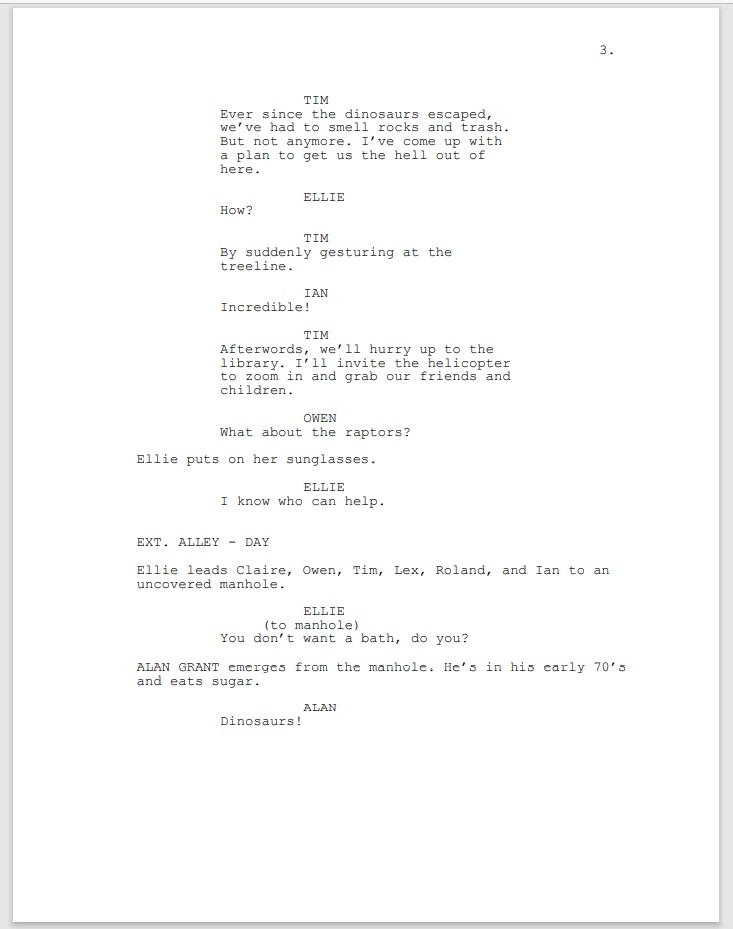
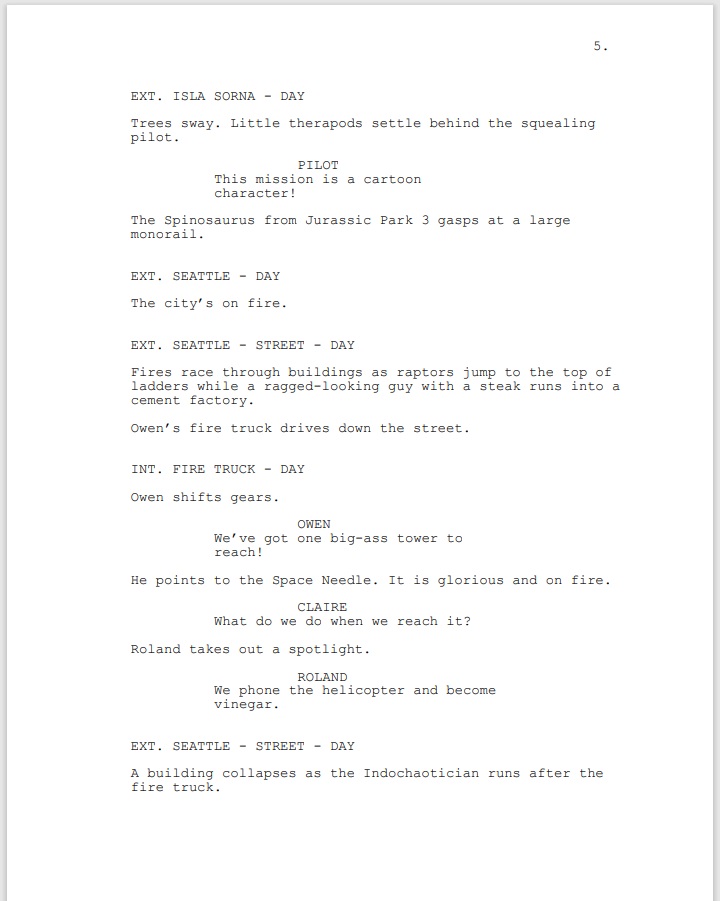
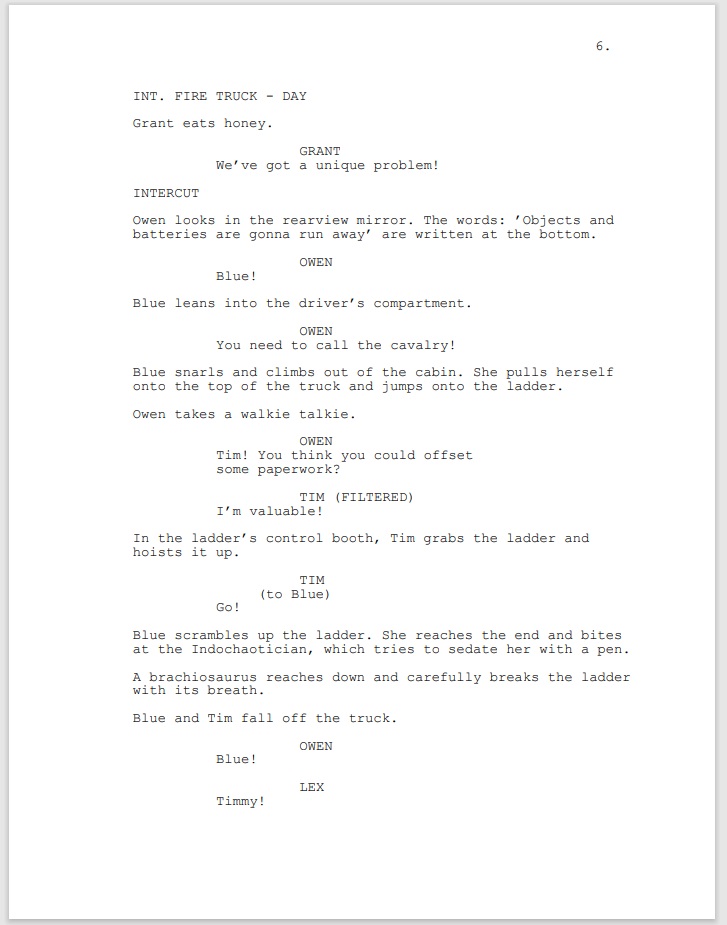
I’ve written about ‘Dominion’ before, and back in 2019 I tried my hand at theorizing how the film might turn out… by taking the scripts for ‘Jurassic Park,’ ‘Jurassic World,’ and ‘Jurassic World: Dominion’ and putting them into a predictive text generator to see what sort of gibberish it would spit out. I originally intended to do dozens of pages of Grant, Ellie, Ian, Owen, and other characters talking nonsense, but real life got in the way and I never finished the project. With the release of the trailer, I figured this would be a good time to post the pages that were finished, if only to give people a laugh at what would have been the most bonkers summer blockbuster ever released. (If the pictures are too small, right click and open them in a new tab.)
Last year, I gathered all my courage, mourned not being able to watch The Incredible Hulk, and finally sat down to watch the Star Wars Holiday Special, which is commonly called one of the worst moments in television history and one of the biggest missteps in the Star Wars franchise, sentiments that are completely and utterly 100% true. And while I played up this awfulness for comedic value, I figured it was time to actually write out what works well and what doesn’t in the special because, despite what pop culture might tell you, I was surprised to find that the special is… not that awful.
Now, don’t get me wrong; the special is not some misunderstood masterpiece that has aged like fine wine. It is a bad show with seemingly endless padding, almost ten minutes of non-stop Wookie gargling without subtitles, stirring and whipping, and the… inconsistent acting. And that’s before Leia breaks out into song. But as hard as it may be to believe, there’s also some good things, too: the lighthearted, feel-good music, seeing Luke, Leia, Han, and all the other classic characters doing their stuff, the 70’s style that saturates the whole thing, and some downright hilarious Youtube comments.
Now, lest you feel the temptation to actually sit down and watch the special (an endeavor I don’t recommend unless you’ve consumed copious amounts of alcohol) sit back and let me present to you the hard-won writing lessons I got from watching this piece of 70’s kitsch.
What does the story do well?
The core concept isn’t bad
Regardless of its execution, the story of the Holiday Special itself isn’t bad: During a period of galactic civil war, Chewbacca tries to get back to his family on Kashyyyk to celebrate Life Day, the most important holiday in Wookie culture. But it won’t be easy: the Galactic Empire is in hot pursuit of Chewie, and maintains a presence on Kashyyyk harassing the locals. Not only will Chewie and Han have to escape the Empire, but Chewie’s family will also have to outsmart and outwit the local Imperials before Chewie arrives so they can all safely celebrate. That’s not a bad story at all, which leads the Special to stand as proof that even the best story ideas can fail due to other circumstances.
It has a good introduction to Boba Fett
While fans generally agree that the Holiday Special is awful, there is also agreement that the best part is a short cartoon that features the first appearance of Boba Fett, one of Star Wars’ most famous side-characters. And they’re right! It’s a short, self-contained story that takes full advantage of it’s animated medium to create interesting and unique visuals that would be expensive to do in live-action, as well as give Boba a moral ambiguity that left first-time viewers wondering if he truly was an ally or someone nefarious, all aided by an excellent voice performance by Don Francks. Plus, hearing Darth Vader in any cartoon is always an excellent thing.
It shows what life is like for ordinary people in a sci-fi universe
If there’s only one thing the Holiday Special does well, it’s to show what life is like for ordinary, everyday people in the Star Wars galaxy, the folks who aren’t involved in the war, who aren’t firing blasters at Stormtroopers, and who just want to get through their day. We get to see cooking shows, what a Wookie home is like, the toys a child has in this galaxy, and what common people do to relax and have fun.
While showing ordinary life in a fantasy world sounds boring (don’t we indulge in fantasy to escape from everyday life?), it actually adds a lot of depth to that universe. Films and books typically devote little to no time showing what everyday life is like for people in fantasy worlds because of needing to focus on whatever is threatening that world. Devoting an hour and half to showing people buying and preparing food, playing, relaxing in bars, and celebrating holidays doesn’t bring in the big bucks at the cinema, after all, which makes these kind of stories rare, and even rarer in one of the biggest film franchises in history.
What could have been done to improve the story?
Everything
Okay, that’s too easy.
It could have cut out the Wookie porn
Unless it is a vital part of the story, we don’t need to watch an elderly Wookie getting sexually stimulated by softcore virtual pornography.
It could have cut out all the padding
On retrospect, I think one reason the Holiday Special earned such a disastrous reputation is that so much of it feels like padding. Part of this is due to the variety show format, but while parts of it are… tolerable… most are not, such as Malla stirring and whipping, and almost four minutes of assembling a transmitter. If these segments were removed and the story revised to focus on the holiday aspect, it would have been a stronger, more enjoyable tale.
It could have made the story more ‘holiday-ey’
While the slice-of-life format of the Holiday Special is a welcome change from the constant, non-stop war seen in all the Star Wars films, the holiday aspect feels almost non-existant. While it wouldn’t make sense for the Star Wars universe to just copy Christmas traditions verbatim, it would have been nice to see more holiday traditions throughout the special, such as festive decorations, gift-giving, etc. Even having Itchy, Lumpy, and Malla try to spread holiday cheer to the Imperials who come to their house would have helped embody the spirit of a winter holiday. As it is, the special’s only holiday aspect comes at the very end; while this works as the climax to the story, it would have been better to have more moments of festivity throughout.
Conclusion
While it deserves much of the negative reception it’s received, the Star Wars Holiday Special is, like every story, a product of its time. Where the rest of the Star Wars saga is a timeless story, the Holiday Special is a weird time capsule of the late 70’s, for better or worse, a time where where variety shows were viable entertainment, but starting their slide into obsolescence, and the Star Wars franchise was still trying to find its footing. And while there is a lot to dislike here, there’s still some good stuff, too. In a way, the Special is like our own holiday season: If we honestly search for things to be thankful for in a world filled with pain, suffering, and misery, we can find them.