Ever since it’s release in 1980, ‘The Shining’ has kept viewers guessing for decades about it’s various secrets, including exactly what is going on with the Overlook Hotel itself. The film strongly hints – and the sequel, ‘Doctor Sleep’, all but confirms – that the building itself has a sort of consciousness that forces the ghosts of the hotel to do its bidding and absorb more souls into its haunted walls. And this hotel is an example of the most frightening kind of evil, one that is patient, biding its time as it watches it victims, learns about them, discovers their weakness, and slowly applies pressure to make them give in to their worst impulses without them realizing it, eventually becoming permanent guests in the time-warp that is the Overlook Hotel.
But like all great horror stories, ‘The Shining,’ never reveals what the Overlook’s malevolent self looks like. It is always out of sight, always hidden, and never seen..
But what if the Overlook’s dark core has been hiding in plain sight?
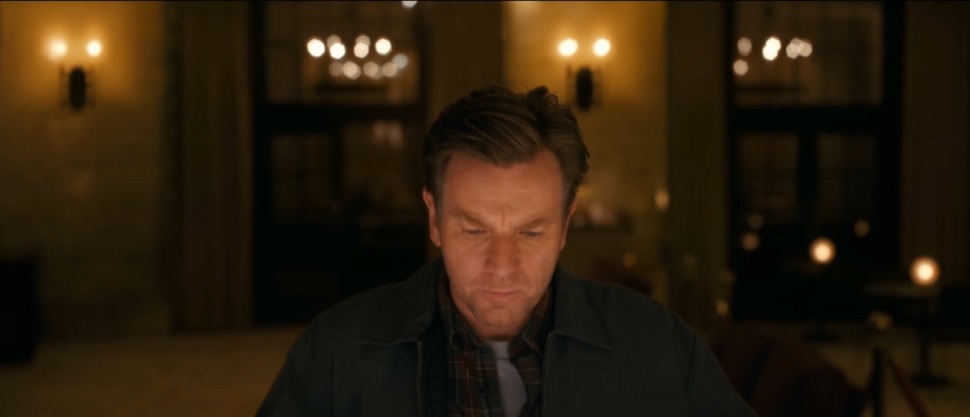
In the 2019 adaptation of ‘Doctor Sleep,’ a grown-up Danny Torrance returns to the rotting remains of the Overlook. What follows is a nostalgic tour of the hotel’s many iconic areas in a state of disrepair, including the Gold Room, where Danny has a ghostly reunion with his father. And while the film rightfully focuses entirely on the talk between father and son, there’s something about this scene that isn’t noticeable unless you’re paying very close attention to the background. Specifically, this shot:
Notice those lamps in the background? They look like mouths. Gaping maws of darkness with the bright, glowing, featureless eyes above them. This, I believe, is the true face of the evil haunting the Overlook, a gaping maw and inhuman eyes, ready to suck in anyone it can get, and they’ve always been there. Compare that shot to the original film:
Notice how in both films, neither Jack or Danny notice these faces. But Lloyd does, and so does Jack when he’s behind the counter in ‘Doctor Sleep.’ How can you tell? Look at their eyelines.
It’s as if they’re silently watching their demonic master before turning their attention back to the latest slave the Overlook wants to add to its collection. And it’s not just the gold room; these lights can be seen throughout the film: the very first time we see Jack, the hotel is watching him.
It watches Jack when he’s working on his book:
Or when Danny is riding his bike:
Or when Rose walks through its halls decades later:
But that’s not all: there are moments when these lights are not lit, like when Wendy is walking around:
The lights aren’t lit because the Overlook isn’t interested in Wendy. It wants Jack and Danny, not her, so it doesn’t bother watching her. Likewise, when Dick arrives at the Overlook and looks for the Torrances, the lights aren’t on; he doesn’t see them:
Yet, moments after he dies, the lights are on, watching Jack, encouraging him to continue his rampage:
Of course, this is just a theory. But perhaps the Overlook has been staring at us for decades; we just never saw it.
Back in 1975, Steven Spielberg made a little movie called ‘Jaws’, creating not only the era of the summer blockbuster, but also the best shark movie of all time. Even after 45 years, no other shark film has managed to surpass it, and Hollywood, recognizing what a gem they had on their hands, wisely and respectfully allowed the franchise to end with just one movie.
Just kidding. This is Hollywood we’re talking about, so we got three sequels of increasingly lower quality, ending with one so reviled that Universal hasn’t tried to make a new ‘Jaws’ sequel in over thirty years. Perhaps no other film franchise in history has suffered so badly from the law of diminishing returns, going from one of the greatest horror/thrillers ever made to one of the most mocked. Yet, are ‘Jaws 2,’ ‘3D,’ and ‘The Revenge’ really that bad? Are they actually better than pop culture would have us remember?
No. No, they’re not. But the greatest learning comes from the greatest failures, and what better way to learn how to do unnecessary sequels than to study the mistakes and missteps of Jaws’ unloved children? Thus, throughout January, we’ll be taking a look at all four Jaws films to see what lessons they can offer writers on how to do sequels. But unlike my Sharknado series, or the Friday the 13th comparisons, I’ll be doing something differently this time around: Instead of focusing on what the films did wrong (too many characters, bad visual effects, roaring sharks who want revenge on the Brodys, etc.), I’ll instead be focusing on what each film does well, because, despite their reputation, the three Jaws sequels do have their merits. Today, we’ll kick things off with the one that started it all: 1975’s, ‘Jaws’
Do I really need to describe just how good ‘Jaws’ is? It succeeds at every aspect, from characters, story, suspension, and casting, to cinematography and visual effects. So, in order to avoid a Stephen King-length analysis of what the film does right, I’ll stick with the four things I think it does best. (If you’re looking for a much more in-depth look at how good the film’s story and characters are, I suggest reading this excellent article by Jabootu.net).
4. The Story Is Self Contained
It seems like every movie made these days is written as the start of a trilogy, with studios hoping to create franchise after franchise they can come back to time and time again for decades to come. But despite being followed by three sequels, ‘Jaws’ is refreshingly self-contained with no loose ends or hints of a sequel. By the end of the film, the shark has been blown up, the threat to Amity Island is ended, and Brody and Hooper are free to pick daisies, frolic through the meadows, and live happily ever after. It’s the logical end to the story, one that doesn’t need any follow-ups or sequels, and doesn’t leave us feeling like we’ve only seen a full-length ad for the next installment.
3. The Isolation
Isolation is a critical part of the horror genre: What’s more frightening then being far from civilization and cut off from help while facing something wants to kill you, or worse? It might not be obvious at first, but ‘Jaws’ thrives on this isolation, taking place entirely on an island and a boat at sea. Yet, there are still multiple examples of characters being isolated and alone when attacked:
The opening attack, where poor Chrissie is alone and helpless in the water, her friends too far away (or too drunk) to hear her screaming for help as she dies.
The two guys on the pier have no time to call for help when the shark goes after their bait, and then comes after them.
Ben Gardner and his mate were alone when he was attacked, and Brody and Hooper are equally isolated when they come across his boat in the dead of night.
Brody, Hooper, and Quint are isolated on a slowly-sinking boat and unable to call for help or get to shore without being eaten, and their only chance is to build a shark cage in a last-chance attempt to kill the beast.
The common thread in all these moments is that the characters are in the ocean with few to no tools or weapons they can use to fight back. The shark has all the advantages (speed, killing power, size, etc.), while the humans have only their wits and intelligence.
2. Everything In The Film Revolves Around The Shark
One thing that I admire about ‘Jaws’ is something that sounds so simple, yet is so hard for so many movies to get right: Everything in the film (with the exception of Brody’s introduction) revolves around the shark. Even when it’s not on-screen or killing anyone, everything the characters do revolve around the shark: A town hall meeting is held because of the shark’s attack on Chrissie; Brody and Hooper have dinner to discuss cutting open the caught tiger shark, despite Hooper believing that the real shark is still out there; Quint talking about the Indianapolis on his boat that he, Brody, and Hooper are on because the want to kill the shark, and so on.
Virtually every scene in the film happens because of the shark, or is influenced by its actions. It’s holding the entire island hostage, and the story and the characters react accordingly. So many other monster movies have scenes or subplots that don’t revolve around their respective beasts that they take away from the film, but ‘Jaws’ wisely avoids such a mistake.
1. The Unseen Is Scarier Than What’s Seen
If there’s one thing ‘Jaws’ does perfectly, it’s that it relies on not seeing the shark so much, forcing our imaginations fill in the blanks every time its presence is felt, making inanimate objects like a broken pier, a stick in the surf, or a splintered piece of wood on Ben Gardner’s boat, bone-chilling. Not seeing the monster makes it so much more horrifying, and this extends to the first time we get a glimpse of it without seeing its whole body. But even better, the film doesn’t go overboard once the shark fully appears when Brody and Co. are hunting it; there are still plenty of times it’s hidden, and uses those moments to imply its intelligence and cunning, before finally having it take center stage at the climax.
Like salt, ‘Jaws’ masterfully uses the shark sparingly, letting it appear just enough to satisfy out curiosity, but letting it stay hidden most of the time, marinating our fear and making its inevitable appearances all the more satisfying.
Tune in next week, where we’ll take a look at Jaws 2, one of the most unnecessary sequels of all time, but not necessarily a bad one.


 Imperfect Glass