Once in a while, you come across a moment in a story that is so perfect that it stays in with you for years, or even a lifetime. These are moments that, in my opinion, are flawless; perfect gems of storytelling that cannot be improved in any way, and are a joy to treasure and revisit again and again.
***
The Video:
NOTE: This video has language that is not safe for work.
Why it’s Perfect
Another Thanksgiving has come and gone, and as we all settle down into our post-dinner comas, we dream of finally being able to put up all the Christmas decorations once again.
But with Christmas comes something else: something malevolent, malicious, and that infects the soul. No matter where you go, no matter what you do, you cannot escape it. But no one who works in our stores can escape it, and they will spend the next month fighting off the madness that will attempt to destroy us all. Please spare a moment to thank them for their sacrifice so that we can continue to get the consume goods we need while they struggle not to go insane.
What is this evil? Well, just watch the video and find out. And if you have scars from having to wrestle with this madness then you’ll hopefully get a laugh out of it like I did.
‘Resident Evil: Afterlife,’ could have – with a few minor changes – worked as a satisfying end to the Resident Evil film series. But with the cliffhanger ending of Alice, Chris, Claire, K-Mart, and other survivors facing a fleet of Umbrella VTOL’s while armed with nothing more than handguns, shotguns, and the power of positive thinking, it was inevitable that we’d get another followup (that, and earning 300 million at the box office). Sure enough, we got ‘Resident Evil: Retribution’ two years later.
Let’s take a look and see what the fifth entry in the series does well and what could use some improvement.
What does the story do well?
It has a memorable title sequence
It has no ultimate impact on the film’s story, but ‘Retribution’ features the most unique opening of the series, depicting Umbrella’s assault upon the Arcadia, but played in reverse.
It’s a great way to get the viewer’s attention by showing Alice’s defeat and the end of the battle first, and then depicting how it got to that point. Having a great soundtrack helps, too!
It has a great cold open to grip the viewer
After the Umbrella attack and Alice’s defeat, ‘Retribution’ cuts to Alice waking up in a suburban home where she’s married to Carlos (who blew himself up two movies ago) and has a deaf daughter. Unfortunately, her suburban bliss is interrupted by a zombie attack that ends with Carlos becoming a zombie and then killing Alice.
Much like the opening to ‘Extinction,’ this is a great sequence because the audience is trying to figure out just what’s going on because it flies in the face of everything we know about Alice: is it a dream? A hallucination? Something from a parallel universe? As a bonus, it also lets us see different versions of Alice, Carlos, and Rain, all three of whom have no combat skills or fighting experience, making their fight to survive all the more gripping. It’s a great way to get our attention while setting up the reveal about the cloning facility later on
It has a great setting
Although the film’s tagline is ‘Evil goes Global,’ ‘Retribution’ actually takes place almost entirely within Umbrella Prime, an underwater Umbrella facility off the frozen coasts of Russia, which houses recreations of famous global cities that are used to test the T-virus. Now trapped inside, Alice and her allies have to fight their way back to the surface before everything is blown to pieces. It’s a great setting for an adventure story that allows the characters to visit a large variety of locations instead of a single environment like the previous films (an underground lab, a city, a desert, etc.).
It has the best ticking clock yet
‘Retribution’ continues the series’ tradition of having a great ticking clock to keep the plot moving, and this is arguably the best one: Alice and her friends have just an hour and a half to escape from Umbrella Prime before it’s destroyed, taking them with it. That countdown gives every action they take and every delay extra weight.
It has more characters from the games
‘Afterlife’ was one of the most entertaining films in the series due to having more elements from the games (Wesker, Claire, Manjini zombies, the executioner, triple-barreled shotguns, and Chris Redfield). ‘Retribution’ continues that trend by having series regulars Leon Kennedy, Ada Wong, Barry Burton, and everyone’s favorite, Sergei Vladimir (you remember him, right?) joining returning faces like Wesker and Jill, the latter of whom gets a much bigger role here as the main antagonist. While these newcomers may not have great characterizations or much to do besides mowing down zombies, it’s still fun to see them on the big screen,
It shatters the status quo
One of ‘Retribution’s best scenes takes place at the end of the first act, where, in a little over five minutes, the narrative of the series is expanded and changed in interesting ways that shatters the status quo.
Among those changes are:
1. The Red Queen has taken over Umbrella and seeks to destroy all life on Earth.
2. Because of this, Wesker has defected from Umbrella and now fights against the corporation.
3. Wesker, Alice, and everyone else must unite to stop the Red Queen, or humanity is doomed.
These changes mark a turning point for the story of the Resident Evil film series, and smartly lays the groundwork for the series finale. We’re not there yet, but we now know what’s at stake and this helps wet the audience’s appetite for said finale.
The main antagonist is now an ally
I’m a sucker for enemy mine stories, and having Albert Wesker now working with Alice and the others against Umbrella has incredible storytelling potential: There’s nothing quite like having an antagonist deciding to join the victims, and seeing their different outlooks, personalities, and histories clashing against each other, which has endless opportunities for not only drama, but the possibility of the antagonist achieving redemption. And one little touch about Wesker’s turn is that he’s now effectively the leader of the United States. In other words, the series’ most awesome villain is now the president of the United States! Awesome!
It brings back the coolest enemy
It’s always a risk to bring back fan-favorite characters, especially if there’s not a good narrative reason to do so, but thanks to Umbrella’s cloning powers we get to see the Executioner return from ‘Afterlife,’ and watch not one, but two of them battle Alice and Ada in the streets of (fake) New York.
While the scene ultimately doesn’t contribute to the story, it’s still great fun to see a great monster come back for an encore performance.
The final battle is different from all the others that came before it
In all the previous films, the climaxes involved defeating a single, overpowering monster or escaping an explosion, often with a hefty dose of CGI. ‘Retribution,’ however, features a massive melee battle between Alice, Jill, Rain, Leon, and Luthor in a snowy field where they have to rely on their fists and hand-to-hand combat abilities and find a way to stop an almost unkillable Rain without relying on guns.
Unlike previous battles where Alice had the upper hand or won fairly easily, she is resoundingly beaten by Jill and would have died if not for freeing Jill from Umbrella’s mind-control at the last second. And as a bonus, it’s satisfying to see Jill – who has always had her thunder stolen by Alice in previous films – get her revenge. Or, rather, her retribution, if you will.
It has the best ending and the best cliffhanger of the series
Cliffhangers are an inherently risky storytelling trope, but when pulled off well they leave the audience excited and eager to see what comes next. ‘Retribution’ does so with flying colors, ending with Alice, Jill, Ada, Leon, and Wesker joining forces in the ruins of Washington DC and preparing for their last stand against an army of undead sent by the Red Queen. Freaking. Awesome.
What could the story have done better?
It could have removed the opening flashback
Though it’s a tradition for each Resident Evil film after the first to recap what happened in the previous movies, it is starting to wear a little thin. And after four movies, it’s safe to assume that people who are coming to watch ‘Retribution’ are fans who know what happened already, making the flashback summary unnecessary.
It could have removed Alice’s bleeding
At two times in the film, Alice looks down to find herself bleeding from a wound in her side… but nothing ever comes of it. Cutting these shots out would have freed up thirty seconds that could have been invested in character moments.
It could have eliminated the cloning aspect
‘Retribution’s biggest draw was the return of several deceased characters from the past films, including Carlos, Rain, and One, via the magic of cloning. However, the film doesn’t do anything with them: the characters show up, shoot bullets, and then get killed. While it’s a stretch to imagine that a zombie action movie would explore the moral delimas of cloning, it doesn’t use the cloning idea in any meaningful way: Pacifist, anti-gun Rain never meets her cold, heartless self, for example, and at one point Ada talks about how Umbrella uses clones and how they’re all disposable; you’d think it’s setting up some interesting moral ideas that will be explored later on (such as Alice seeing clones as people instead of disposable test subjects), but nothing comes of it. In hindsight it might have been better to remove the cloning aspect entirely and perhaps have all the test subjects at Umbrella Prime be prisoners that Umbrella has captured, which would force Alice and the others to decide if they could risk spending the time to save them or continue on and leave them to die to ensure Alice’s survival.
It could have removed the Las Plagas parasite and the enhanced zombies
Another selling point for ‘Retribution’ was that the Las Plagas parasite would make an appearance from the fourth Resident Evil game, which allows zombified people to keep their intelligence and the ability to use weapons and tools. As such, we’re given scenes of Russian zombies using assault rifles, machine guns, rocket launchers, chainsaws, and even driving cars and motorcycles.
The problem is, zombies are supposed to be mindless killing and eating machines who are dangerous because of their resistance to physical injury, immunity to pain, and sheer numbers. By giving them guns and vehicles, they’re essentially normal human enemies with bad teeth and rotting skin. A good solution would have been to have the T-virus continue to mutate, giving zombies more abilities and intelligence, which could have been followed up on in the next movie. But the Las Plagas parasite doesn’t return in the final chapter, and aside from making Rain impossible to kill with bullets, it ulitmitly has no impact on the story.
It could have given characters time to breathe
‘Retribution’ is the most action-packed film in the Resident Evil series, with a breakneck pace that never lets up. While this – in conjunction with the ticking clock – is great for keeping the film moving, it would have been nice if the story took a few moments to breathe between action scenes and invest in letting us get to care for the characters, or develop their relationships between one another. It would have been nice to have Luthor and Alice have a longer reunion, given their shared experiences from ‘Afterlife,’ but they only get a few seconds to speak before we’re off to the next action sequence. While well-done action scenes are fun, caring about the people in those sequences is more important.
While ‘Retribution’ exists to set up the final chapter of the series instead of being a standalone story, it at least offers some good action, has a story that is never slow or dull, and while it doesn’t do anything meaningful with the cloning aspect, or giving characters much to do beyond shooting guns, it’s still an enjoyable entry in the saga. More importantly, it sets the stage for the final film; come back next time, where we’ll take a look at how the series ends. With all the elements in place for a truly epic grand finale, there’s no way the series could mess it up!
Ever since it’s release in 1980, ‘The Shining’ has kept viewers guessing for decades about it’s various secrets, including exactly what is going on with the Overlook Hotel itself. The film strongly hints – and the sequel, ‘Doctor Sleep’, all but confirms – that the building itself has a sort of consciousness that forces the ghosts of the hotel to do its bidding and absorb more souls into its haunted walls. And this hotel is an example of the most frightening kind of evil, one that is patient, biding its time as it watches it victims, learns about them, discovers their weakness, and slowly applies pressure to make them give in to their worst impulses without them realizing it, eventually becoming permanent guests in the time-warp that is the Overlook Hotel.
But like all great horror stories, ‘The Shining,’ never reveals what the Overlook’s malevolent self looks like. It is always out of sight, always hidden, and never seen..
But what if the Overlook’s dark core has been hiding in plain sight?
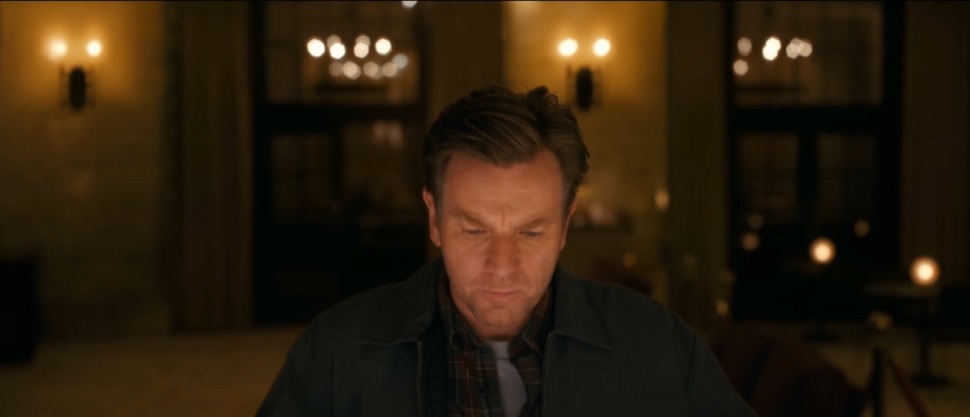
In the 2019 adaptation of ‘Doctor Sleep,’ a grown-up Danny Torrance returns to the rotting remains of the Overlook. What follows is a nostalgic tour of the hotel’s many iconic areas in a state of disrepair, including the Gold Room, where Danny has a ghostly reunion with his father. And while the film rightfully focuses entirely on the talk between father and son, there’s something about this scene that isn’t noticeable unless you’re paying very close attention to the background. Specifically, this shot:
Notice those lamps in the background? They look like mouths. Gaping maws of darkness with the bright, glowing, featureless eyes above them. This, I believe, is the true face of the evil haunting the Overlook, a gaping maw and inhuman eyes, ready to suck in anyone it can get, and they’ve always been there. Compare that shot to the original film:
Notice how in both films, neither Jack or Danny notice these faces. But Lloyd does, and so does Jack when he’s behind the counter in ‘Doctor Sleep.’ How can you tell? Look at their eyelines.
It’s as if they’re silently watching their demonic master before turning their attention back to the latest slave the Overlook wants to add to its collection. And it’s not just the gold room; these lights can be seen throughout the film: the very first time we see Jack, the hotel is watching him.
It watches Jack when he’s working on his book:
Or when Danny is riding his bike:
Or when Rose walks through its halls decades later:
But that’s not all: there are moments when these lights are not lit, like when Wendy is walking around:
The lights aren’t lit because the Overlook isn’t interested in Wendy. It wants Jack and Danny, not her, so it doesn’t bother watching her. Likewise, when Dick arrives at the Overlook and looks for the Torrances, the lights aren’t on; he doesn’t see them:
Yet, moments after he dies, the lights are on, watching Jack, encouraging him to continue his rampage:
Of course, this is just a theory. But perhaps the Overlook has been staring at us for decades; we just never saw it.
Every story has a cast of characters that we follow and watch and come to love… but what about the background characters? The nameless masses who rarely get our attention? This column examines my favorite background characters who deserve a moment in the spotlight.
***
The Show:
‘The Lenny Henry Christmas Show’
The Character:
A random audience member
The Scene:
Why He Deserves A Moment In The Spotlight
It’s spooky season once again, and what better way to mark the occasion than with this terrifying live action parody of Wallace and Gromit from 1995’s ‘The Lenny Henry Christmas Show’? The lovable, charming duos of Wallace and Gromit have gone from England’s most lovable couple into inter-dimensional abominations wearing skinned flesh in an attempt to blend in with humanity and their canine companions. It’s so grotesque, so horrifying, that at 0:51 in the clip, you can just faintly hear someone in the audience groaning, ‘Oh god…’ I don’t know who this man is or anything about him – and he’s not even a background character, per se – but he sums up the audience’s feelings so perfectly that he becomes the best thing about this sketch, stealing the show from the two things that will haunt my nightmares forever more.
Every story has a cast of characters that we follow and watch and come to love… but what about the background characters? The nameless masses who rarely get our attention? This column examines my favorite background characters who deserve a moment in the spotlight.
***
The Show:
‘Stranger Things: Season 4’
The Character:
Agent Harmon
The Scene:
Why He Deserves A Moment In The Spotlight
Recently, I watched all four seasons of Stranger Things, a show with a great many characters both major and minor, but one of whom stands out as one of the most awesome redshirts you’ll ever see on TV.
For those of you who are unaware, a Redshirt is a minor, typically unnamed character in a movie, show, or book who exists sorely to die and establish how dangerous a situation is for the main characters. Named after the famous crewmembers from Star Trek, they’ve become a joke in pop culture, and I was expecting the two government agents in the fourth season of Stranger Things to be the same.
Boy, was I wrong.
When military spooks break into Will and Jonathan’s house to kill them, I thought agent Harmon would quickly fall like his partner, leaving the boys to fend for themselves. But to my surprise, Harmon immediately morphed from an overweight, lazy, tv-watching agent into a stone-cold warrior who fearlessly takes on an entire squad of soldiers with only a pistol and wins. Granted, he doesn’t kill them all, but he does stop them from getting Will and the others, ensuring that they escape to find Eleven.
What’s so great about this scene is that even though we know so little about Harmon, we quickly become invested in his struggle because we subconsciously know he doesn’t have plot armor and could die at any time, making his fight even more engaging than the main characters who we know are going to survive until the climax of the story. He’s a redshirt who temporarily becomes a main character, one who is responsible for keeping the others alive… but, sadly, at the cost of his life.
Rest in peace, Harmon (AKA, Unknown Agent Hero Man). We only knew you for a few minutes, but if you had gone to the Upside Down with the others in the season finale, you’d have killed Vecna in seconds with that legendary pistol of yours and saved the world.
With the conclusion of 2004’s, Resident Evil: Apocalypse, the Resident Evil film series was in a unique position: because of Apocalypse’s open ending, future movies could either stick to the story, characters, and settings of the games, or forge a new path that wasn’t tethered to its source material. While the safest option was the former, the series went with the latter, but with a twist: it would take characters, monsters, and ideas from the games, but explore what would happen if the T-virus escaped into the wider world instead of being stopped time and time again.
The answer? Disaster.
Picking up five years after the events of Apocalypse, Extinction drops us into a world where the T-virus escaped Raccoon city and spread worldwide, causing billions of people to turn into zombies and turning the planet into a barren wasteland on the brink of total collapse. Now, Alice and the few remaining survivors struggle not only to escape the undead, but end the pandemic once and for all (and presumably struggle to find toilet paper). It’s a great setup for (what was supposed to be) a series finale, so let’s see what worked, and what didn’t.
What does the story do well?
It has an opening that sucks the viewer in right away
If there’s one thing that Extinction does truly well, it’s getting the audience’s attention from the very start by having Alice wake up in the shower from the mansion from the first film.
But this can’t be; the mansion was destroyed when Raccoon City was nuked. And then when Alice leaves the main room, she enters the famous laser hallway, and then a hospital hallway, leaving us to wonder if this a dream, a flashback, or something else… only to discover that Alice is actually a clone going through a murder training simulation run by Dr. Issacs.
By showing the audience something familiar, yet mixing up to play with expectations, the movie gets their attention immediately and makes them want to see more.
It has a unique twist on a zombie virus
Most zombie movies have their respective virus turn people (and the occasional animal) into zombies; Extinction mixes things up by having the virus affect water and vegetation as well, something I don’t recall any other zombie film doing.
Granted, this idea is retconned out in future films (and it does bring up the question of if there are undead plants that desire to eat the flesh of the living), but it’s a fascinating idea that makes the T-virus a truly diabolical threat to humanity: by wiping out plants, then herbivores, then carnivores, and eventually the entire food chain, it means that humanity will inevitably go extinct, lending even more urgency to find a cure.
It has a clearly defined goal for the characters
Extinction continues the Resident Evil film series’ tradition of giving the characters a clear, concrete goal to work towards. Here, it’s to reach a settlement in Alaska that’s free of infection, a safe haven in a world that’s dying. By making the film’s goal have a clearly defined finish line, it gives both the characters and the audience something to focus on instead of just meandering around.
The comic relief character has become more mature
While Apocalypse had it’s share of problems, one of the most egregious was making LJ little more than a walking cliche of the trash-talking, sassy black gangster. Thankfully, Extinction corrects this; while LJ is still the story’s comic relief and cracks a few jokes, he’s much more serious this time around, focusing on doing his part for the convoy, trying to save people, and mourning his girlfriend after she dies. You really sense that LJ has gone through a lot in five years and has grown as an individual… which makes it all the sadder when he (and we) realize that his death is inevitable after being bitten by a zombie in the first act.
The post-apocalyptic convoy gets along with each other and has a good leader
One small thing I like about Extinction is the lack of conflict among the survivors in Claire Redfield’s convoy: there’s no infighting, squabbling, or backstabbing. After countless post-apocalyptic tales where everyone is at each other’s throats, it’s a welcome change to have a similar story where people can get along and work together. This also extends to the convoy’s leader, Claire, who – instead of being a tribal warlord who rules through threats and fears – treats those under her care with respect, is honest with them about difficult decisions they have to make, seeks their input before making those decisions, and works hard to keep everyone safe, even if it means charging into battle instead of letting others fight for her.
It has a unique monster that relies on numbers instead of strength
Aside from the zombies themselves, the Resident Evil film series likes to focus on individual monsters to antagonize the heroes; while Extinction does feature a Tyrant at the climax, it is unique in all the films in that it has monsters that rely on sheer numbers to win instead of being bullet sponges, and that’s the undead crows.
While it would be fairly easy to kill a single crow in a fight to the death, having hundreds attack the convoy makes them a much bigger threat that’s impossible to stop with bullets or conventional weapons, making them into a truly unique enemy in the series.
It has a great setting for the final act
Compared to the dark, gloomy settings of the two previous films, Extinction spends most of its runtime in the desert during bright, sunny days. But at the end, Alice has to got into another underground facility to face off against a heavily-mutated Dr. Issacs and save humanity. But it’s not that the facility is deep underground that makes it so compelling: by the time Alice arrives, the place has been wrecked and torn apart by Issacs. There’s no one left alive, all the lights are flickering on and off, and evidence of Issac’s rampage are everywhere. Alice knows that Issacs is somewhere in the facility, and it’s just her against him. And, smartly, the film holds off on showing him as long as it can, letting our minds race and wonder just how grotesque he must look after mutating and inflicting so much carnage.
This buildup is surprisingly suspenseful, and arguably the tensest sequence in the entire series. Having the final battle take place in a replica of the mansion from the first film is also a clever way to end the series where it began (sorta), and using the laser hallway to finish off Issac once and for all is a great example of why bringing back fan favorites to save the day is always a win.
It tones down Project Alice
Compared to the previous film where Alice was an arrogant Mary Sue who could take on anything that came her way with ease, Extinction learns from those mistakes and tones her down considerably, making Alice more subdued and getting rid of her ‘I don’t give a shit’ attitude. And unlike the last movie, the other characters have more opportunities to have their own action scenes and moments to shine without Alice coming in to steal her thunder.
While she’s still the main character and still the focus of this film’s universe, Alice feels more like a normal person, and that’s a welcome change from the previous film.
What could have been improved?
Issacs could have had a more logical plan throughout the film
Dr. Issac’s plan of domesticating zombies to create a loyal work force to rebuild the world is not only silly, but flies in the face of all logic: Considering how the T-Virus has brought humanity to the brink of extinction and turned the world into an uninhabitable wasteland, you’d think that Issacs would realize it makes more sense to destroy the T-virus and everything it’s infected instead of creating zombie butlers, zombie farmworkers, and zombie retail employees, which could have led to an interesting conflict between him and Alice: both groups would want to save the world, but Alice and her companions wouldn’t trust Umbrella or Issacs, a relationship that could have had all sorts of compelling drama. That’s also not factoring in the nonsensical ‘tests’ he has the Alice clones go through. (Why not just grow one and regularly extract her blood instead of wasting an unimaginable amount of resources putting dozens of them through unwinnable deathtraps?)
This point could be negated, however, if we theorize that Issacs is actually using his research as a mask to create an army of super-zombies that he alone will be in control of, allowing him to overthrow Umbrella and become the sole ruler of Earth. It’s still a silly plan, but a bit more logical and reinforces his sociopathic nature.
LJ’s inevitable death could have been explored more deeply
Near the end of the first act, LJ is bitten by a zombie while investigating an abandoned motel and hides this from the others, progressively becoming sicker until he finally succumbs at the end of the second act and bites Carlos before being killed. And while it’s depressing to see the admittingly charming LJ die an undignified death (In the original script LJ actually accompanied Alice into Issac’s underground compact), the movie misses the opportunity to have LJ confess to the others that he’s been bitten, and the drama that would come from that: perhaps the convoy would have decided to let him live long enough in the hopes of finding an antidote, with LJ determined to do as much as he can to help the others before he succumbs. But instead, we get him hiding his zombie bite, which makes the other characters look quite dumb for not realizing that he’s getting progressively sicker and weaker.
The secret facility could have been guarded by more than a single chain-link fence
This has little impact on the story, but it’s improbable that Issac’s super-secret, camouflaged underground fortress is protected from billions of zombies by a single chainlink fence. How it hasn’t been breached after five years of zombies banging against it is beyond me!
It could have cut down on the number of characters
It’s a tale as old as time: a zombie movie comes out, and it’s filled with lots of expendable characters who are only there to be killed off by the undead, and Extinction makes the same mistake of introducing lots of new characters without giving us reasons to care about them. K-Mart, for example, is a teenager who was found in a K-Mart and… that’s all we know about her. Similarly, all we know about Betty is that she’s the group’s medic, LJ’s girlfriend, and the two care about each other.
To the film’s credit, it doesn’t try to make us care about everyone, instead letting most of the convoy’s survivors be nameless masses to be eaten, but it would have been better to cut down on the new characters. Instead of a multi-vehicle convoy with dozens of people in it, perhaps it could be a three-vehicle convoy with a dozen people maximum, giving the story a bit of breathing room to let us get to know them better.
It could have removed the cliffhanger ending
When originally created, Extinction was billed as being the final installment in the Resident Evil film franchise, complete with Alice learning that she can wipe out the virus for good near the end of the movie. Yet, instead of cutting to ten years later where the undead are gone and nature is healing, Extinction ends with Alice waking up her clone buddies in preparation for an assault on Umbrella’s Tokyo headquarters. While this ending would have worked if the series had ended (the main conflict is resolved and Alice has everything she needs to wipe out the virus and bring justice to Umbrella), Extinction doesn’t feel like the end; the story clearly isn’t over, and there’s more to come (an idea that would be revisited later in the series to better effect).
Personally, I find Extinction to be the best of the original trilogy: it manages to achieve a respectable balance between plot and action (along with somereally greatmusic), as well as trying to tell it’s own unique story while being faithful to the spirit of the games. It doesn’t do anything overly well, but neither does it falter too much, making a solid, respectable B movie, and would have made a satisfying end to the series… but the truckloads of money it got at the box office ensured that it would rise once more and continue on. Come back next time, where we’ll head into the franchise’s second half with ‘Resident Evil: Afterlife.’
Last year, I gathered all my courage, mourned not being able to watch The Incredible Hulk, and finally sat down to watch the Star Wars Holiday Special, which is commonly called one of the worst moments in television history and one of the biggest missteps in the Star Wars franchise, sentiments that are completely and utterly 100% true. And while I played up this awfulness for comedic value, I figured it was time to actually write out what works well and what doesn’t in the special because, despite what pop culture might tell you, I was surprised to find that the special is… not that awful.
Now, don’t get me wrong; the special is not some misunderstood masterpiece that has aged like fine wine. It is a bad show with seemingly endless padding, almost ten minutes of non-stop Wookie gargling without subtitles, stirring and whipping, and the… inconsistent acting. And that’s before Leia breaks out into song. But as hard as it may be to believe, there’s also some good things, too: the lighthearted, feel-good music, seeing Luke, Leia, Han, and all the other classic characters doing their stuff, the 70’s style that saturates the whole thing, and some downright hilarious Youtube comments.
Now, lest you feel the temptation to actually sit down and watch the special (an endeavor I don’t recommend unless you’ve consumed copious amounts of alcohol) sit back and let me present to you the hard-won writing lessons I got from watching this piece of 70’s kitsch.
What does the story do well?
The core concept isn’t bad
Regardless of its execution, the story of the Holiday Special itself isn’t bad: During a period of galactic civil war, Chewbacca tries to get back to his family on Kashyyyk to celebrate Life Day, the most important holiday in Wookie culture. But it won’t be easy: the Galactic Empire is in hot pursuit of Chewie, and maintains a presence on Kashyyyk harassing the locals. Not only will Chewie and Han have to escape the Empire, but Chewie’s family will also have to outsmart and outwit the local Imperials before Chewie arrives so they can all safely celebrate. That’s not a bad story at all, which leads the Special to stand as proof that even the best story ideas can fail due to other circumstances.
It has a good introduction to Boba Fett
While fans generally agree that the Holiday Special is awful, there is also agreement that the best part is a short cartoon that features the first appearance of Boba Fett, one of Star Wars’ most famous side-characters. And they’re right! It’s a short, self-contained story that takes full advantage of it’s animated medium to create interesting and unique visuals that would be expensive to do in live-action, as well as give Boba a moral ambiguity that left first-time viewers wondering if he truly was an ally or someone nefarious, all aided by an excellent voice performance by Don Francks. Plus, hearing Darth Vader in any cartoon is always an excellent thing.
It shows what life is like for ordinary people in a sci-fi universe
If there’s only one thing the Holiday Special does well, it’s to show what life is like for ordinary, everyday people in the Star Wars galaxy, the folks who aren’t involved in the war, who aren’t firing blasters at Stormtroopers, and who just want to get through their day. We get to see cooking shows, what a Wookie home is like, the toys a child has in this galaxy, and what common people do to relax and have fun.
While showing ordinary life in a fantasy world sounds boring (don’t we indulge in fantasy to escape from everyday life?), it actually adds a lot of depth to that universe. Films and books typically devote little to no time showing what everyday life is like for people in fantasy worlds because of needing to focus on whatever is threatening that world. Devoting an hour and half to showing people buying and preparing food, playing, relaxing in bars, and celebrating holidays doesn’t bring in the big bucks at the cinema, after all, which makes these kind of stories rare, and even rarer in one of the biggest film franchises in history.
What could have been done to improve the story?
Everything
Okay, that’s too easy.
It could have cut out the Wookie porn
Unless it is a vital part of the story, we don’t need to watch an elderly Wookie getting sexually stimulated by softcore virtual pornography.
It could have cut out all the padding
On retrospect, I think one reason the Holiday Special earned such a disastrous reputation is that so much of it feels like padding. Part of this is due to the variety show format, but while parts of it are… tolerable… most are not, such as Malla stirring and whipping, and almost four minutes of assembling a transmitter. If these segments were removed and the story revised to focus on the holiday aspect, it would have been a stronger, more enjoyable tale.
It could have made the story more ‘holiday-ey’
While the slice-of-life format of the Holiday Special is a welcome change from the constant, non-stop war seen in all the Star Wars films, the holiday aspect feels almost non-existant. While it wouldn’t make sense for the Star Wars universe to just copy Christmas traditions verbatim, it would have been nice to see more holiday traditions throughout the special, such as festive decorations, gift-giving, etc. Even having Itchy, Lumpy, and Malla try to spread holiday cheer to the Imperials who come to their house would have helped embody the spirit of a winter holiday. As it is, the special’s only holiday aspect comes at the very end; while this works as the climax to the story, it would have been better to have more moments of festivity throughout.
Conclusion
While it deserves much of the negative reception it’s received, the Star Wars Holiday Special is, like every story, a product of its time. Where the rest of the Star Wars saga is a timeless story, the Holiday Special is a weird time capsule of the late 70’s, for better or worse, a time where where variety shows were viable entertainment, but starting their slide into obsolescence, and the Star Wars franchise was still trying to find its footing. And while there is a lot to dislike here, there’s still some good stuff, too. In a way, the Special is like our own holiday season: If we honestly search for things to be thankful for in a world filled with pain, suffering, and misery, we can find them.
NOTE: Some of the links and videos in this article contain language that is not safe for work.
Despite bearing little resemblance to the video game it was adapting, 2002’s ‘Resident Evil’ was enough of a hit at the box office to warrant a sequel, one that arrived in theaters two years later with ‘Resident Evil: Apocalypse.’
Picking up almost immediately after the events of the first film, ‘Apocalypse’ follows Alice as she heads out into Raccoon City to fight the undead and escape while the sinister Umbrella Corporation – proving that they have the intelligence of a rotting cucumber – reopen the zombie-infested Hive, triggering a citywide outbreak, and forcing Alice and several newcomers to find a way to escape the city before the whole place is nuked to prevent the virus from spreading to the wider world.
Much like its predecessor, ‘Apocalypse’ was not a critical hit, and is rated among professional critics as the worst in the series, while fan reception was (and continues to be) mixed. But despite this, the film was a box office hit, making $129 million worldwide on a $45 million budget, which meant there had to be some things in the film that fans liked. So with that, let’s wade into the hordes and see if we can figure out what they are.
What does the movie do well?
It’s more faithful to the games
Compared to the previous movie, ‘Apocalypse’s greatest virtue is that it actually feels like an adaptation of the games instead of a standalone zombie film with the Resident Evil brand slapped on it. The movie has locations from the games (Raccoon City, the police department), monsters (zombies, zombie dogs, lickers, and Nemesis), characters (Jill Valentine, Carlos, Yuri, Nicholai, and Ashfords), and does a much better job embodying the spirit of the original Playstation games, while also leaving out elements that wouldn’t translate well to the big screen. (Burn in hell, water-tetris puzzle)
It has a very effective stairwell scene
Though it’s more focused on action, ‘Apocalypse’ does feature its fair share of horror elements, with people being eaten alive by zombies, unstoppable monsters, and abandoned environments. But one scene early on stands above the rest: a woman flees from a horde of zombies inside a stairwell, only to come to a locked door and just barely manages to enter the code to unlock it and escape.
Though a short scene, it taps into the primal fear of being trapped in an enclosed area and facing a horrific, painful, and slow death.
It has a great introduction for Carlos
In fiction, first impressions matter, and Umbrella operative Carlos gets a great one, as seen in the above clip: Seeing a woman fleeing from zombies, he immediately abandons his current mission, rappels out of the helicopter, kills all the zombies, and tries to save the woman, who, having been infected, takes her own life.
While Carlos’ efforts were in vain, the scene establishes that not only is Carlos an accomplished marksman, but despite being an employee of the most evil corporation ever, he has a heart and is not afraid to go out and save innocent people even if it means defying his orders, instantly making him a likable man we’d want to be around if we got stuck in a zombie outbreak.
It has an effective ticking clock
The first film had Alice and her friends racing against the clock to escape the Hive before it was sealed, and ‘Apocalypse’ ups the ante by forcing Alice, Jill, Carlos, and the others to escape Raccoon City before the Umbrella Corporation destroys it with a nuclear bomb. Having an unbreakable deadline gives the characters a great motivation to constantly keep moving, as well as giving their every choice and decision additional weight, forcing them to be strategic with how they spend the limited time available to them.
It gives all the characters a good reason to risk going into a zombie-infected area
So often in stories where a character or a group of characters are forced into performing an unpleasant or dangerous task to gain something they must acquire, ‘Apocalypse’ has a rare twist: In order to secure an exit from Raccoon City, Alice, Jill, and the others are recruited by Umbrella Scientist Charles Ashford to rescue his daughter before she’s turned into radioactive ash by the incoming nuclear missile. Having a loved one rescued is a refreshing change from so many deals where one side is aiming to get more wealth, power, or selfish desires. Plus, audiences will always applaud characters who go out of their way to rescue children from dangerous situations, even ones they don’t know.
It has an effective backstory for the virus
Though the first film revealed that the T-Virus was going to be used as a military weapon, ‘Apocalypse’ reveals that the virus was actually created by Charles to save his daughter from a disease that would have left her crippled for life. Such a revelation makes Charles Ashford a tragic figure: the father who only wanted to save his daughter and help humanity, only to lose control of his creation to a heartless corporation who defiled his creation and turned into a weapon of mass destruction. Even worse, by creating the T-Virus, Ashford – a fundamentally good and decent man – unknowingly became the person who brought humanity to the brink of extinction. Yikes.
It has a fantastic main monster
If there’s one thing that both fans and critics can agree on, it’s that ‘Apocalypse’ does a superb job with its main monster, Nemesis, who is brought to life directly from the third game via great use of prosthetics and practical effects. Unlike the Nemesis of the game, who is a nearly mindless killing machine, the Nemesis of ‘Apocalypse’ is a monster who doesn’t slaughter everyone in sight, but only attacks enemies he’s ordered to; in my favorite scene of the movie, Nemesis, having killed a group of STARS operatives, comes across LJ, the film’s comic relief and a civilian armed with two handguns. Realizing that he doesn’t have a chance of taking on this hulking brute, LJ tosses his guns and surrenders. Seeing that LJ doesn’t pose a threat, Nemesis spares him and leaves.
Much like the title monster from the Predator series, giving Nemesis a moral code (for lack of a better term) makes him a much more interesting foe than if he just killed everyone and everything in sight.
But what truly makes Nemesis so interesting is the (fairly obvious) reveal that he’s actually Matt from the previous film, now mutated and twisted into a monster under Umbrella’s control, forced to fight and kill against his will. And like any great monster, seeing him break free from his unjust fate is a crowd-pleasing moment of the highest caliber: Matt may still a monster, but he’s now on the side of the angels and helps Alice and the others escape, sacrificing his life to do so. Audiences love a monster who abandons its killing ways, and who fights to save good people of its own free will, and Matt/Nemesis fits that role perfectly. No matter what other flaws ‘Apocalypse’ has, Nemesis stands apart as its single-best element, and becomes one of the best characters – and the best monsters – of the entire series.
What could the story have done better?
It could have given the characters a concrete goal earlier in the story
As noted above, ‘Apocalypse’ gives Alice, Jill, and the others a ticking clock to up the tension and drama. The problem is that they aren’t given this clock until about 42 minutes into the film. Had they learned about the nuke by the end of the first act – or been given an equivalent goal to work towards – the story would be more focused and had a more tangible finish line instead of the generic, ‘Oh noes we gotta get out of the zombie-infested city.’
It could have come up with a more definitive reason to do Project Alice
Pop Quiz time: You are an evil Umbrella Corporation agent in charge of Raccoon City and have just learned that the T-virus is rampaging out of control. You order a nuclear strike to obliterate the city and (hopefully) stop the virus. What is your next move?
A: Immediately evacuate all Umbrella personnel, equipment, and vital data as far away from the city as possible, as quickly as possible.
B: Decide that now is the perfect time to set up tents and do a field test on a biological weapon.
The film chooses option B, and it comes off as nonsensical; why spend your limited time doing a field test when you should be running for your life? Adding a scene where Major Cain decides that deploying Nemesis to ensure Alice is killed to prevent her revealing what happened in the Hive would have alleviated this problem. Or, better yet, have Cain be ordered to do the test from his superiors, much to his annoyance, showing that he’s more interested in taking care of the men and women under his command, and only does such a test begrudgingly, hating that he has to risk his personnel for such a stupid reason.
Speaking of Project Alice…
It could have removed Project Alice
While ‘Apocalypse’ has issues that most action horror films have (too many characters who exist just to serve as cannon fodder, an unremarkable story, cliched ethnic stereotypes who serve as comic relief, etc.) and issues with logic and common sense (The Umbrella Corporation couldn’t find Angela after the crash, but her father can locate her in a minute with a personnel tracker), it’s biggest problem is the decision to give Alice superpowers and an unpleasant, smug attitude who is stronger, faster, and better than established canon characters at everything and puts them down at every opportunity in an attempt to look cool and awesome (all of whom eventually come to devote all their efforts in helping her).
Now, imagine a version of ‘Apocalypse’ where Alice has no superpowers. She can’t jump over a fence in a single-bound, can’t take out three hunters with barely any effort, and can’t fight Nemesis in hand-to-hand combat. She’s an ordinary person fighting for her life with other people who are just like herself, with only their wits, courage, and whatever supplies they can gather. Worse, the Umbrella corporation wants Alice dead before she can reveal to the world what was going on in the Hive, and sends Nemesis to kill her. Now she not only has to fight an entire city filled with the undead, but a homicidal monster with a minigun and rocket launcher while she has, at most, a pistol and shotgun, forcing her to constantly run from a beast she can’t kill until the climax where she has to stand and fight. Doesn’t that sound more engaging than superhero Alice killing everyone and everything with ease? Watching overpowered characters escape from danger again and again is not engaging; watching ordinary people fighting and overcoming impossible odds while completely out of their element is.
While Project Alice drags ‘Apocalypse’ down and would cast a shadow over the rest of the series, the rest of the film is a perfectly serviceable action film. I admit to enjoying it quite a bit more than its predecessor, and it moves the story forward in a logical way, and serves as the cutoff point for the series: Up to this point, the movies have followed the games, more or less. But from here on out, Anderson’s films head into uncharted territory and forge their own path separate from the games. Tune in next time, when we’ll take a look at the 2007 sequel, ‘Resident Evil: Extinction,’ and see just how that path begins to play out.
It’s October once again, and our annual celebration of all things spooky: Vampires, skeletons, ghosts, witches, political lobbyists, and everything else that lurks in the shadows under the midnight moon. But there’s nothing to celebrate about the troubled times we live in: democracy is under siege worldwide, the climate is changing for the worse, and a virus is running rampant that causes some people to go mad and attack others for the most trivial of reasons. In light of all these troubles, I thought, in spirit of the season, why not take some time to unwind by watching a movie series about a virus running rampant that causes people to go mad and attack others, eventually destroying civilization and bringing humanity to its knees? The series of which I speak is the long-running, seemingly undead saga of ‘Resident Evil.’
Ever since the introduction of the original Resident Evil on the Playstation in 1995, the series has gone on to encompass 28 games (!), several novels, action figures, and even a freaking restaurant. It’s not surprising that a movie adaptation would eventually come along, and we got such an adaptation with the Paul W.S. Anderson series that ran from 2002 to 2016. While a critical failure, the series was a financial success (they remain the highest-grossing zombie movie series in history), which means that they must have been doing something well. That’s why we’re going to dive into all six films and see if we can discover just what those things are.
Much like my previous analysis of Friday the 13th, the Matrix fight scenes, and the Jaws series, we’ll be taking a look at each movie and seeing what they do well, and what could have used some improvement. And once we reach the end, we’ll see what the series accomplished and what lessons it can offer writers. So without further ado, let’s dive into the world of movies about video game zombies. We’ll start at the beginning, with the simply-named, ‘Resident Evil.’
Released in 2002, the movie follows a group of heavily armed Umbrella soldiers and a lady in skimpy clothes as they infiltrate the Hive, an underground research facility where a killer virus has broken loose and turned the people inside into bloodthirsty zombies, hideous monsters, and other icky horrors that our heroes must fight in order to escape.
What does the film do well?
It has an effective horror location
Any self-respecting horror story has its characters eventually stuck in an isolated, out-of-the-way location where it’s difficult, if not impossible, to get help, forcing the characters to rely on their wits and each other. ‘Resident Evil’ is an interesting variation of this: the film takes place almost entirely within the Hive, an underground research facility located beneath a major metropolitan area. This serves a dual purpose: It makes it so that the characters are so close to help, but are still cut off, and since the facility is deep underground, they can’t just jump out of a window, run out through the main door, or otherwise easily escape. Worse still, if the virus breaks free, everyone the surface will suffer the same fate as the poor souls who have been transformed into undead ghouls.
It has an effective ticking clock
One of the best ways to keep a story moving is to have a ticking clock, something bad that will occur if the protagonists don’t accomplish their goals in time. ‘Resident Evil’ features a particularly effective one: Alice and the other security forces heading into the Hive have to get back out or they’ll be trapped inside when the Hive is permanently sealed. That’s a good incentive to keep moving and ensure that the story does, too.
It has a great psychological death scene
‘Resident Evil’ gets off to a good start by having a bunch of innocent workers die during the initial virus outbreak, most by being gassed, some by being dropped to their death in an elevator, and one poor lady getting her head smashed into goo. It’s all suitably unnerving, but I think the most effective part takes place in a sealed lab.
(the scene in question starts at 4:55)
There, three workers realize that, because the lab is sealed, the water pouring in has nowhere to go. If they don’t find a way out, they’ll drown. Later, when Alice and the soldiers pass through the lab area, we learn that the workers did indeed drown.
The other deaths in the opening may be more graphic, visceral, and direct, but for my money this is the most unnerving death scene of the film. It taps into the fear of facing a horrible, painful death and not being able to do anything about it. Worse still, it’s not a quick death: you would have plenty of time to watch the water slowly rise, covering your knees, then your waist, then your chest, and shoulders, until there’s only a few inches of space left for you to breathe… and then there would be nothing. And all the while you’re trying to cut your way out with an axe, only to realize that there’s no way out. You’re going to drown, and there’s nothing you can do to stop it. It’s a terrifying thought, and a perfect example of how horror is more than just decapitations and buckets of blood being thrown all over the screen: It’s about suffering and being helpless to stop it.
It has an awesome deathtrap
If the James Bond and SAW series have proven anything over the years, it’s that people get a kick out of elaborate deathtraps, and ‘Resident Evil’ features a particularly infamous one: the laser hallway.
This scene is a doozy because it’s so simple, yet devastatingly effective: our operatives are trapped inside a tight, confined space with nowhere to hide, and their only hope to survive is to dodge the lasers until the system is shut down. But the lasers’ path is unpredictable and constantly changing, culminating with an inescapable grid that chops One into bite-sized pieces.
Yet, like all great traps, it is possible to survive. The people facing it have a chance if they’re fast, flexible, and have taken plenty of Zumba classes, but messing up just once means losing body parts if you’re lucky, or death if you’re not. It’s simple, effective, and memorable, so much so that even the Resident Evil video games featured a homage to it.
It has a villain doing the wrong thing for very justifiable reasons
The very best villains are the ones that make audiences ponder what they would do in their place, making them more memorable than the routine, ‘kill ‘em all for money/power/the evulz/etc.’ villains we see so often. It’s hard to beat a villain who relies on logic instead of malice and does horrific things for the right reasons (and is even willing to let Alice and the others escape if they kill the one infected member of their group).
It features a great cliffhanger ending
As is so often the case in action-horror movies, only a few people make it out alive at the end (Alice and Matt) before the Hive is finally sealed. But the movie doesn’t end there: the true ending finds Alice waking up in a hospital and emerging into an abandoned Raccoon City. There’s no help coming, no rescue party, and all Alice has is a single shotgun to face off against the unseen armies of the undead. Even worse is the knowledge that Matt is being put into the Nemesis program, a great tease for fans of the game as to who will appear in the next film. And while it’s always risky to end a movie on a cliffhanger (there’s no guarantee you’re going to get that sequel), this one is terrific, leaving viewers imagining what’s going to happen next in a world that’s on the brink of the apocalypse.
What could the story have done better?
It could have been much more faithful to the games
The biggest flaw with ‘Resident Evil’ is that it has almost nothing to do with the game it’s based off of. While the main elements are here (a team of trained operatives, a mansion, zombies, a licker, and the Umbrella Corporation), none of the characters from the game appear, and we have a plot that bears little resemblance to the source material, a massive disappointment for anyone who hoped to see Jill Valentine, Chris Redfield, and Barry Burton’s Jill Sandwich jokes.
When a book, a video game, or other property gets adapted into a film, fans of those properties expect to see the story and characters brought to life on the big screen, and ‘Resident Evil’s lack of faithfulness to the source material leaves it feeling like a In-Name-Only adaptation designed to deprive fans of their cash without giving them what they were expecting.
There are too many side characters
‘Resident Evil’ features the undead horse-trope of ‘large group of individuals go through a horror movie where 80% of them exist to die horribly.’ While there are plenty of deaths to satisfy horror fans, those deaths would have much more impact if we got time to know more of the soldiers, giving their deaths more emotional weight. As with so many other films of this type, it might have been better to have only a handful of characters instead of a lot.
It has a cliffhanger ending
The biggest risk of having a cliffhanger ending is that, unless you’re doing an installment of a major, pre-established franchise or already filming the sequel, a sequel is not guaranteed. People may just not go see the movie, the hoped-for profits never come, and a followup is never made, leaving a cliffhanger eternally unresolved. While ‘Resident Evil’s gamble paid off, it could have also left fans angry at never seeing the coming zombie apocalypse or Nemesis stomping about while yelling about stars.
Cliffhangers, while effective, should be used carefully, both in case a project never gets a followup, or if the followup itself is… well, we’ll get to that later. But we’ve still got five movies to go through, so tune in next time where we’ll see Alice jump out of the frying pan and into the zombie-infected fire in ‘Resident Evil: Apocalypse.’
Normally most of us try to forget our nightmares, especially the more distressing ones, and I’m no different. But after a particularly vivid nightmare last night, I decided to instead remember it and see what nuggets of writing wisdom could be unearthed.
In the nightmare, I was in a future where poverty, suffering, and desperation was out of control in the United States (in other words, the present-day). But in this nightmare future, kidnapping is a frighteningly common occurrence, and I was only the latest victim. I was kept inside this grungy, run down house by a group of young 20 somethings who didn’t see me as a person but as a product to be used, sold, or traded. Thankfully, I managed to sneak out of the house and tried to run to freedom, including going through the backyard of a house owned by a bear and asking her for help. However, when I was being pursued and realized there was no way to escape, I used the back button on an internet browser to go back in time so I was back at the house to try and figure out a smarter way to escape.
Then, to make matters worse, I was shown why all this suffering was so commonplace: the kidnappings were done in such a way that if you resisted your captors or tried to escape, they responded by digging out your eyes, cutting off your limbs, then digging out your ears, ripping out your teeth, then your tongue, and finally tearing off your nose so you would become little more than a living sex toy to be used however rich people wanted to use you. It was no wonder so many people just meekly went along with whatever their captors wanted.
But it wasn’t just what happened to individuals: the kidnappings were all being orchestrated by an unspeakably powerful gang that was making headroads into the United States, and threatened all members of law enforcement that the fate of being turned into a blind, deaf, mute, and crippled sex toy was what would happen to their loved ones if they tried to stop the gang in each city they went into, and the gang had the power and ability to do so, meaning it was not an idle threat. Against such malevolence, police and federal law enforcement were all but powerless… and that’s when I woke up, thank God.
What did the nightmare do well?
It used the ‘If you try anything we will harm your loved ones’ trope to devastating effect
It may be used time and time again in countless stories, but there is no faster way to make a good character capitulate to evil than by having evil threaten his or her loved ones with horrific suffering. That taps into our deep-rooted desire for our loved ones to be safe, and the terror of something awful happening to them. While simple, it’s always a devastatingly effective storytelling tool (and an excellent way to make your audience eager to see the villains get their equally horrific comeuppance).
It showed evil as cold and indifferent
It’s easy to imagine evil as smug, cruel, and enjoying tormenting people. But the other side of flashy, smug evil can be equally frightening, if not more so: The kidnappers I faced in the story didn’t care about me or my feelings. They were unaffected by screams, pleas for mercy, threats, and begging. To them, captives were just products, and using torture didn’t bother them at all. They were indifferent to human suffering.
That kind of evil is, in my opinion, more frightening because we expect people to be swayed by emotions, even if it’s only to be more cruel and to laugh at our pain and suffering. But people who aren’t moved are like aliens or robots in human flesh: they may look normal, but we realize that something about them is wrong, and we instinctively fear them because they’re unpredictable and could do anything to us without any warning. They are like spiders, always watching you, never betraying any emotions, waiting to strike when you least expect it, and when they do, it’s unexpected and overpowering. At least with people who relish watching you suffer, you know what to expect and can try to prepare. But with these people? You can’t.
Cold and impersonal is the opposite of smug and selfish. Both work in different circumstances, but in my opinion the former is more frightening.
It threatened the protagonist with a fate worse than death
While death is often seen as the ultimate bad ending, there are fates far, far worse: Does spending decades as a limbless, blind, deaf, mute, and helpless living sex toy sound like fun to you? In any case, threatening a character with such a fate is a quick way to show that the antagonists aren’t messing around.
What could be done to improve the nightmare?
The bear could have had more characterization
The bear I encountered was a fascinating individual, as it was a single mother, had a house, and dressed in human clothes. Clearly, it was an intelligent being who was able to hold down a job and afford a house, but when it saw me and heard my pleas for help, it did nothing but stare at me with its stupid bear-face. The nightmare missed out on the chance to show what it would be like to interact with an intelligent, talking animal, but instead chose to do nothing. How lazy.
There was no explanation how time travel worked
In an otherwise rational, logical, and cruel world, there was no dwelling on the fact that time travel was real, or how it worked. There wasn’t even an attempt to explain how pressing the back button on an internet browser allowed me to reverse time and only have me be the one to realize it. What a disappointment.
Conclusion
Though there were some missed opportunities with regards to the bear’s characterization, and being able to time travel using the back button on an internet explorer was out of place in such an otherwise consistent and grim world, the nightmare did an amazing job showing how indifference can be terrifying, and how threatening ourselves and our loved ones with a fate worse than death is evil’s greatest and most powerful tool. That being said, I wouldn’t recommend revising this nightmare, as it really wasn’t fun to watch or experience. I’d recommend something like this instead.


 Imperfect Glass